Archives

Rayon Rainbows

I was in a shawl mode with the silk & linen ones, so decided to make another handwoven shawl. I love my rayon chenille rainbow shawl so much that I decided I’d weave a shawl for summer weight. I have lots of colors of rayon, plus plenty of black, so I set up the loom and went for it.

handwoven shawl rayon rainbow

I love how well it drapes, and the sheen. For me, I’d still choose the rayon chenille. It’s chilly in the evening out here in the sticks even most summer nights. Plus, the colors in the chenille are much brighter. They weren’t on the cone – it’s a matter of the fuzziness of the chenille that stands up above the weft threads, I think.

rayon chenille rainbow handwoven shawl

Anyway, I’ve received several compliments on it. I put it in the Allegany Arts Association’s Fiber Arts show this weekend, and I think I have a buyer. Glad I made two.

Opposites attract

I’ve been on a quest, and I still am. I want to find a silk, already dyed, in roughly a 30/2 size with a great sheen. I can occasionally find a 30/2 undyed, and can always buy undyed silk both larger and smaller sizes – sometimes with sheen, and can usually buy silk that has more texture than sheen. Combining all the qualities I’m looking for seem to elude me. In the meantime, I try a variety of silks to see what has the greatest appeal to me and my customers.

When I think of silk, the words sheen, softness, and drape come to mind. Conversely, when I think of linen, crisp and matte predominate my thoughts. So when I found yarn that combined silk & linen I was intrigued. What would this fiber look like on the cone? (I bought it from colourmart in the UK, so couldn’t see it in person prior to purchase.) How would it work up into a fiber? Which properties would predominate?

I’ve had the yarn for a few months while it was waiting for me to choose the right project. I decided on a shawl. I’d wanted to try a snowflake pattern, and decided this was the perfect opportunity to develop an 8-shaft pattern and show it off in the silk-linen fiber.

So I went to my computer to play with my Fiberworks software, and came up with this draft.
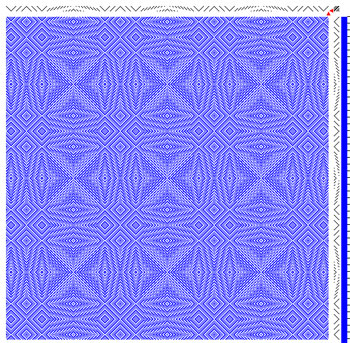
snowflake twill shawl draft

I measured out 480 threads of white silk-linen yarn long enough to weave two shawls, and set up the Macomber loom at 24 ends per inch.

I had a blue in the same fiber that I thought was too bold for my purpose, and a lilac that I thought was too subtle. I decided to start with the blue, and was really amazed at how tame it became with the white in this pattern. (Sorry this picture is so yucky. I only shot two on the loom, and this is the better one. I tried fixing it in Photoshop, but the uneven lighting made it a real challenge.)
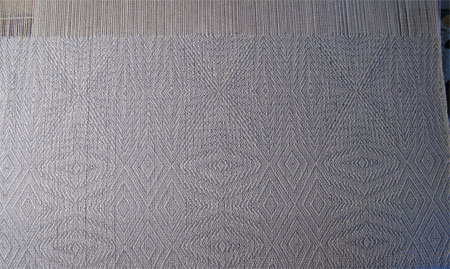
snowflake shawl on loom

It was clear to me that the ‘snowflakes’ themselves – the Xs, didn’t predominate. Instead the diamonds between them did. While this wasn’t exactly what I had in mind, I thought the pattern pleasing enough that I wasn’t going to re-design and re-thread. Particularly since I still had no idea how the finished fabric would feel and drape.

I wove both of pieces, took them off the loom, wet finished and pressed, and was happy to see that these handwoven shawls seemed to marry the qualities of the silk and the linen beautifully.
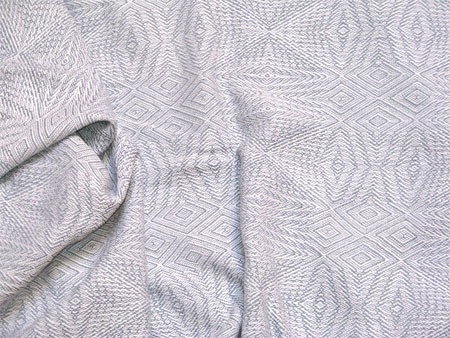
handwoven shawl in white & blue silk-linen

They have a nice drape while still maintaining body. The pattern is much more subtle with the silver lilac, but it’s still a lovely shawl. At least I think so.
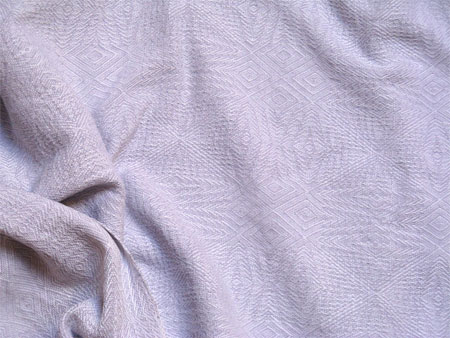
handwoven shawl in white & lilac silk-linen
I’ve worked on making some changes in the draft so that the X of the snowflake is more predominant (I now have 7 versions saved on my computer), and I’ll try the new draft with another fiber, another day.

Handwoven Gems

My next batch of handwoven scarves was Tammy’s Gems colorway in a bamboo-cotton blend. I don’t think I’ve used this one before, but I’ll definitely use it again. I love the colors!

I use so much of her hand painted yarn, but I think not everyone knows what that means, or how it happens. Here’s a mini-primer.

  1. Wind yarn off a cone into a skein, tie it in four places to keep it all together.
  2. Lay the skein on top of a wide piece of saran wrap on the work surface.  Paint, or squeeze, concentrated dye onto the skein in a pattern you determine in advance (in this case, three different colors).
  3. Wrap the sides of the saran wrap over the skein, roll it up like a jelly roll, and steam it for about an hour.
  4. Remove from the steamer, cool the yarn, and rinse it until the water runs clear.  Hang to dry.

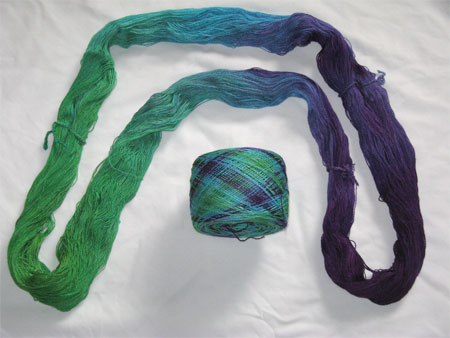
Here’s what a skein of the Gems colorway looks like when I get it, and what the same yarn looks like after I’ve wound it into a ball.
Gems hand painted yarn

After I wound the yarn into balls so that I could work with it, I measured a warp of 180 ends over 11 yards long – enough for 4 scarves.   I threaded the loom for a rather random point twill, and used a simple 1-2-3-4 treadling for all 4 scarves.

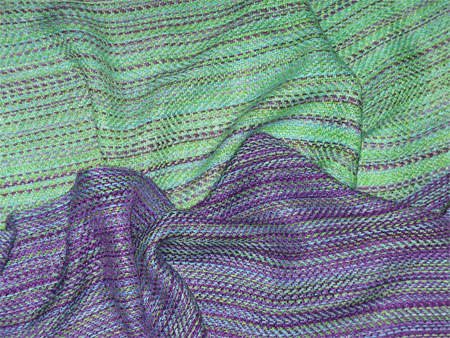
Tammy had dyed me a solid green to coordinate with the Gems, and I used that for weft for the first scarf.  Even though I’m not a green person, I liked this one.
Gems bamboo cotton handwoven scarves
For the second one, I used a dark purple rayon.  I  liked that, too.

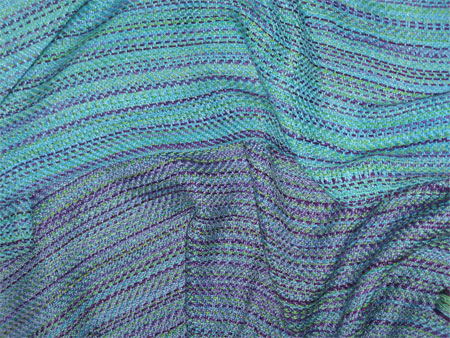
For scarf number three I used a bright blue weft Tammy’s dyed for me, and for the fourth, a lightweight lavender cotton.

Gems bamboo cotton handwoven scarves 2

It was interesting to watch how the different colors of the weft yarn each brought out a different aspect of that gorgeous hand painted weft.

I like each and every one of these handwoven scarves.  They’re all nice and lightweight and drape beautifully.  I think the colors are quite like the eggs lots of people are dyeing for Easter.

Speaking of dyed eggs, check out this method of using old silk ties to make really interesting and beautiful Easter eggs.

Saturated Colors

My last batch of the hand painted bamboo-tencel blend yarn is Tammy’s North Shore. Again, I’ve used this colorway before, and I like it.

This time I remembered to make a simple threading pattern – just a large point twill.

First handwoven scarf (top)- yep, I stuck with the variegation for weft, too.

Green isn’t typically one of my colors – it doesn’t usually work well with my skin tone. As a result, I forget that other people like it, and I don’t order it as often as I probably should. Since I always sell the green I do weave, I had Tammy dye me some solid green to coordinate with this North Shore yarn to please my customers. That’s the middle scarf.

For the last scarf, I returned to a color in my palette – a bright, medium blue. If you look closely you can see that I modified the treadling pattern at the beginning (and end) of the scarf for about 8″. I thought it was too busy, so changed to a straight draw treadling for the rest of the scarf.

handwoven scarves, North Shore bamboo tencel

Your turn: what colors dominate your wardrobe?

Weaving New York

Still working on Tammy’s hand painted yarn, next up for my handwoven scarves was her New York colorway. Several shades of purples and pinks. This 8/2 yarn is a blend of 2/3 bamboo & 1/3 cotton. It’s not quite a soft as 100% bamboo, but it has a much softer drape than all cotton.

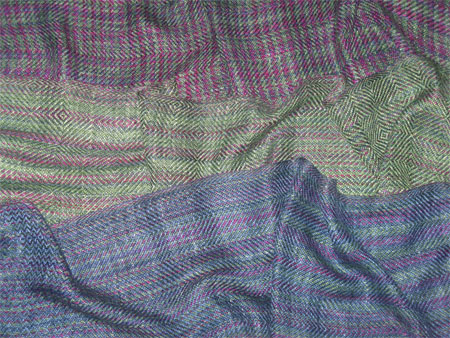
As I often do, I started by weaving with the same variegated yarn for weft as warp. That’s the top scarf in the photo, creating a faux plaid.

Then I wove the middle scarf, using a pale lavender 10/2 cotton. I like the look, and the solid cotton is finer than the bamboo-cotton blend, so the scarf is really lightweight and comfortable. It’s really hard to see in the photo (not so easy in real life, either), but once again I didn’t really listen to my ‘simple pictures are best’ advice. I tried a new weaving design, and it hardly shows up at all with a variegated yarn.

So for the third scarf, woven with a solid eggplant weft, I did a straight twill treadling instead of the pattern treadling.

Of these three scarves, my personal fav is the one in the middle. I like the lightness of weight and color.

bamboo cotton New York handwoven scarves

One of the other things I like about weaving with the bamboo-cotton yarn is that I don’t have to twist the fringe. With the bamboo, rayon, and silk, I have to make double-twisted fringe. For a scarf, we’re looking at about 15 minutes per end, 1/2 hour per scarf. So I can save that much time per scarf if I don’t have to take that extra step.