|
|
I just realized that although I showed you the towels I made for the exchange, I never showed you the terrific towels I got back. I’m always impressed with the work of other weavers. I’d like to honor them by giving their names, but I’ve decided that I can only responsibly do so when the weaver is online with more than email. Unfortunately, I can’t find any of them in the blogosphere or with a website, and I don’t facebook, so I’ve had to omit all they’re names.
This weaver used an Ms & Os profile draft for her 4-shaft loom. I’ve never seen Ms & Os in person before, so was glad to get this real-life version.
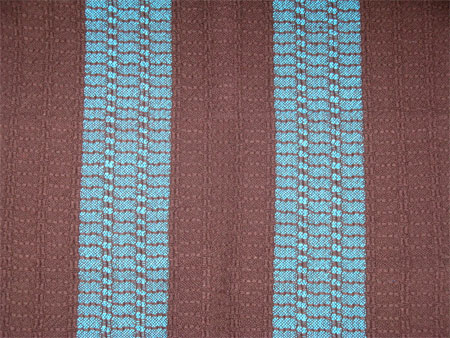
I’m surprised by the variety of structures people come up with for two shafts. I tend to think more of color and weave effects or hand manipulation rather than creative patterns like this one.
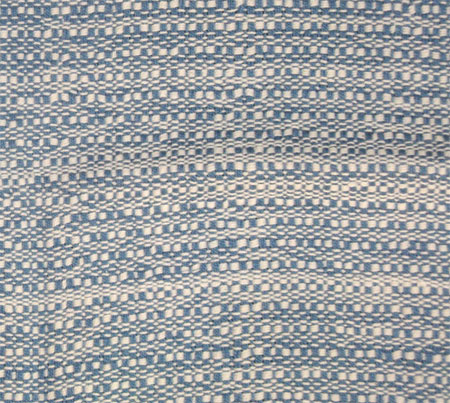
This weaver not only sent along the required draft, but also a little bio….and a photo! How sweet was that?! Her towel is a simple rosepath threading with three treadling patterns repeated.
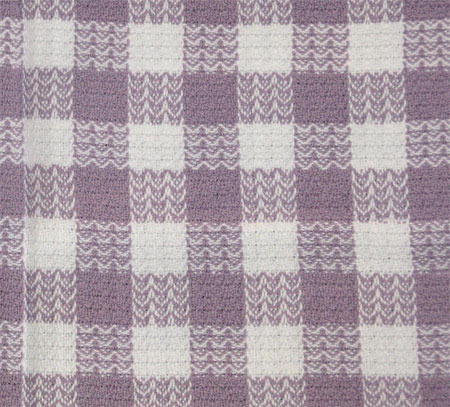
You know, the traditional checks of the towels above and below are so appealing, I wish I’d chosen something more like this than the pattern I did chose. There’s always next time.
This sweet green & white towel is the only one woven on 8 shafts. It looks deceptively simple. And lovely. I might have to try and work up a similar design on my 4 shaft loom. Just ‘cuz I love the loom so much.
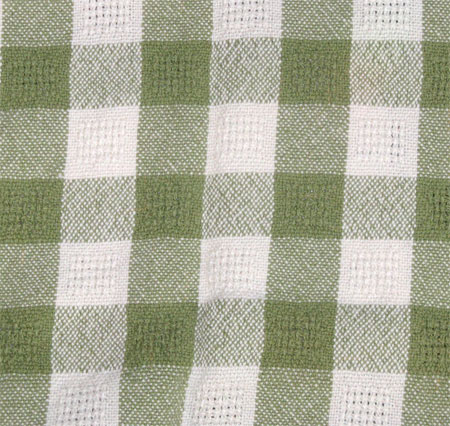
Here’s another towel that opened my eyes. I would have told you that crackle weave doesn’t appeal to me, but then I saw this towel. I think this is beautiful! And since the darker color is colorgrown cotton, it will only deepen with repeated washing.
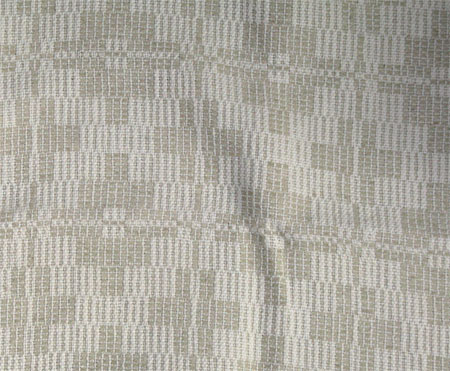
In keeping with the simple pictures are best lesson I try again and again to learn, I think this is my favorite towel.
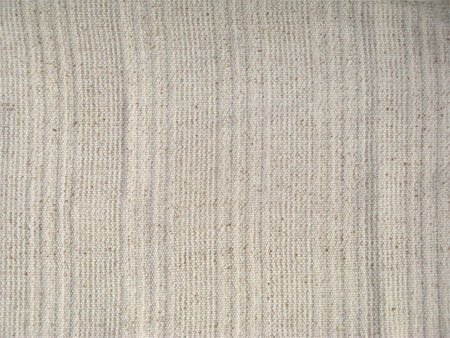
The weaver said that she broke her foot just before starting the towels, so she searched for a pattern that would be easy to treadle with one foot. She also decided she’d weave with a thicker thread than usual so she didn’t have to be in front of the loom for so long with her bum leg, so made a hand towel instead of a kitchen towel. You’d never know that she had to make any comprimises by the richness of this towel.
One of the weavers also sent along this sweet little warp rep mug rug. Unfortunately, I didn’t keep it with the towel and now I don’t know who it was.
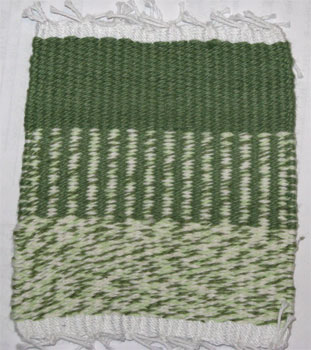
Yay to weavers in the towel exchange! If you’re jealous, you can sign up now for next year’s exchange.
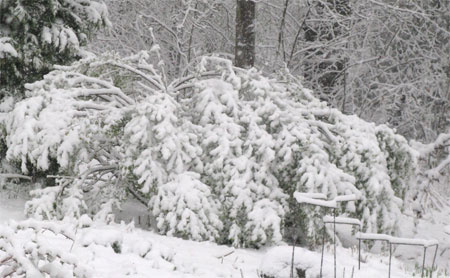
This is what my burning bush looked like when I woke up this morning. I realize that you have little frame of reference for this bush that’s taller than my 5’2″ height, but if you look carefully, you can see my metal plant supports in the foreground – the tallest one is about 18″ high. That gives you some idea of how the wet, heavy snow is really dragging the branches down.
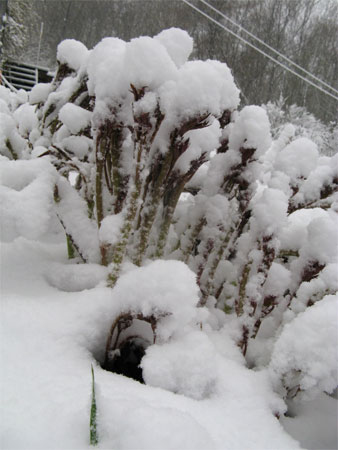
My peonies were still standing up tall, but I can’t imagine they liked it.
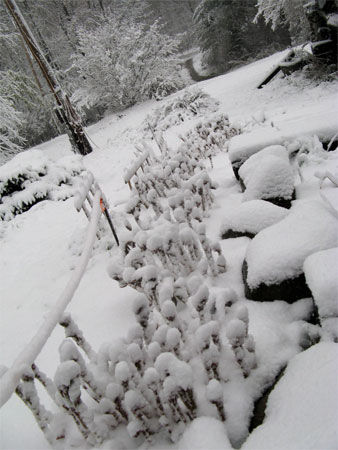
I think peonies are pretty tough and I’m sure they’ll come back, but I don’t know what impact this will have on this year’s leaves or blooms. Although they’re far from budding, if these leaves die, the plant will have to put more energy into leaves, and may not have enough left for flowers this year.
Here’s a close up from the opposite end of the row.
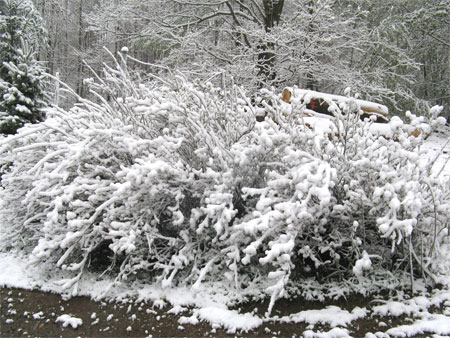
My old-fashioned roses don’t seem as weighed down at the moment.
The arbor looked beautiful.

The Japanese quince is really hardy. I don’t worry about it at all. Even if some branches break, it’ll be fine next year.

I took these photos at about 7:00AM – we had about 3.5″ of snow at that hour. It’s now 8:00PM and it still hasn’t stopped snowing. At around noon there was over 6″ of snow, and I went outside and helped out a lot of my shrubs and my crab trees, all of which had already started leafing and flowering, by beating off the snow with a stick. It was remarkable to watch the heavy branches rise as the snow flew off with each hit of the stick. Of course, I was completely soaked by the time I was done.
Amazingly, by about 4:00PM, I could see many more leaves on trees & shrubs that I hadn’t touched. Although it was still snowing, the temperature had apparently risen enough that the snow melted off many branches. Even so, I’m still glad I did the snow-beating bit with my ornamentals. I was too late for one of my Bradford pears – it had already lost two large branches by the time I went outside. Plus, those trees are too tall & I’m too short to reach most branches.
The evening news predicted another 4-6″ of snow by morning. I wonder if I’ll be going to the office in the morning.
I’ve made some ‘ahem’ interesting yarn purchases. Sometimes in person, sometimes over the internet. They may sit in my stash for a long time before I figure out what to do with them, or even decide that it’s time to weave a sample and see if I like it. That’s what these scarves were all about.
I had a big cone (a few pounds) of a blend of rayon, cotton, and flax in a neutral thick-thin yarn. I also had about a pound each of various colors of a cotton-linen blend. So I thought I’d warp up with that big cone and try some of the cotton-linen for weft.
I was a little apprehensive about the finished scarves; although it wasn’t at all obvious on the cone, once I started handling it, something in that big cone — I’m guessing the flax — was quite scratchy. I thought it might soften up in the wet finishing process. I also figured I had little to lose, since the all the yarn was inexpensive, and besides, it wasn’t doing me any good sitting around.
So I prepared a warp for 3 scarves in a very simple rosepath threading, and planned to use a rosepath treadling, too.
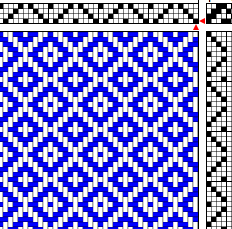
First I wove the scarf in the middle with a twisted yarn of tan & black for a nice neutral. Then I wove the scarf on the left with a twisted yarn of cranberry & black.

Then I decided I’d go back to the neutral weft, but change the treadling for a slightly different look.

What’s that you’re saying? The scarf on the right looks nothing like that draft? Hmmm – I started the treadling and I had super-long floats. That’s not what I designed! I unwove and started again, figuring I’d lost count somewhere critical. Same long floats. I unwove again and went back to my computer draft. It all looked good there. I went back to the loom and wove a third time – same long floats!!!
I had no clue what the problem was, but decided it wasn’t worth any more futzing around, so I just went for a straight 1-2-3-4 treadling – quick & easy. I was a few inches into weaving the scarf when something struck me as odd about the way my harnesses were moving. What was that I was seeing? I stepped on each treadle in order very slowly, and then started laughing out loud.
My 4th treadle, which should have been tied to heddles 1 & 4, was instead tied to 1 & 3. When I realized that, I was surprised that the diamonds worked out well. Interestingly, it was only then that I noticed that the back, which should have been identical to the front, wasn’t.
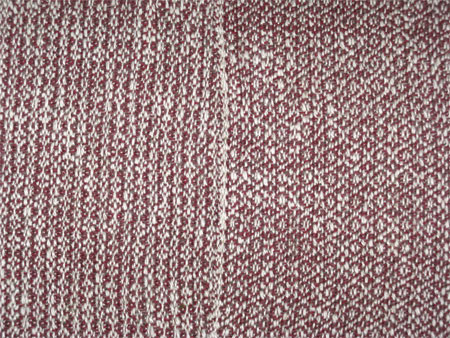
C’est la vie!
I wet finished these three scarves to see if they were scratchy. I decided they were mostly tame, so wound a warp for another three in a different threading pattern. You can bet I double-checked the tie up before I started weaving!
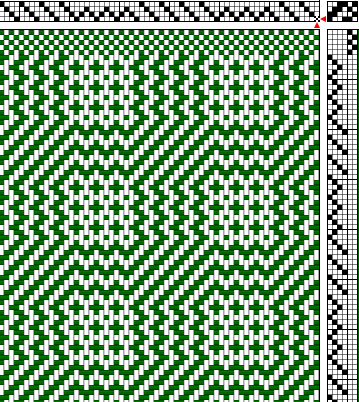
I wove the first with that same cranberry-black twist, the second with a green-yellow twist, and then returned to the cranberry-black. I thought I’d weave the third with a different treadling, but after I did the first few patterns I decided I’d return to the original treadling, repeating the variation at the other end.
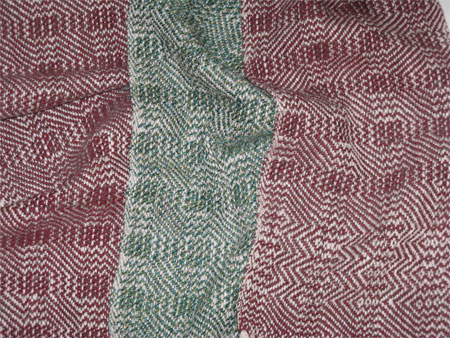
The front & back of these scarves emphasize different colors.

We’ll see if my customers like these stash-busting handwoven scarves.
I’ve just spent three days on tasks essential to my weaving business, but not actually weaving.
First, you know all those newly-woven scarves and shawls I’ve been posting here on my blog since early January? Yeah, well, they were all sitting in nice, neat piles on my dining room table, waiting to be tagged and put away.
Each scarf gets a tag that has my logo, identifies the fiber(s) it contains, care instructions, the size, and the color name(s). I hbelieve the law requires most of that information, just like any other garment you buy. Even if it didn’t, I know it’s appreciated by my customers. I haven’t made the transition to tags that have a whole list of fibers and care instructions and I just chedk the appropriate ones – all my tags include the information just about that particular scarf or shawl. So I make them all as needed on my computer. (Not one-by-one. I made a full page of each particular fiber or blend of fibers. I keep a little box with the extras so I don’t have to print every time.)
Then I have to measure each piece, write the size & name on the tag, make a little price tag, and pin them together on the bottom of the scarf. After that, I fold them roughly in half, roll them into a loose jelly roll, and carefully stack them sideways in a plastic bin.
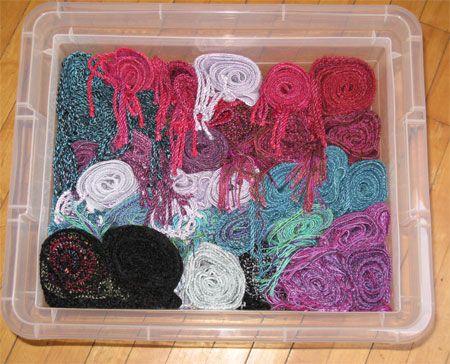
Because I’d waited so long before doing this task, I had to go back into my yarn invoices and/or my blog posts to confirm the fibers on some of them. It was beyond me to tell by look or feel the difference between 100% bamboo, 100% tencel, and a bamboo-tencel blend. So that took more time than necessary. Certainly more time than if I’d tagged them as I went along.
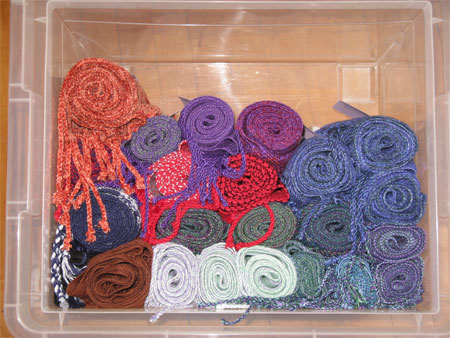
I like the way they look in their little bedroll state. When I’m at a show, I have many scarves draped over rods and the like, some laid casually on tables, and still more on a hanging shelf system in one corner of my booth. I used to group them on those shelves by fiber, but last year another vendor suggested I group them by color, saying, “When you go into the store for towels, you want to look at the purple towels, not all the towels of a particular size or weight.” She was right. We are attracted by the colors that call to us. That being said, I’m still getting used to this, because my weaverly self prefers them grouped by fiber.
Once those scarves were all tagged, I had to face another task I’ve been putting off. Not a single one of those scarves one shawls was put up on my website. This meant I had to go back to my original photos, save it once in the ‘large’ size I use on the web, crop it for detail, and save it again in my ‘small’ size. Since, as I’ve mentioned, my internet speed isn’t really high, uploading photos, even ones that are relatively small and optimized for the web, is painful from home. I opted to spend hours in a little coffee shop that has free WiFi.
After I had all the photos loaded, I could go to my Dreamweaver program and start writing descriptions and laying out the pages. I’d wanted to update the organization of the site for a long time, and decided that if I didn’t do it now, another year would roll by with the same clumsy structure. Simplify, simplify, simplify. Don’t make your customers do a lot of work to see the results of your labor. At least not if you want them to buy from you!
Once again, my trusty MacBook worked just as hard as I did.

So I think I’ve got the pages done and uploaded. But it’s to the point that I can’t know anymore what I’ve already looked at and proofed and checked the links on. I’ll really appreciate it if you have the inclination to look at it and tell me where you find broken links, missing pictures, misspellings (I think I did spell check on them all), or bad grammar. Click around my website to your heart’s content (actually, don’t bother with any of the jewelry pages – they need to come down), then leave me a comment or send me an email (peg at handwovenscarves dot com) with your helpful suggestions. I’ll be grateful for your time and attention.
Now I’m going to get back to my loom!
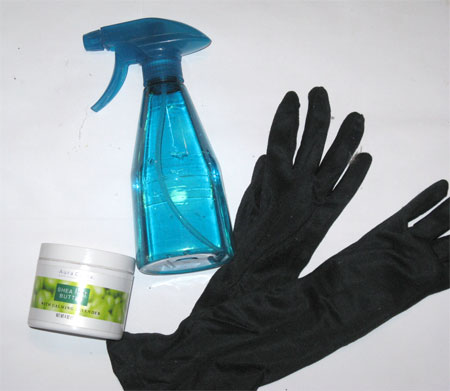
Those may look like non-traditional weaving tools, but trust me, they are essential when you’re warping with tram silk.
Tram has lots of sheen and very little twist, and mine, purchased from Lunatic Fringe Yarns at last year’s MAFA conference, is really fine. (Maybe tram always is, I don’t know.) It sat in under a table in my weaving room while I gathered the courage to approach it. I decided to start with the color I have the most of, a luscious 12 ply in light gold, with an amazing 18,000 yards per pound. That’s not a typo – it’s 18,000 yards per pound! To give you some comparison, the rayon chenille I work with has around 1,400 yards per pound, the fine tencel has 3,360 yards per pound, and the really fine cashmere-silk blend has 7,200 yards per pound. So this silk is 2-1/2 times finer than anything I’ve worked with before. Add the low twist to it, and you’ve got a real challenge.
The silk catches on every little rough spot on your hands, your warping board, and your lease sticks. I tried using some cotton gloves, which helped a little when I wore them wet, but I couldn’t really feel what I was doing, so I put them aside and decided I had to work with and on my hands. For a few days, whenever I was away from the loom and could remember, I moisturized my hands. That helped. The spray bottle of water was used occasionally to minimize the static electricity that caused the silk to fly away.
The most important tool in getting this yarn on the loom and threaded through heddles and reed?
My MacBook. The excellent weavers at Weavolution and the helpful staff at Lunatic Fringe Yarns were able to offer not only concrete suggestions, but also encouragement – it could be done. And if it could be done, I would do it.
I’ll keep you posted as the project progresses.
|
|