Archives

Weaving with Cashmere & Silk

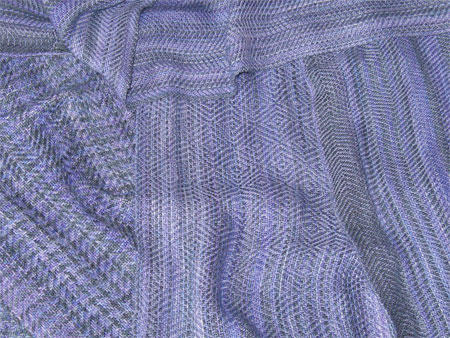
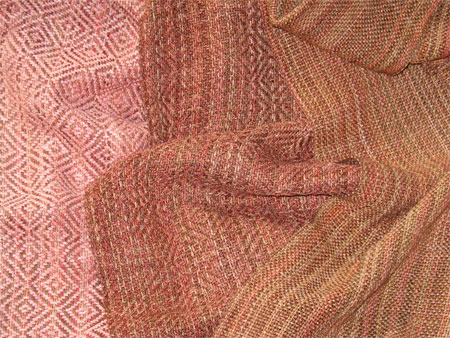
Thanks to my daughter, I recently decided to try some weaving in a cashmere silk blend. I ordered two different colors in a very fine yarn, actually a thread, since it’s 6,000 yards per pound. The colors are really beautiful — a deep, dark, purple like the royals used to wear, and an earthy, coppery orange.
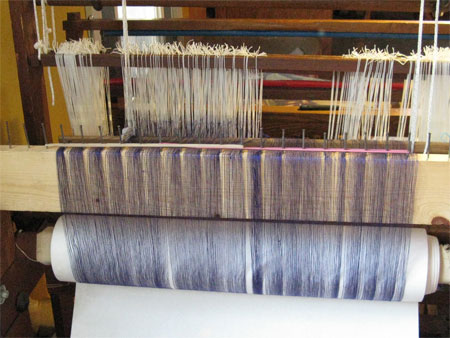
cashmere silk yarn on back beam

This picture gives you an idea of how fine the threads are, and how I’m planning to sett it at 20 ends per inch. I want the finished scarves to be very fine and light. We’ll see if this sett works. (Of course, as per my usual mode of operation, I haven’t done a sample. Lots of weavers are now shaking their heads in dismay.)

The blend I’m working with is 45% cashmere & 55% silk. It’s so soft – when I took the chain off the warping board, it was all I could do to not just pet it.

I ordered the yarn directly from China, from Yubina. I was a bit apprehensive, but Fleegle convinced me that the company was reputable, so I took the leap, and had no problems at all.

Despite all its wonderful qualities, I have to say that NOTHING I have warped before – wool, cotton, bamboo, rayon, cottolin, or even rayon chenille – holds a candle to winding this cashmere silk yarn onto the loom. Although the yarn feels very smooth to the touch, the cashmere has the tiny little hairs associated with wools. These tiny little hairs, on such fine thread, catch on each other and cause the yarn to stick together. It took me HOURS to wind the 9 yards on the back beam at this pace: wind about 6″, comb for 5-10 minutes, wind about 6″, comb for 5-10 minutes. Now I’ve finally gotten it wound on the back beam, and have about half the heddles threaded.

Your turn: weavers out there who’ve worked with this yarn, please tell me the secrets you’ve used when winding on.
Cluster Flies

If you live in the city, chances are you never even heard of cluster flies. But if you live in the sticks, well, they’re just part of your life.
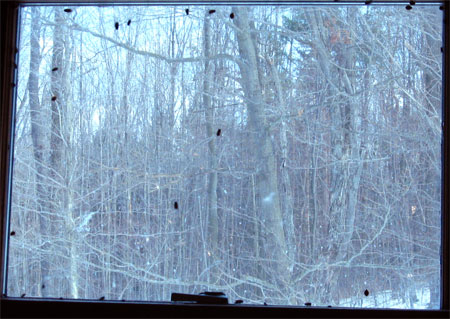
cluster flies

For reasons that are beyond me, cluster flies have window preferences. In my house, they really like my bedroom window best of all. It faces east, but so do my dining room windows, so it’s not that. This isn’t a particularly bad day for cluster flies, it’s a light-average sort of day.

If you don’t know them, cluster flies aren’t like regular house flies. They are about the same size, but cluster flies are STUPID!! They’re likely to fall in your hair or your cereal bowl, and once there, they can’t figure out how to get out, like you’d eat the rest of that cereal anyway. They’re slow moving and slow witted. That does make them easy to kill, leaving you with little dead, black bodies.

I used to think that cluster flies only lived in old houses, but not so – they’ll inhabit brand new ones, too. I’ve heard it said by those in the know that if you live where there used to be farm animals, you’ll have cluster flies. Period.

Now, you can have the outside foundation of your house professionally sprayed with some kind of chemical to kill them (they mostly live in the ground, but I swear some live under my clapboard or in the walls). But I figure that if that spray will kill the cluster flies, it’s probably not doing other living things any favors, either.

You can vacuum them up, but trust me when I tell you that when you empty that canister or trash that bag, you’ll have flies, dirty and dusty but alive, crawling around.

My favorite thing to do is to open the window, take the screen out, and push them out into the cold. I know that most of them probably crawl back into their little homes and then come back into my bedroom, but it gives me some small amount of pleasure anyway. And if it’s nice and warm in the house and really cold outside, I snicker while I’m doing it.

Cluster flies hang around for a few weeks in the spring and the fall, and then they disappear. I figure they must make protein-rich meals for the early bird arrivers and late leavers, and probably for other creatures, too. So I’ve just learned to deal with it.

Learning to handle cluster flies was one thing, but a few years ago they decided to invite along their friends, the fake ladybugs. Real ladybugs are swell – cute, red, and very helpful to the garden. The fake ladybugs, on the other hand (actually they’re Asian lady beetles) are nasty. They smell bad if crushed, bite you, and their orange color isn’t nearly as attractive. And god forbid they land on the top of your sports bottle and you take a swig without looking – they taste TERRIBLE!!! If you vacuum up these babies, they will ultimately ruin your vacuum cleaner, rendering it unusable because their smell will have permeated it and will be spread through the air when you next vacuum. In fact, a friend of mine is very sensitive to their odor, and it causes him to have coughing fits if he has to clean them up.

So although I love living where I do, surrounded by woods, barred owls, fox, birds, and the occasional bear, country life does have its drawbacks. For me, I’ll take the cluster flies over the noise & air pollution of city living any day.

Your turn: what’s a pest at your house that you’ve learned to live with?

Bamboo Log Cabin

A few years ago when I first saw a scarf handwoven in a log cabin pattern, it blew me away. It was completely beyond me how this pattern could possibly be done. I spoke with the weaver, who insisted it was really easy. Huh.

I could see that it was a tabby weave, but how could you possibly achieve the stained glass look she’d done? I didn’t even attempt it until now.
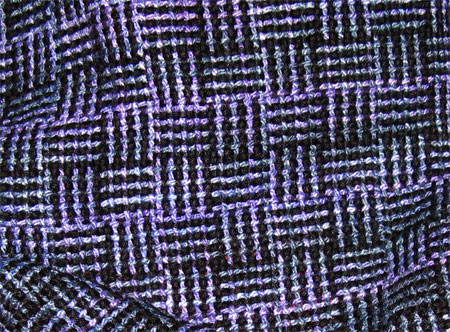
handwoven scarf - log cabin

I’m happier with the scarf than I am with the picture. I can’t tell you how many shots I took to get one that was even this good. The colors just don’t show up well, now matter how many adjustments I make on the camera itself or what I try to fix it in Photoshop. So you’ll just have to take my word for it that all the parts that aren’t black are variegated blue & purple.

Actually, they’re the handpainted blue violet yarn that I had already woven four scarves from.  So there’s blue, purple, and green in it. I didn’t want the kind of color dichotomy that many log cabin weaves have, with a very dark color and a very light color – that’s a bit too much for my eyes. With the blue-purple-green combo offset with the black, it is sort of stained-glass-like.

That blue violet yarn is a bamboo cotton blend, the black is 100% bamboo, resulting in a handwoven scarf that’s 85% bamboo and 15% cotton. So even though it’s a tabby weave, it’s very soft and flexible with all that bamboo in it.

I have to say, even now having woven a log cabin scarf, it remains rather like magic to me how the pattern comes out of two alternating colors. I don’t know who figured out this color and weave effect, but it’s genius. I can’t wait to try more – different colors, modifications of the pattern, different fibers. For instance, I haven’t seen log cabin in rayon chenille, and think it’d look good. And I wonder what it would look like if you doubled each of the colors, making each color band wider. Or what if you did it all in one color – what would the weaving effect be like then? Would you see it at all?

Your turn: have you woven log cabin? What worked & what didn’t?

Weaving Blue Violet Scarves

handwoven scarves - blue-violetI’m still working on bamboo cotton handwoven scarves. I really like this colorway of Tammy’s, which she calls Blue Violet. And it sure is. It even includes a nice deep green like the leaves of a violet. Pretty, pretty, pretty.

Again, I wove each of the scarves on this warp slightly differently.  On the left is a simple point twill woven with the same weft as warp.  It’s nice and flexible as well as lovely colors.

The middle scarf has a weft of 10/2 periwinkle pearl cotton.  It’s an exact match for one of the colors in the bamboo cotton, and the slight sheen of the pearl cotton is a really nice counterpoint to the matte of the bamboo cotton blend.  But even nicer than that, the pearl cotton is so fine gauge that this handwoven scarf is as light as air.  I just love it.

The scarf on the far right and draped across the top has that same pearl cotton weft, this time in a simple point twill.  The scarf is just as light and airy, and the weave pattern just a bit less complex. The two scarves with the pearl cotton weft end up being 65% cotton and 35% bamboo. The other two have are 65% bamboo and 35% cotton.

handwoven infinity scarfAgain, I made the last scarf on the warp into an infinity scarf. This one again has the same warp as weft, this time woven in a tabby pattern. Even though tabby is a bit less flexible than twill weaves, the bamboo cotton fiber itself is so wonderful drapey (is that a word?) that it moves and twists easily into whatever wrapping style you like.

Your turn: what kind of great mixes have you done in different yarns for warp and weft?

Moccasin Handwoven Scarves

Yikes! How has a whole week gone by without me posting?! Trust me, I have been keeping busy.

I was babysitting for my grand-dog for a week while my daughter was out of town. Baxter kept us all amused for 5 of the 6 days he was with us. Then he got bored and we (ok, I) got cranky. One of my tasks while he was here was daily posts to his blog. I actually enjoyed that task, but guess I wasn’t keeping up with mine at the same time.

I did get weaving accomplished, too.
Handwoven bamboo cotton scarves
Still working on Tammy’s hand painted bamboo-cotton blends, I made four handwoven scarves in a colorway she calls Moccasin.  Nice earthy colors.  As is common for me, each of the four scarves is a bit different, although they all have the same warp.  On the left, I used a 100% bamboo yarn in coral as the weft.  With the variegated background, the final effect is somewhat tapestry-like.  And that scarf is now about 85% bamboo and 15% cotton.

The middle scarf has the same warp and weft.  Woven in a diamond twill, the same pattern as the one with the coral bamboo, the weave pattern pretty much disappears in this one.

On the right is a tabby handwoven scarf with a solid tan weft.  Although the tabby makes it a bit less flexible than the scarves woven in twill,  I like the simple, natural look of this one a lot.  Perhaps the best.

handwoven infinity scarfThe final scarf on that warp is also handwoven in a tabby, this time with a solid medium weft. I made this one into an infinity scarf. I really like the flexibility of the bamboo cotton and how well it twists around my neck.

Your turn – what have you been up to for the past week?