Archives

Great Weaving Video!!!

One of my must-visit blogs is Laura’s Loom. Laura’s a very experienced weaver, and although everything she does isn’t in my style or repertoire, I find her both interesting and informative.

She’s just posted a few videos on YouTube, and now that I have high speed, I could actually check them out. I was really impressed!

Her video on throwing the shuttle is clearly the best 37 seconds I can imagine spending. I watched it several times, not believing what I was seeing. Her shuttle FLYS!!! Surely I couldn’t do that, could I?! Her technique seems remarkably simple — too simple to work.

So of course I had to try it immediately. OMG, it’s AMAZING!

I’m not yet able to move as fast as Laura, but using the “over the beater” technique has increased my speed dramatically. Although I’ve developed a number of techniques of my own over the years that have helped me improve my weaving speed and product, I don’t believe I would have come up with this simple move on my own. I’d been using the method I was taught, which includes “pinching” the selvedge with each throw of the shuttle to achieve nice, clean edges. I thought this was essential. I’d seen other weavers be successful without the pinching technique, but only those who use end-feed shuttles. I had considered buying new shuttles to increase my speed, but hated to spend the money and have my comfortable and beautiful boat shuttles relegated to the shelves instead of being used. I had no idea that simply changing where my arm was at the end of each row could accomplish the same thing with my boat shuttles.

If you’re a weaver, go watch Laura, then try it. Let me know if you’re as blown away as I was.

Wildflower Beauty

After weeks of not being able to do any walking outside of my house, I’ve been gradually extending my outdoor activity. I’m up to walking twice a day, 1/2 mile round trip each time. I’m sure I could walk farther if I live on flat land, but I don’t, and those downhills are difficult. (Much harder than uphills.)

So I’ve really been enjoying being back on my road after my hiatus, and decided that I’d do a Nature’s Garden Journal, since I missed so many weeks of my own garden. Besides, I’ve always loved wildflowers, and what grows along the edges of my road is really beautiful, so yesterday I carried my camera on my walk with me.

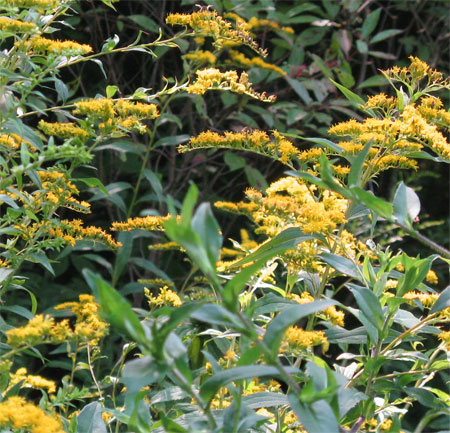
Before I even get to the bottom of my driveway, there’s a stand of goldenrod. In another week or so, old pastures will show the bright yellow goldenrod counterpointed beautifully with deep purple asters.
goldenrod

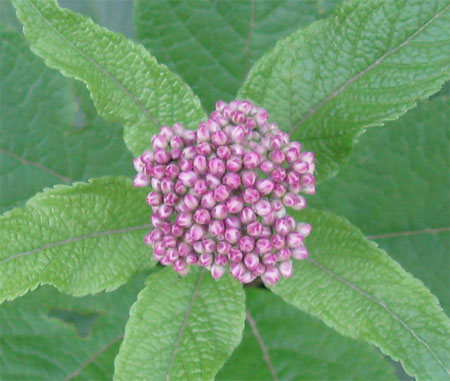
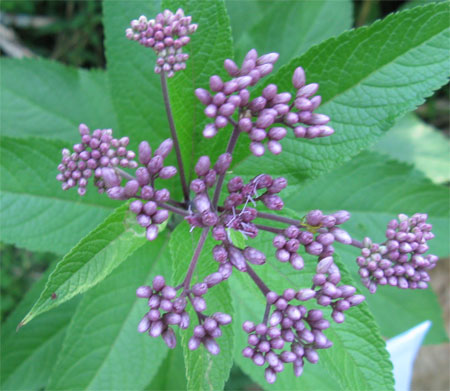
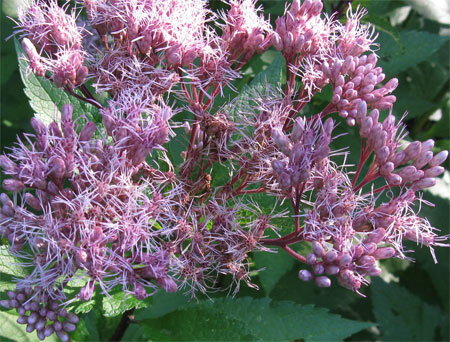
Near the goldenrod is a great collection of Joepye weed. I couldn’t stop myself from taking several shots of it in its various phases, all visible on just one day. In addition to being gorgeous, Joepye weed is beelicious — the bees just love it.
joepye weed flower buds
joepye flowers starting to open
joepye flowers open

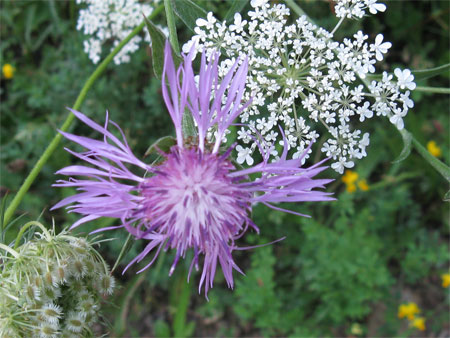
The next flower that called me to shoot it was a knapweed. I like the form of the bud (not visible in this shot), the color, and the interesting petal formation. I am also fond of this shot, with Queen Anne’s lace. Although it doesn’t show up well in this small photo, in a larger version of the same image, I am intrigued by the Queen Anne at the bottom left – the seeds show up in the photo in a way they never have to my eye in real life. I’m going to have to look at it more closely on my walk today.
knapweed and queen anne's lace

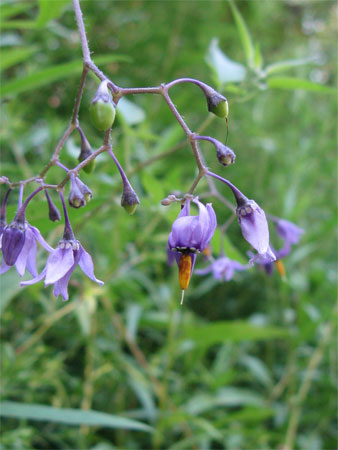
Not far from the knapweed is the gorgeous nightshade. I don’t really know if this is the plant of poison-of-old, but I’m not going to taste it to find out!
nightshade

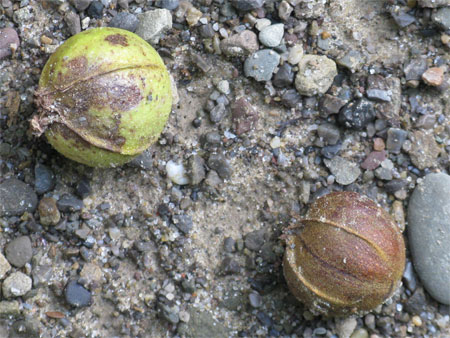
Not a flower but a fruit, I was pleased to see a bunch of bitternuts on the road. This means that there will be a nice crop for turkeys to eat.
bitternuts

When I turned around and focused on the other side of the road, I couldn’t resist the beauty of this thistle.
thistle

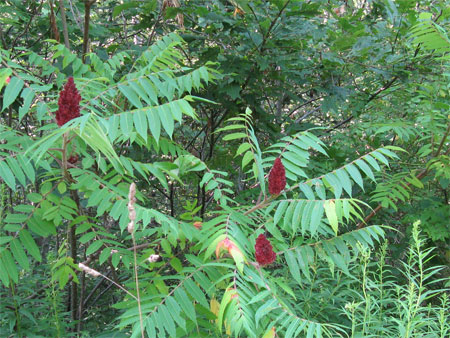
I closed my walk with the strength and grace of the lovely sumac.
sumac

Your turn: In addition to being lovely to look at, most of these wildflowers have some interesting properties — medicinal, edible, or other. Me, I just enjoy looking at them. Do you make use of any of their other properties?

Welcome to 1995

satellite dishI finally did it. It took years. Nay, decades.

I’ve moved beyond the dialup internet connection I’ve had for probably 30 years and made the switch to what we in the sticks consider to be high speed — connecting through a little dish.

The installer was here today. For almost 4 hours. I’m hooked up. It’s definitely faster than my dialup already. But it’s not done yet.

Tomorrow my firewood guy has to come and cut down a double-trunk soft maple tree that’s interfering with the satellite’s view of the sky. When he does this, it will not only make my internet satellite perform better, it will also improve the reception of my TV dish.

Plus, I’m not wireless at the moment. My ancient airport couldn’t seem to comprehend the new system, so I have an ethernet cable connected directly to my computer for now. That means I’m tied to this one spot. My wonderful friend came and retrieved the old airport and assures me that he’ll either get it working or get me a new one.

But hey, at the very least, now I can be online and talk on the phone at the same time. Is this a good thing? Is it worth an extra $35/month? I think not. I am sure, however, that the situation will improve. (Think positive, think positive, think positive.)

Your turn: what are you hanging on to from the last century?

Cashmere Breakthrough

I freely admit it: I’m OCD. Not professionally diagnosed, but obsessive-compulsive nonetheless. For the most part, I believe that this is a good thing, tht it makes me do well at my various endeavors. It is, however, not uncommon to find that it’s caused me do something the hard way. Here’s an example.

I’ve commented that the cashmere silk blend yarn I use for those airy scarves is a challenge to beam. As a result, after my first really frustrating effort with winding a warp for three scarves (which is how many I usually warp for) I’ve been warping for only two scarves at a time. While this made the beaming process remarkably less frustrating, it also made it much less efficient. Threading 300 threads though heddles and reed for just 2 scarves instead of 3 takes much more of my time: for every 6 scarves I have to thread heddles and reed 3 times instead of 2. But at least I could do it without wanting to scream.
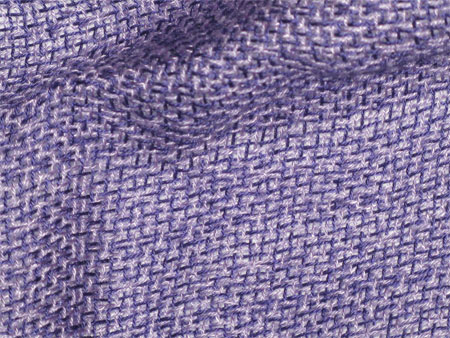
handwoven cashmere silk scarves in light and dark purpleThen I decided to weave a scarf that used both the light lavender and dark purple colors of the cashmere silk yarn. I am decidedly unhappy with the finished product. It’s fine, but not even close to what I had in mind, or what I had planned. I spent a fair amount of time planning the pattern, but the yarn is so fine, that the pattern’s not visible unless you catch it at just the right angle, just the right light. BUT…I had a breakthrough while measuring the warp. Since my pattern called for alternating strands of light and dark purple across the width of the warp, it only made sense that I would hold one strand of each as I wound the yarn on the warping board; anything else would have been silly.

When the threads were all measured and I moved to the warp to beam it, I was AMAZED — it was easy to beam that warp! I didn’t think it was just because I was beaming for only 1 scarf; it was mostly because of the 2-threads-at-a-time process at the warping board. Yippee! I was definitely going to try this for my next 2-scarf warp!

I decided to try the new light slate blue yarn.  I measured the warp using two cones at the same time on the warping board.  Not only did it cut the measuring time in half, when I moved to the loom it beamed like a breeze!  It was as quick and easy to wind this lovely cashmere silk yarn on the back beam as any other fiber I’ve used.  Not an inch of difficulty.

Why hadn’t I done this before?   Go back to the top of this post – it’s my OCD nature.  I like to finish one ball or cone of yarn before I start the next.  Starting two cones of yarn to measure the warp doesn’t fit in with my nice, neat desires.  Of course, I have what I think is a good reason for using up one cone before starting the next: it’s much easier to know how much yarn I have left when I’m planning my next project if I have one whole cone vs. two half cones.  Are those started cones half full?  2/3 full?  1/3 full?  The answer sure makes a difference to the new project!

handwoven cashmere scarf
I used that nice, smooth, easy warp to weave two light blue cashmere silk scarves in a huck pattern.  It’s not my favorite pattern, I prefer the blocks of Swedish lace or huck lace, but it is pretty and airy.

I don’t have any of the handwoven cashmere silk scarves up on my website yet, because they sell out as soon as I bring the to a show. So if you want one and can’t come to a show, leave me a comment or email me, and we’ll work it out from there.

I’m going to try the two-cones-at-a-time thing and warp for 3 of these handwoven cashmere scarves next time!

Your turn: how have you gotten in your own way?

Why is plain weave called tabby?

plain weave

Margaret asked me a great question in a comment to my post about rigid heddle weaving. The question — why is plain weave called tabby?

I had no idea, so decided to do some googling.

Here’s what wikipedia has to say: “According to the 12th-century geographer al-IdrÄ«sÄ«, the city of Almería in Andalusia manufactured imitations of Iraqi and Persian silks called ‘attābÄ«, which David Jacoby identifies[4] as “a taffeta fabric made of silk and cotton originally produced in Attabiya, a district of Baghdad.”

I have no idea if this is true, or if there’s another answer, perhaps a better or more accurate one.

So all you weavers, lexicographers, and people who have high speed and like to do searches out there: what do YOU know or can find about why plain weave is called tabby?