|
|
I had to pick up and pack the rental van this morning to head to the next show, and I didn’t stop weaving till 8:00PM last night. After that I pressed all the scarves I’ve woven in the last two weeks, measured a mohair warp for my rigid heddle, and wound that warp on the back beam. This morning I still have to finish threading that loom and tie on to the cloth beam, and label the 18 finished pieces.
18 finished pieces?! All made since August 29 – 11 days ago?! I can hardly believe it myself. I have been B-U-S-Y! My back is really glad that today is the last day of that craziness. It’s tired of sitting at the loom for hours on end.
As promised, here are more finished scarves.
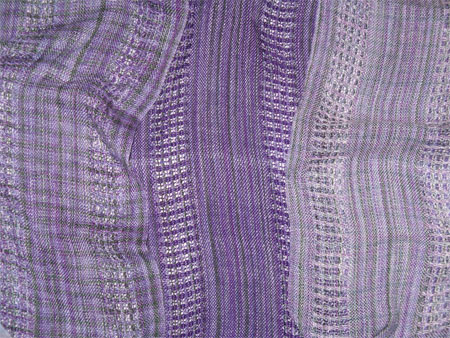
I wove these three scarves with Tencel rayon hand painted by Tammy. I used her Visionary colorway for the warp for all three, with a different weft for each. All have Bronson lace along the borders. On the left I used the same hand painted yarn as weft; in the middle is a solid deep purple rayon, and on the right is another of Tammy’s yarns, this time Silver Linings. The colors are more alive in person than they are in this photo.
Next I wove three more rayon scarves. The weft is a variegated boucle in red, purple, and blue.
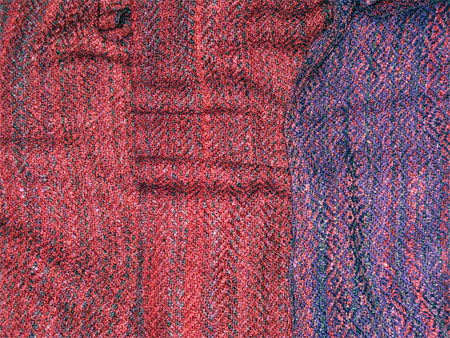
Interestingly, I think the picture of these three scarves looks ‘cleaner’ than the scarves themselves; that’s the opposite of usual. Although the colors were crisp on the loom, they got rather muddy when wet finished.
Anyway, the first two have a solid red rayon boucle weft, one in a diamond pattern and one in a wave twill. The third has a solid purple rayon weft in diamonds. Because my purple rayon was much lighter weight, I used my double shuttle and threw two strands of rayon at once. I liked it better on the loom than off, when that purple really predominates.
The last scarves in this post (hopefully I’ll have time to post the last new scarves this weekend) are hand painted bamboo.
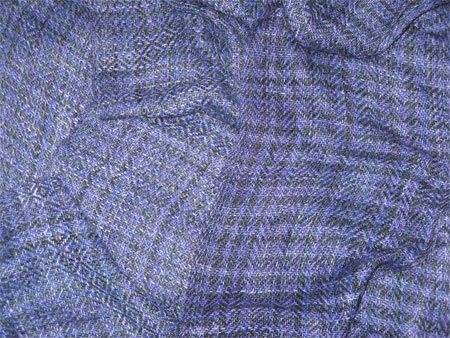
This is a colorway Tammy calls Blue Violets. I just love it. I’ve used this colorway in bamboo, rayon, and rayon chenille, and think it turns out gorgeous in all of them. I wove two scarves with a diamond twill, one with twill waves. I think it’s odd that the scarf on the right is so much darker than the one on the left; it’s not just the photo – they’re like that in real life, too. Weird.
Gotta get in that van right now – check back for the last five scarves.
Hoping you’re not in the midst of either flooding or fire!
As planned, I’ve been weaving just as fast as I can. I’ve made 13 scarves in the last six days. Everything’s been wet finished, but nothing’s been pressed yet.
The first thing I did was tie the fringe and wet finish the log cabin scarf I wove on the rigid heddle loom at my last show. The gray is a bamboo, the blues are hand painted rayon boucle.
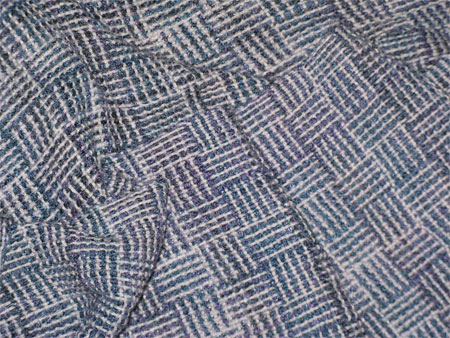
Although the scarf wove up quickly, getting it on the loom was anything but speedy. I recently bought a second 10 DPI (dents per inch) heddle for the loom so that I could weave fabrics that needed to be sett more closely. With 2 of these heddles, I could make the scarf be between 10 and 20 ends per inch. I wanted this scarf to be 18 ends per inch, so it should be easy to do. I’d never threaded two heddles like this, so I opened my Betty Davenport book, Hands on Rigid Heddle Weaving. I tried to follow her directions to thread both heddles at the same time, but was having difficulty since I had to turn the page in the middle of the process each time till I had it firmly implanted in my brain.
That wasn’t working, so I printed off instructions from Schacht. They seemed easier to follow: thread all of 1 heddle first, then pull them into the 2nd. Sweet.
So I got my first heddle threaded in log cabin pattern, and proceeded to thread the second. This wasn’t working anywhere near as easily as I’d hoped. The fact that I was trying to do 18 ends per inch (EPI) instead of 20, and keep it in log cabin pattern at the same time, wasn’t helping. And it sure wasn’t a good idea to try several new things at once the afternoon before I had to leave for a show. I couldn’t spend any more time on it, so I had to change my plans. I’d use just one heddle and thread at 10 EPI. I’d used the bamboo at this density before, but the rayon boucle was way too thin; I’d have to double it in both warp and weft.
After all that, fortunately the scarf worked up nicely. I do like log cabin and want to weave more of it as soon as I have time. (Because it requires using two colors in the weft, and therefore two shuttles, it takes a little longer than using just one shuttle, so I won’t be doing it in my rush before my next show.)
Then I made six rayon chenille scarves: three in rich red and three in deep blues. I wanted to add that bright red to my stock for the show, and I had an order for the blue; the other 2 would make a nice addition for next weekend.
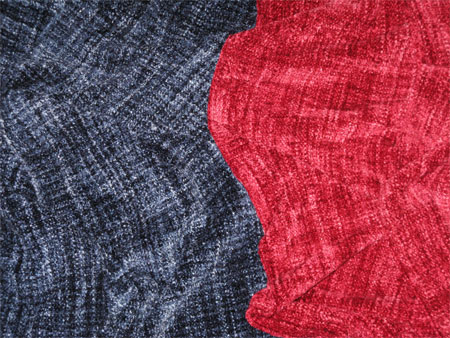
Although rayon chenille is always more challenging to work with than many other fibers, I just love the finished product and can’t give it up. I’ve used both of these yarns before, both purchased from the same supplier, both made by the same manufacturer. The red worked up beautifully, the blue – not so much. I had an above-average number of broken warp threads. Now, I know how to repair a broken warp thread and have done plenty of it, but I did not want to take the time now to do so.
In addition to the warp breakage, the chenille was massively shedding while I was weaving. So much so that I had to vacuum after weaving each scarf – unheard of for me. Again, I wasn’t happy about having to take the time, but I was mostly concerned that after wet finishing they wouldn’t be as luscious as usual. Thankfully, they are just fine. Why did this yarn behave badly this time? Wish I knew. Actually, if I’m wishing, I’ll skip wishing I knew, and just wish it would never happen again. Why waste a perfectly good wish on knowing why something in the past happened?
I’ll share the next six scarves I wove in the next post.
Your turn: what’s worked well, or not so well, for you lately?
How is it possible that another 10 days have passed without a blog post? Answer: I’ve been really busy.
Last weekend I had another great show in Buffalo. People were particularly interested in my scarves on Sunday, when the weather was cooler.
And next weekend I have another big show – Clothesline in Rochester.. So now I have to weave, weave, WEAVE! I’ve gotten six scarves done in the last 4 days, and will put a warp for 3 more on my loom today. I’ve taken a few days off my paycheck job to give me more time. The new scarves are in the drying process, so haven’t been photo’d yet, but I can show you a few more things I finished before the Elmwood Ave. show last weekend.
First I finished the two purple & silver mohair scarves I’d put on the rigid heddle loom for the Chautauqua show. I do love how these scarves look, and am getting better at wet finishing them in soft-as-a-cloud delights. Many other people agreed, so I simply re-created the one I’d woven in May.

I knew I needed to stock up on some cashmere silk blend scarves, so I started with the light blue. I would have made 3 of them, as is my usual fashion, but I only had enough of the blue yarn to warp for 2.
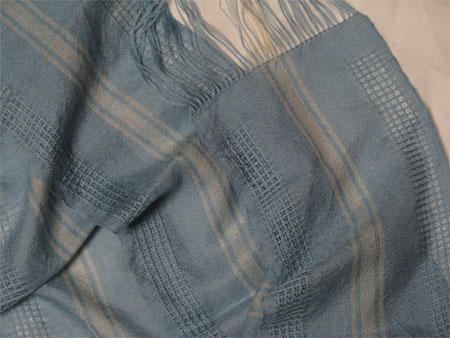
I put a cream stripe down the center, and wove lace along both edges. I think they’re lovely. Interestingly, although I did sell four handwoven cashmere silk scarves last weekend, these were not among them. That’s not a problem, just a comment.
I also had some black cashmere silk yarn that I hadn’t used yet, so I could definitely warp for 3 of those. And did. (Warning to non-weavers: weaving terminology follows. Simply skip down to below the picture if you don’t want to read this part.)
I decided this was a great opportunity to try something I’d been wanting to do since the MAFA workshop in July – name drafting in overshot. Since I was only making a scarf and wanted to have a reasonable number of repeats, I didn’t want to use my entire business name – second wind weaving – so just used the first two words. I played with star fashion vs. rose fashion and an assortment of assignment strategies, ultimately choosing a standard arrangement in rose fashion. I really like the visual.
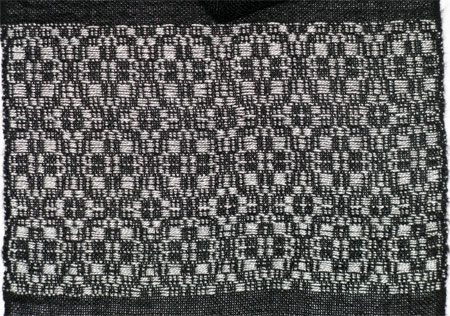
I used a gray silk for the pattern on the black cashmere, making a border that’s about 4″ wide. The rest of the scarf is plain weave. I enjoyed weaving the border.
It is funny to me how I forget things. When I wove the first border on the first scarf, I was being very careful to follow the pattern correctly, and used a very light beat. After I got my border done I thought my beat was too light — the fibers weren’t packed in tightly enough — and the pattern was therefore more vertically oval than round. I had to make the other end of this scarf the same, so used the same light beat.
For the second scarf, I beat the pattern in more firmly, making the pattern more rounded. Looked great to me. Until, of course, I took them off the loom and wet finished. DUH!! Of course those vertical ovals on the loom reverted to circles when they were released from the tension of the loom, and circles on the loom became horizontal ovals. I think only a weaver would notice these details, it just made me chuckle.
So here are the two scarves.
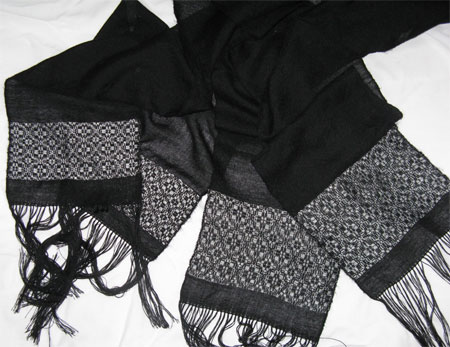
I really like them, both on the loom and off, but can’t decide if they’re classy scarves or grandma scarves.
I had planned to make the 3rd scarf different – no border and a lace treadling. Unfortunately, I couldn’t do it. I found the black yarn to be problematic from the beginning. Lots of broken warp threads, something that hasn’t happened with any of the other colors I’ve used. However, I did have the same experience with black rayon chenille last year, and did some online research that told me that black yarn can be troublesome. A solid black can be a challenging color to achieve in dyes, and as a result, it can sometimes weaken the fiber.
I was clearly having that problem. By the time I’d gotten to the end of the second scarf, I was fixing lots of warp threads. That was enough of a pain, but the yarn along the selvedges was become really troublesome. As a result my selvedges were thick and uneven. I tried several strategies to try to correct it, all unsuccessful. I ultimately decided it was better to cut off the 2 scarves and waste the rest of this lovely fiber than waste my time weaving a scarf I was not going to be happy with that was not going to be saleable.
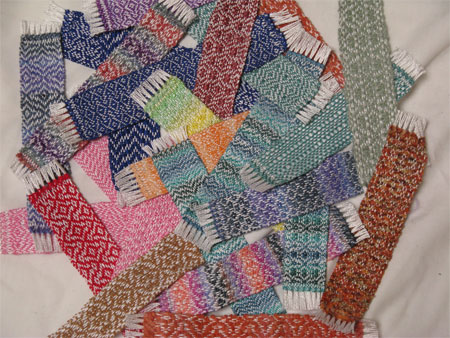
After this frustration, I needed to weave something quick and easy. So I put on a narrow warp (42 ends) of cotton and wove 25 bookmarks. I used a periwinkle overshot threading, an assortment of weft yarns, and an array of treadling patterns.
Your turn: are those two black scarves with the gray borders something a young woman would wear, or only a woman of a certain age?
Have a great Labor Day Weekend!!!!
I have no idea how two weeks goes by so quickly! I thought for sure I’d posted since August 10, but apparently not.
So I’ll play catch up here, and show you several finished pieces, all of which were completed prior to my participation in the Chautauqua Crafts Alliance a few weeks ago.
I really wanted to try another undulating twill. I wasn’t overly happy with my first attempt some months ago, but had a different threading that I’d seen being woven, and thought it’d look smashing in a silk shawl.
But then I got chicken. What if I sett it too far apart and the cloth was not stable? What if I simply didn’t like it? That was a lot of silk to potentially waste! So I decided that I’d sample the design first making a scarf using a similar size cotton yarn. Sure, the two fibers (cotton & silk) would behave differently, but at least I’d have something to go on.
So I used a rich, burnished copper color in 10/2 cotton, sett at 24 ends per inch.
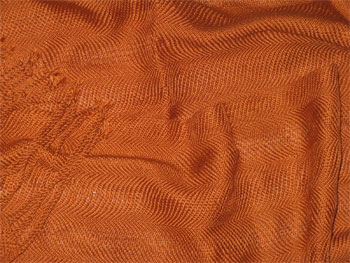
Actually, you did already see this scarf when I told you Dolly could stand independently, but the distance shot doesn’t give you any idea of the weave structure. I really like both the color and pattern of this scarf, so decided to move ahead with the silk, but thought I’d like it a bit softer, so sett the 20/2 silk at 22 ends per inch. (For you weavers, my 20/2 silk is 4,500 ypp, and my 10/2 cotton is 4,000 ypp; they are similar grist, despite the tale their numbers might tell.)
When I started weaving with the silk, it became clear to me that it’s slipperiness was potentially a problem, that it might not be as stable as I wanted it to be. I didn’t really want to unweave and re-thread the reed closer, so I decided that I could offset that potential to some extent by changing my treadling slightly, changing directions periodically. In my usual fashion, I did these symmetrically. The end result was a beautiful shawl that reminded me of butterflies. I’m not sure the picture shows it well, but I can’t shoot it again — I sold this piece in Chautauqua.

Again, in my typical fashion, I didn’t want the second shawl (I’d warped for 2) to be identical. I wanted to use the wave pattern without reversing it, and decided I had to cut the first shawl off and re-thread the reed at 24 ends per inch. Once that was done, I decided to take advantage of the wave structure and use blue silk to enhance the watery look. 
Interestingly, I thought the 24 ends per inch could have been even a bit closer in the silk. I sold this one, too. I sold lots of pieces in Chautauqua – good thing I’d been weaving consistently for months on end, since I have two more big shows coming up!
I wanted to have small things people could pick up on a whim, too. I’d been weaving bookmarks at the ends of many of my scarf warps, some more successfully than others, and had what I thought was a decent supply.

Hah! I sold 16 of my 18 bookmarks. So right now I have a very narrow warp on my loom to see if I can get some more made by this weekend. They won’t be as varied as the prior batch, since they’ll all be made on a white warp, but it’s all I have time for. I can, and will, of course vary both treadling and weft color.
I also decided to use some of the learning from the MAFA conference, and threaded my loom with the end of the warp I had from that workshop, using a periwinkle overshot threading. I made four sets of mug rugs, using many different treadling patterns.

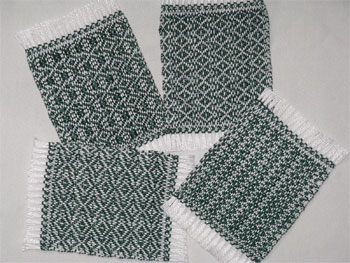
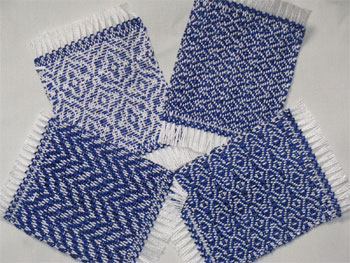
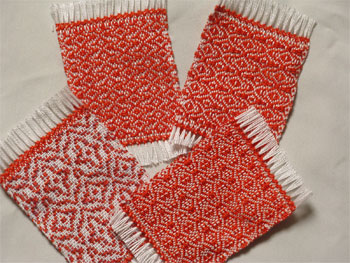
That orange is really bright! Anyway, I had envisioned the ‘set’ being four of the same color. I laid them out that way, but hadn’t gathered them with a ribbon or otherwise restricted selection. Of course, the first purchaser, a young girl, chose one of each color. Fortunately, the second purchaser also chose one of each color, because she was a weaver and wanted to get different patterns. Then I sold the remainder of the forest green and royal blue from an email order, making four more of each color for sets of six – I had to really squeeze that last one out of the warp on my loom!
So now you’re caught up. I’ll have to be sure to take pictures of what I’ve woven since Chautauqua before I pack them up for my next show. Gotta run and weave!
Late last month I showed the twill block scarves I wove with silk on a gray warp. They were successful, but didn’t have as much contrast as I was looking for.
So I tried the concept again, this time with a white bamboo warp and three different colors of bamboo weft.
The first one I did was with a black weft.

THIS was the kind of contrast I was looking for! You can easily see the difference between the front and the back of the scarf.
I didn’t have any black bamboo that was the same size as the white, only a much finer yarn, so I used two strands at once. Experience has taught me that unless those two strands are spun together, they will never come off a bobbin the same way — one will always be longer than the other, causing much difficulty about half way through a bobbin. I don’t spin, so I wound two separate bobbins and used my double shuttle.
As usual (for me), I didn’t want to make all three scarves on the warp the same color, but I wanted to keep the colors quite distinct, so I used navy the second time. While close in concept to the black, I had the size yarn I needed, so only needed a single shuttle.
It was just as successful as the black.
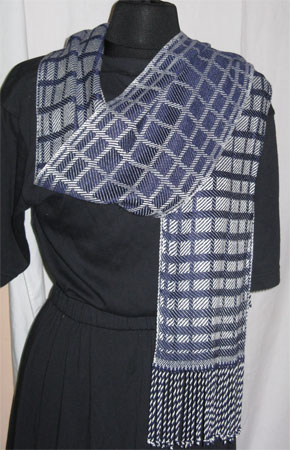
I do like the scarves, but the concept I was going for with the sizes of the blocks isn’t as obvious as I’d like, given the length of the scarves. I had the blocks much thinner at all 4 edges and gradually increase near the middle of the scarf. If I’d been making a placemat, or even a table runner, the optical illusion of the piece bulging in the center would have been much more obvious.
For the last scarf I used a bright red, and liked it equally well.

I modified my treadling pattern on this one, simply alternating my smallest block and my largest block all along the length of the scarf. It was easier to remember, and had a look that was just fine.
This bamboo yarn separates quite easily upon wet finishing and wearing, so the fringe had to be twisted. For the red scarf, I simply twisted up the white warp yarn. Experience has taught me, however, that if I just twisted the white yarn for a scarf as dark as the navy and black, that the eye would get jarred, and the fringe would seem wrong. So I carefully added the black and navy yarn to my fringe before twisting. This added more work, and for the navy scarf twice as much twisting, but I’m happy with the result.
Why was the navy scarf more twisting than the black one? Well, as I mentioned the black yarn was much thinner. So I could add two doubled lengths of black yarn, resulting in four strands, and they didn’t add much bulk. I decided to simply twist two strands of black into the four strands of white, so ended up with the same number of fringe ends. The navy yarn was much thicker, so when I added two doubled strands of it, I would have had fringe that was too thick to look good. As a result, each twisted pair is made from four strands of navy and four strands of white for a more candy cane effect. This means twice as much fringe. I was a bit concerned that it would be too much, but I think it’s just fine.
I’ll be interested to see the reaction to these scarves at my upcoming shows. That’ll tell me whether I should make more of them.
Your turn: After a VERY dry July, August has finally brought us rain, and I’m enjoying it. How about you?
|
|