Clearly my best intentions are useless. In blogging, as in life, actions are what counts, not words. It’s now been a whole month since I wrote. Sigh.
I’m going to try to take things in chronological order. And I’m going to try to not write excessively – time won’t permit me to sit in front of my computer that long this evening, and you probably wouldn’t want to read it all if I could.
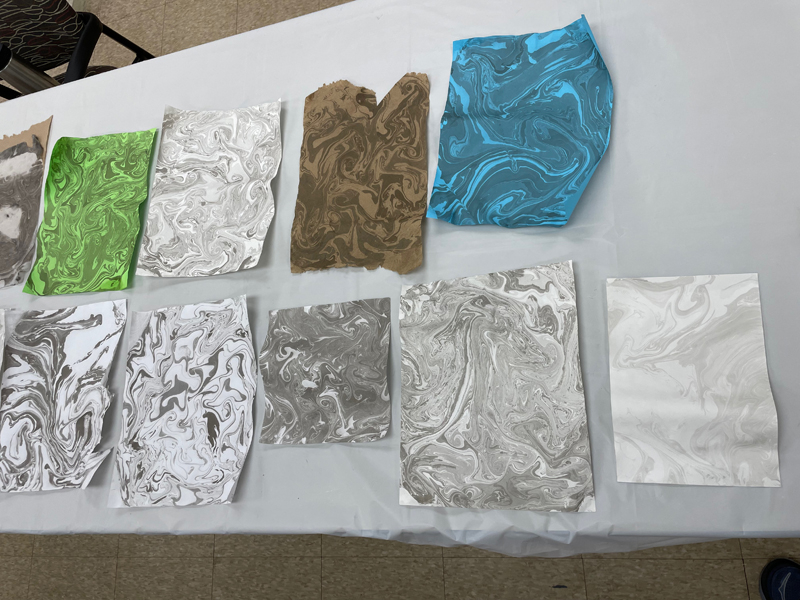
In early March I took a class at the Weaving Center, Suminigashi. Ever hear of it? I hadn’t till recently. A Japanese ink marbling technique. It was actually a two-session class, but I could only attend the first part. We used just black ink for this class. It was pretty cool. Here are my finished papers.
I couldn’t attend the second class because I went on a program with Road Scholar – my first but it won’t be my last. They did SUCH a good job giving us a very high quality program. I could go on and on about what we did for the week that we were in Santa Fe, but I won’t. I’ll just give you one highlight. We spent an afternoon at Ghost Ranch, where Georgia O’Keefe did much of her painting. The tour guide took us around the Ranch, very slowly, in small vans. They stopped frequently and we go out and they pointed out a specific visual, and then held up an 9″x12″ color copy of an O’Keefe painting and showed us exactly what she was looking at when she painted that scene. Wow! Here are 2 photos from that visit.
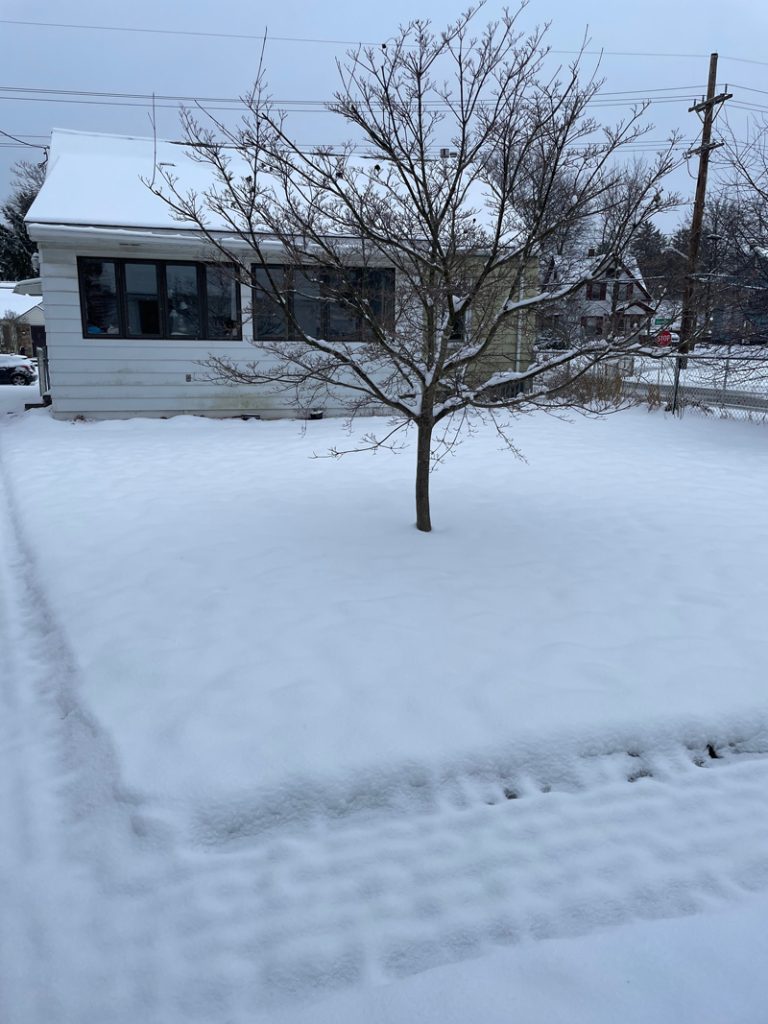
The weather was beautiful in Santa Fe that week – cool in the morning and sunny and warm in the afternoon. At home in Rochester? Not so much. Here’s my yard on March 23, the morning after I returned.
I got my taxes done, shared a lovely Easter day with family, and did a variety of mundane tasks.
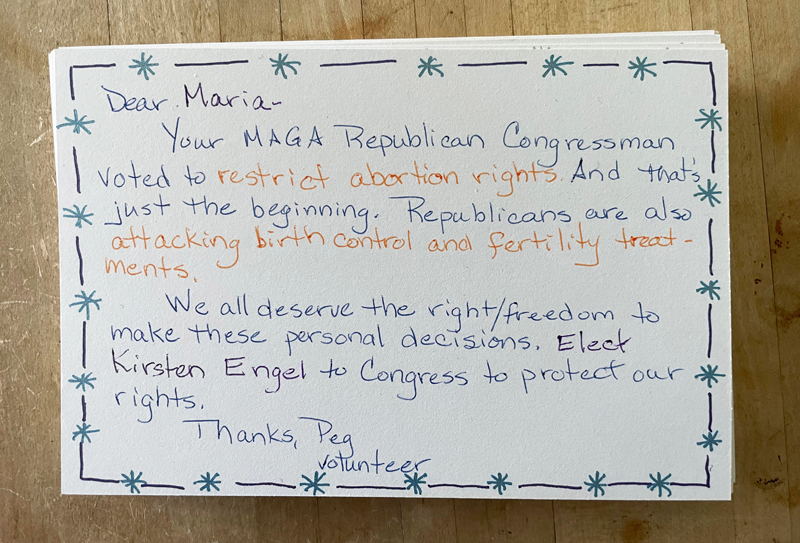
I’ve joined a group of local women who write postcards motivating people to vote. They’ve been doing this since the Women’s March in 2017, growing their list of people willing to write since then. Their email list now tops 500, and it’s not all talk. This group send out roughly 600 postcards EVERY WEEK!! The core group studies races, determining where extra encouragement is needed. Writers can pick up packets at a variety of locations, which include 20 postcards and stamps, a mailing list, and a script. We’re encouraged to decorate the postcards to make them more eye-catching. Here’s one of the 60 I’ve already mailed. It feels good to DO something instead merely worrying. Or kvetching.
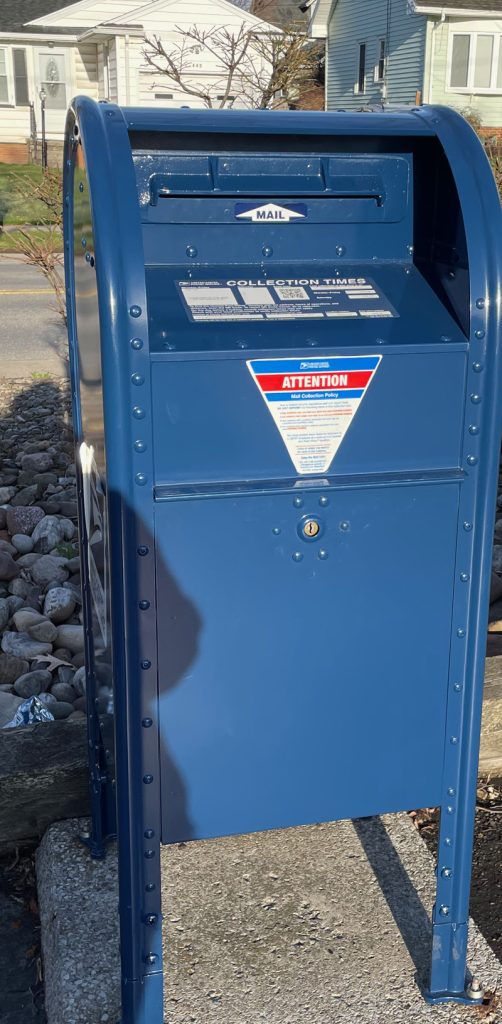
Then, of course, the postcards have to go to a mailbox. This is where I got sad. Or frustrated. Or some other unpleasant emotion. Not that long ago these PO drop boxes had big ‘doors’ that pulled down so you could put a pretty decent-sized package in them. A few years ago they switched to a much smaller door that would accommodate a thick, soft package; all of the USPS Priority Mail boxes were too large to fit. When I went to drop off a batch of 40 postcards, I put a rubber band around them to make it a tad easier for the postal carrier – pick up one wad of postcards instead of a mess of single cards. Hah! The boxes had been modified again, this time there’s only a slot. Nothing opens. And a group of 40 postcards was too thick to fit in that slot. I’m guessing they did this because some jerks were putting garbage or other nasties in the boxes.
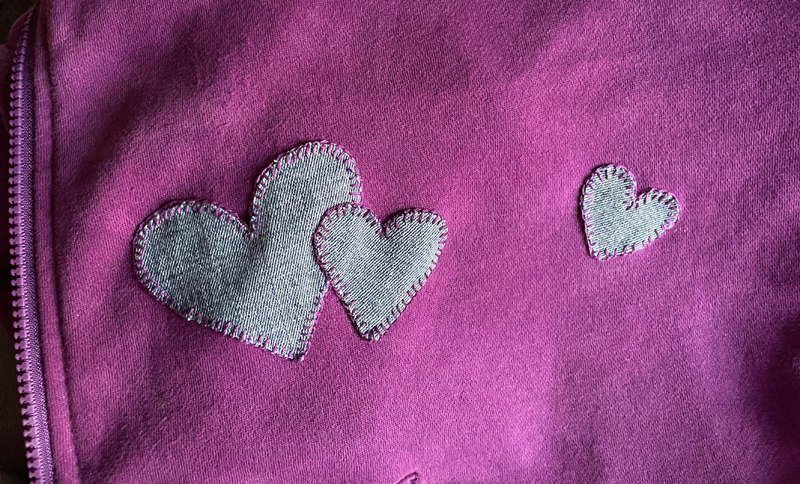
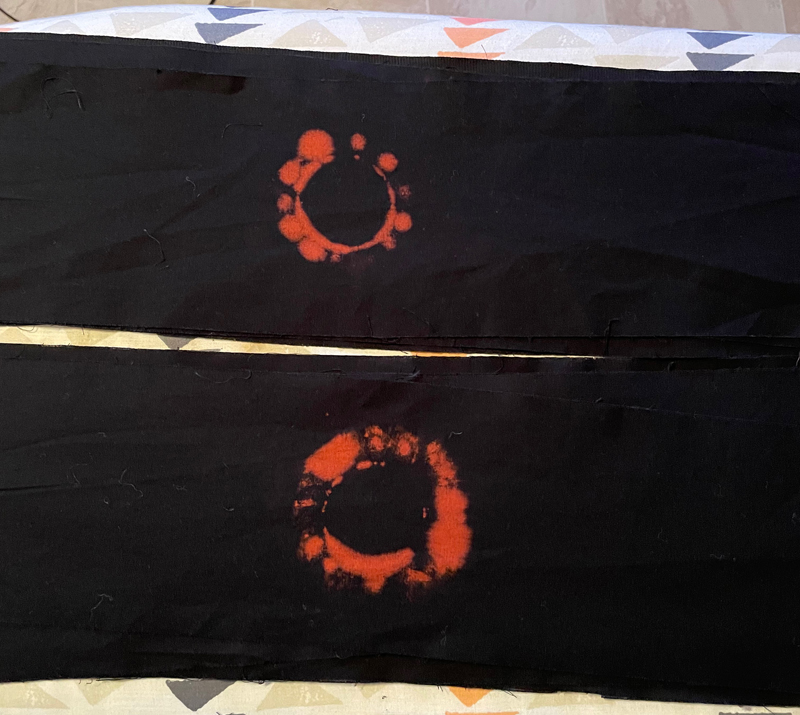
Then there was the eclipse. I made my grandson a Tshirt, and wish I’d taken a photo of it because it turned out much better what you’ll see here. It just involved black fabric, a bowl, and bleach. Of course, my grandson did fine, but I got bleach on my favorite sweatshirt, so I decided I’d put decorative patches on it. Since there’s a big heart on the back of the sweatshirt, I went with hearts on the front. When I have time I may do some simple sashiko embroidery on the hearts. Or maybe not.
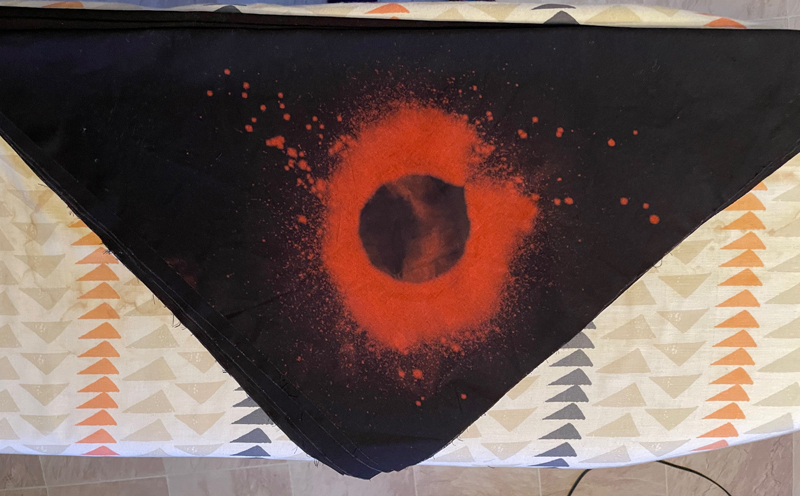
On eclipse day my daughter had a party, with a total of 31 people – adults and children – attending. I offered to use the Tshirt technique to make eclipse bandanas and head ties. They did not work as well, but here you can get an idea.
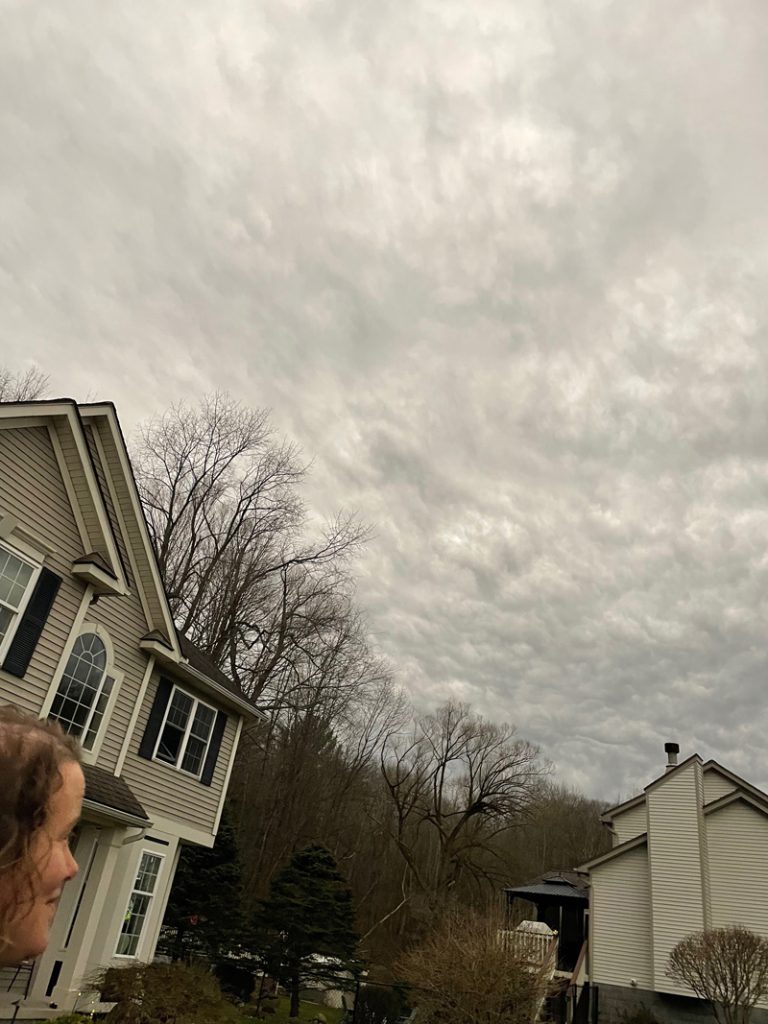
Of course, because we live in Western NY, the weather didn’t cooperate. It had been sunny and beautiful Saturday and Sunday, and was again on Tuesday. But Monday? We were SOCKED IN with thick clouds that never parted.
It was still very cool. It got darker out very gradually, and then all of a sudden, BAM, it was pitch dark! A minute later BAM it got much lighter quickly. I do wish it had been clear as none of the many kids there had ever seen a total eclipse. They’ll just have to wait.
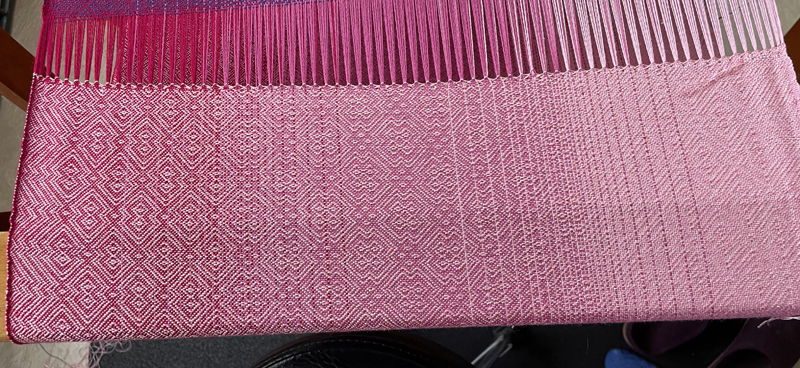
Meanwhile I put a warp on the loom – all 16/2 Jaggerspun fine superwash merino. Long enough for a shawl and a mobius. I wove the shawl of 2 strands of 60/2 pink silk held together.
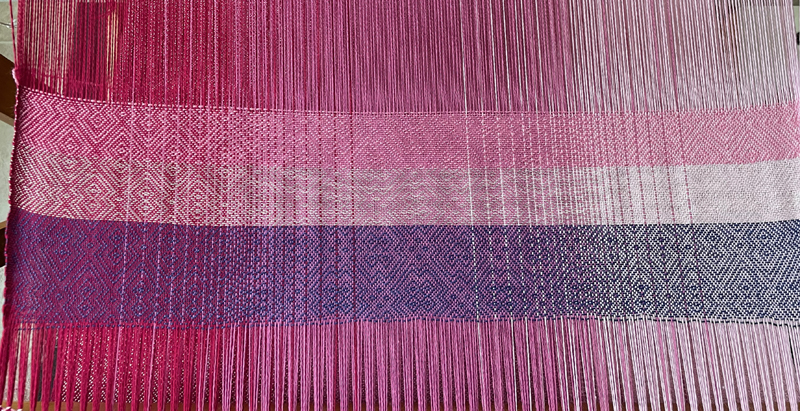
Here I was auditioning wefts for the mobi. I really wanted to like the navy (I’d already tried black), but I just didn’t. I ended up using a 30/2 cream silk.
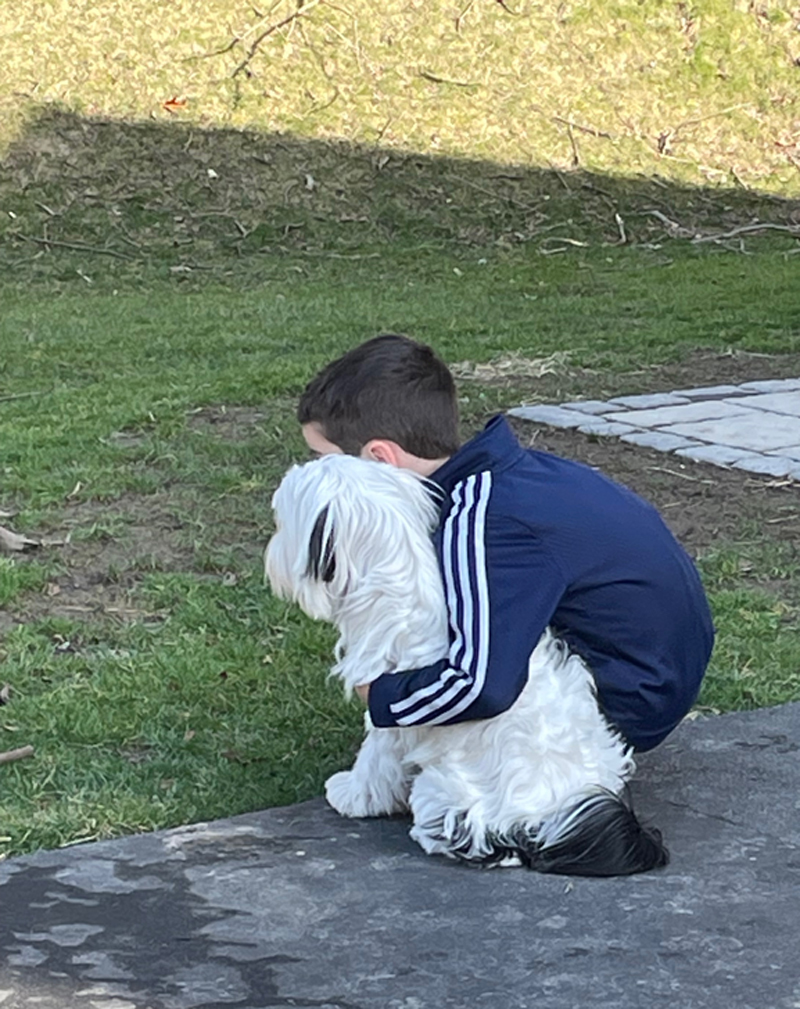
I’m leaving in the morning with 3 of my line dance sisters for a Beginner’s Ball in Richmond, VA. Although I’ve attended a few local & regional line dance parties, this is a MUCH bigger deal – 850 people and 3 days of dancing! WOO HOO!!! I’ll leave you with this photo I love of my grandson and his dog.
Somehow it’s a whole month since my last post, despite my intentions and efforts. I was pushing myself to finish some things in the last few weeks, which kept me away from my computer. But let’s not focus on the negative.
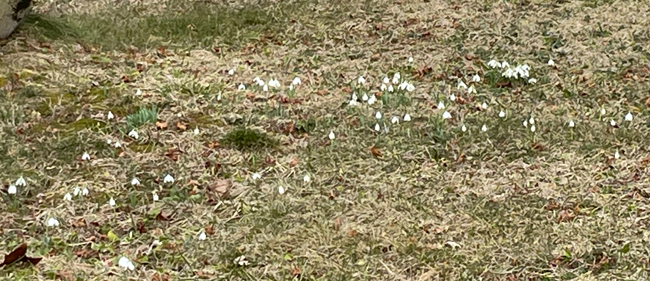
I took the photo above on February 10. Those snowdrops were quite brave, as we had plenty of both very cold temps and snow after that. Since they’re not mine and I didn’t record the address where I snapped the image, I can’t tell you how they made out, but I am seeing lots of snowdrops on my morning walks now, in early March, so I know plenty of these little lovelies made it.
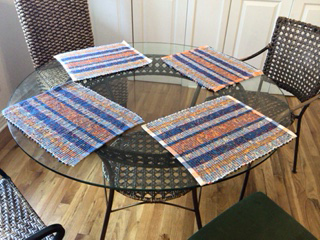
What was I so busy with? I finally admitted to myself that the USPS was never going to find the package I’d mailed on 12/18. So I remade both the placemats and the handknit fingerless mitts, filed for a refund of the shipping & insurance coverage, and sent off a new package. Along with his thank you, my nephew kindly sent me a photo of the placemats on his table.
I made a batch of 10 more bead bags, although I apparently forgot to photograph them. I THOUGHT I had taken a picture, but it’s nowhere to be found. Not even in my recently deleted file. Oh well.
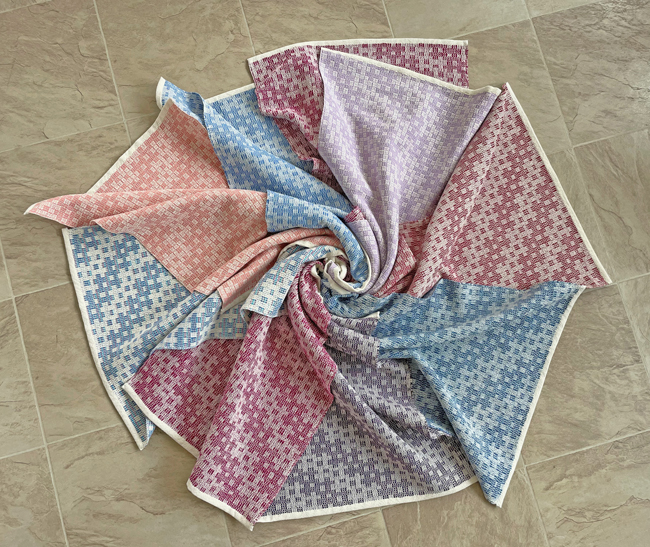
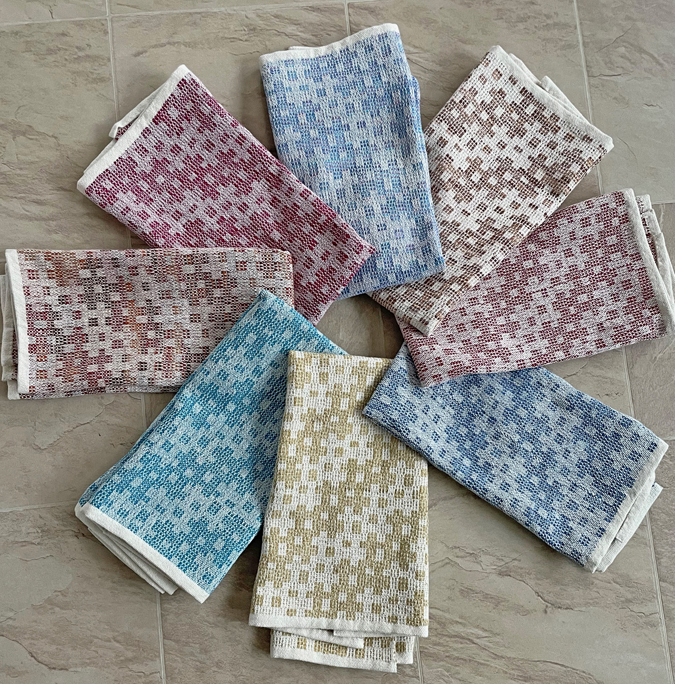
At a customer’s request I wove a batch of 9 more crackle towels. We kept in close contact throughout the process, and within hours of me listing them in my Etsy store she’d purchased 7 of the them.
After those two weaves I immediately warped my loom for some black & white gradient scarves in Tencel.
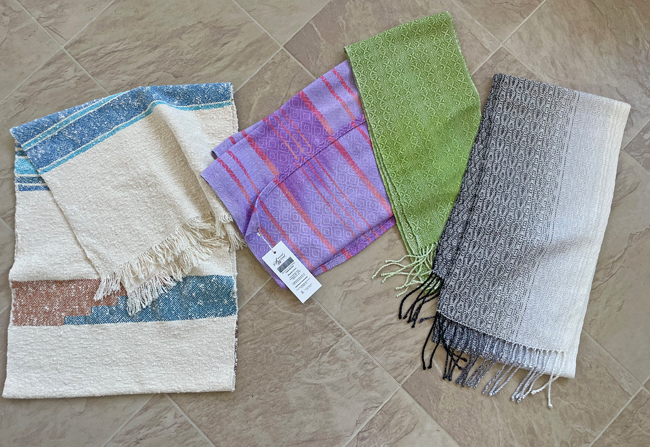
The Copper Shop Gallery at the Roycroft Campus in East Aurora had sold some items I’d sent them in November, so I wanted to send them a few more. A scarf from this warp seemed like a seller to me. Here are the 4 items that finally made it into the mail today.
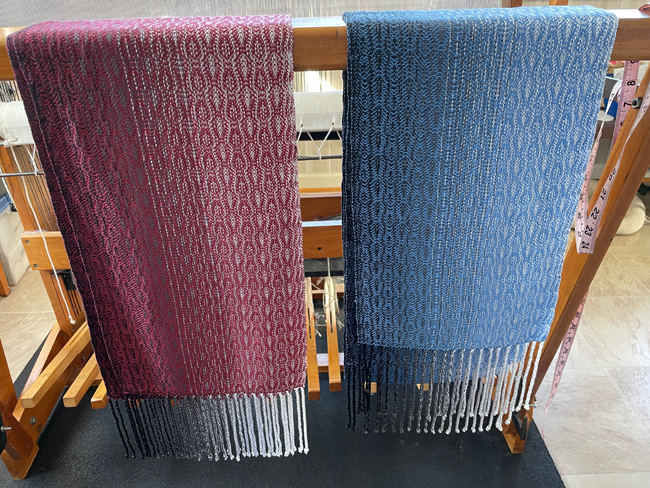
They got the gradient scarf with white weft. I also wove 2 more. Personally, the blue is my favorite, but I think the black & white will move faster. We’ll see.
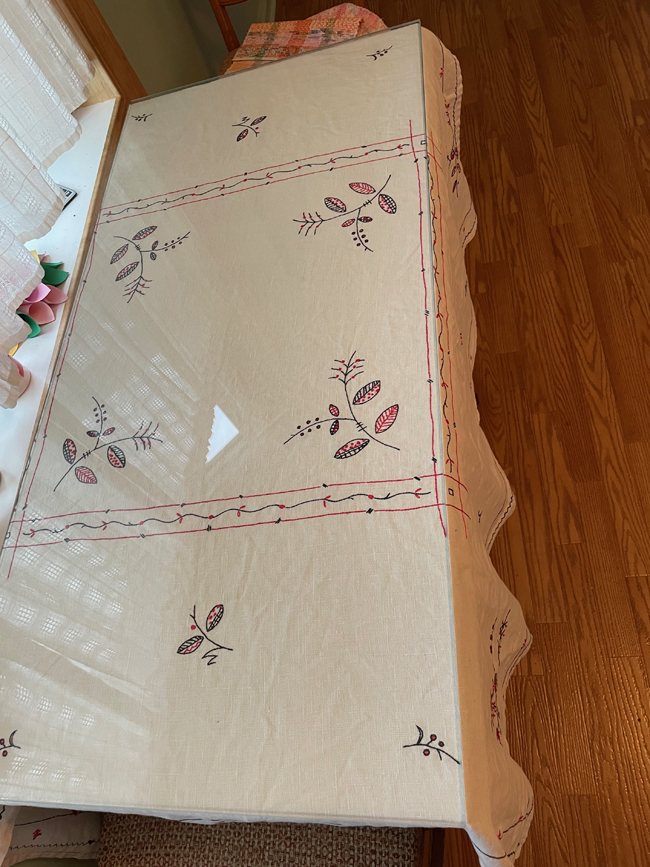
Not something I made but instead something I just think is too sweet not to share. This vintage tablecoth is hand emboidered. I’m pretty sure it came from my mother’s, but I don’t think she made it either. Maybe my sister knows???
Now I have to go pick up my grandson from school, and if I don’t hit Publish RIGHT NOW this post will continue to linger.
I can finally show you what I made for Christmas presents…sort of. USPS has lost one of the packages I mailed on December 18, and I am in the process of re-making those gifts, but since that family doesn’t read my blog I’m not worried about revealing what they will get…hopefully in a few weeks. 🙁
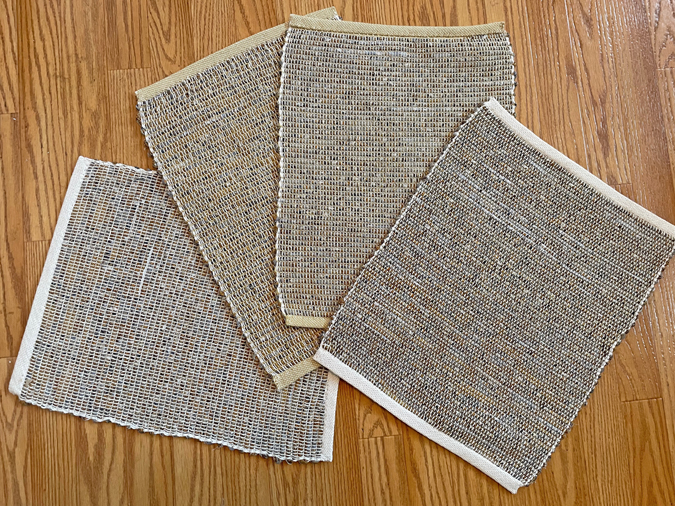
In mid-December I shared my early efforts with weaving rag placemats. After having what I considered to be success, I decided to weave placemats for my sister, my niece, and my nephew. For my sister’s placemats I used some really beautiful fabric that our oldest sister had, which I saved when I cleaned out her apartment.
I was a tad disappointed that the beauty of that fabric didn’t really show through as much as I’d hoped, but I knew that they would be appreciated anyway.
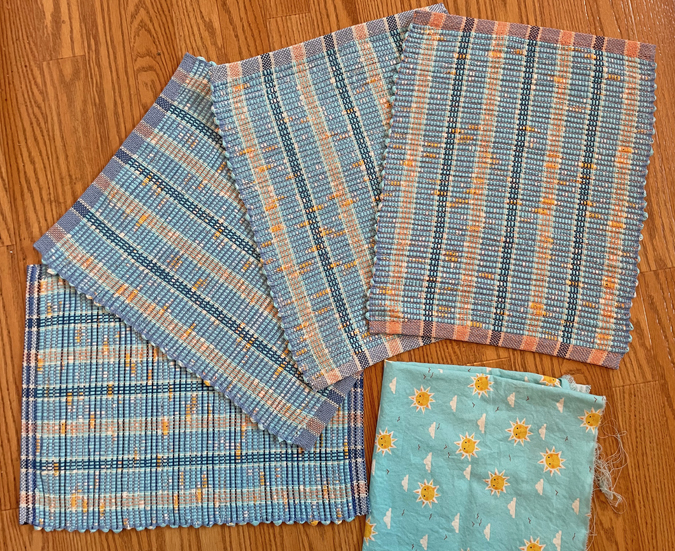
While I had more gorgeous fabric from that oldest sister, they were all rather dark. After my experience with the above placemats, I thought my niece and nephew, each with young families, would prefer something lighter, so I made a trip to the fabric store and bought some cotton yardage for this purpose. My niece and family live on Hilton Head Island, so I decided she needed beachy colors. More weaving surprises…the sun was more identifiable than I’d expected, but not in a bad way.
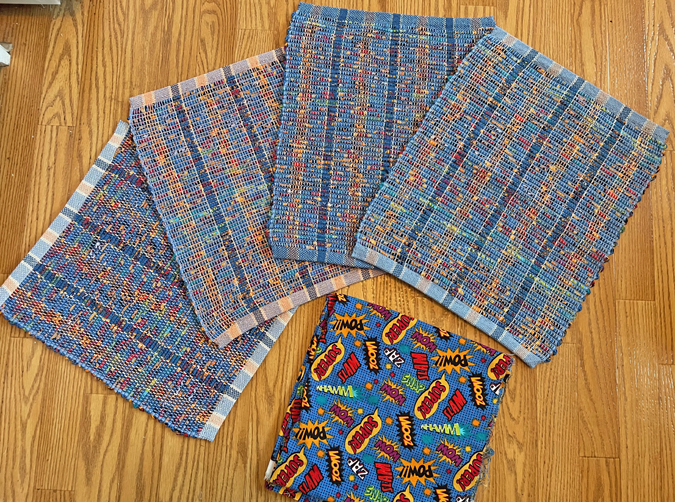
My nephew and family live outside Dallas and have 2 very active little boys, so I chose yardage that seemed perfect to me. This time I was surprised that none of those words showed up, just the colors. That was actually what I was hoping for but didn’t expect. 😉 After accepting that the package was really lost I made another trip to the fabric store and managed to snag the last of this fabric to re-make the placemats. I haven’t finalized warp colors yet.
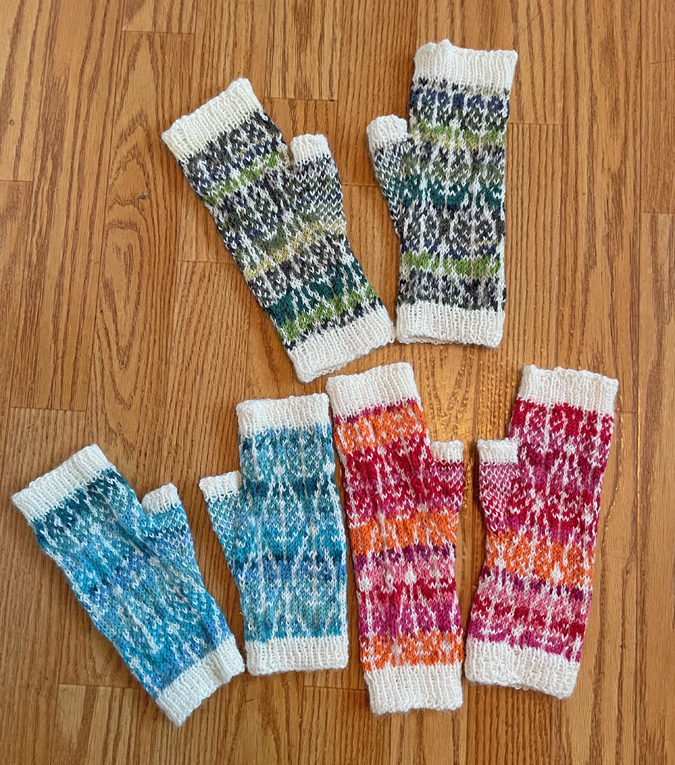
The other things I made for Christmas weren’t from my loom; they were made sitting the living room watching way too many cheesy holiday movies. But knitting isn’t a fast process, at least not for me. I made 6 pairs of these fingerless mitts, and am now making a 7th pair to replace the ones in the lost package. Cindy over at EweniquelyEwe turned me on to the pattern, which is free from Carolyn Greenwood on Ravelry. The pattern is called Keep the Leaf.
So much for the Christmas reveals. Life has been…interesting. About 10 days ago, almost home from our evening walk, Jack & I were…assaulted…by a pair of French bulldogs who had clearly escaped from their home. Real short version of the story – I was saved by a runner who heard me screaming. THANK HEAVENS FOR HIM!! It could have been SO much worse!
Jack & I were both emotionally traumatized, and Jack has a wound on his tail that doesn’t look bad and will heal. I ended up at urgent care with 2 wounds on my right hand from one of the Frenchies biting me, and bunch of bruising on that forearm from other attempted bites. Those wounds are healing well, BUT, my ulnar nerve had some trauma and as a result my pinky & ring finger have a constant tingling as if they’d fallen asleep. Numb but not really. I’ll be seeing an ortho doc on Tuesday, and am hoping he can give me better news and/or strategies than my PCP had, which is that it can take 6-12 months for the nerve to fully recover.
I’ve never seen those dogs before and have no idea where they live. I’ve been doing some asking around to see if anyone knows them, but so far no luck. I doubt I’ll ever know. I now have both pepper spray and one of those little emergency alarms. I don’t know that I could have made effective use of the pepper spray in the moment, but I feel like I could have activated that alarm, which would hopefully either sent the dogs running or alerted neighbors sooner.
Other than that, I keep line dancing, reading, doing yoga, baking sourdough bread, living my life.
Oh, yeah, and weaving. Thank you to Susan Poague for providing a great crackle draft. I’ve said it before and will say it again, I always think I don’t like crackle weaves – until I see them. Then I really like them. 🙂
I made a TINY modification to the treadling in Susan’s draft. I wove eight towels and listed them in my Etsy shop at 8AM Saturday morning. By 9AM four of the towels were sold, and three more were gone by 5PM. WOWOWOW!!! Truth be told, one woman – who has purchased countless towels from me – bought all seven – she’d been waiting for me to list more towels.
Now I must get back to re-making Christmas gifts. In February. Sigh.
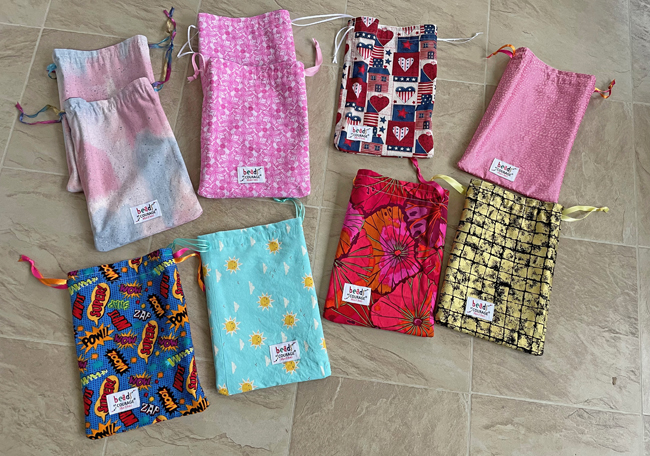
I knew what was coming up on my to-do list and knew that I’d better get my bead bags for January cut out and sewn before I started my next project. With more duplicate fabrics than I usually like to use, I got them done.
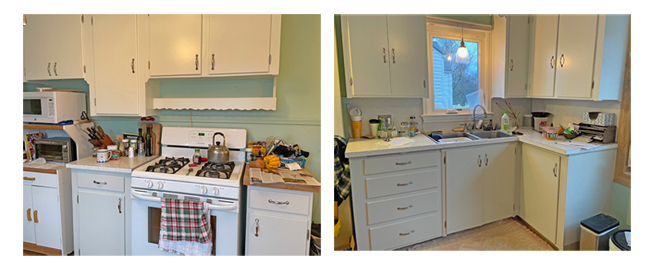
While that was going on I had a professional painter working in my kitchen. My cupboards had been painted many times since the house was built in 1948. They definitely needed a refresh, and this was not a task I wanted to undertake, especially because I wanted to replace all the hardware. I hired a painter I’d used before and was very happy with, and early January was when he could fit me into his schedule. Here are the before photos. Everything was white, white white.
The differences may not be so obvious in the photos (I almost didn’t post the photos because of this), but suffice it to say that in real life the change is very noticeable. I am very happy with the work. And thrilled that I didn’t try to do this myself. The man I hired is a professional, for sure, and it took him a full 40 hours to do the work. Much time had to be spent removing the doors. Those old hinges had so many coats of paint on them, getting the screws out without stripping them was not easy. I know I would have been in tears of frustration trying to do this myself. The upper cupboards are white with a bit of tint to soften the look. The lower cupboards are a light grey.
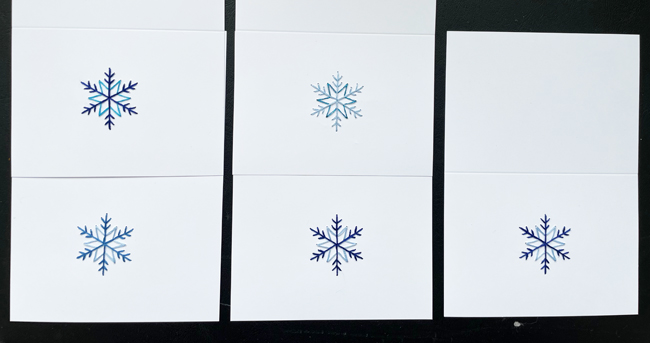
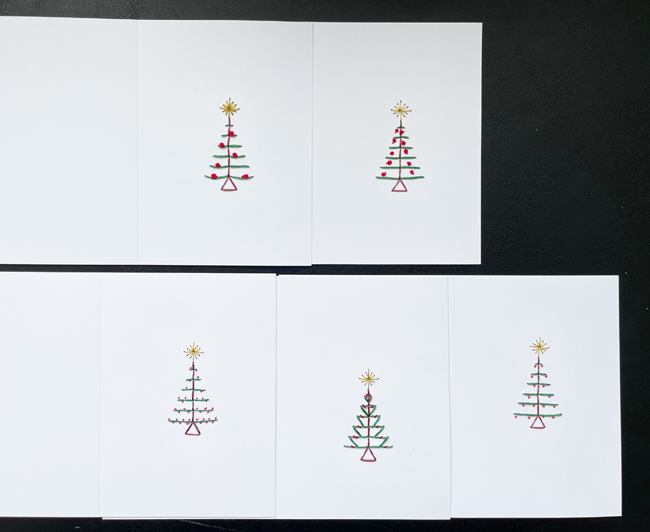
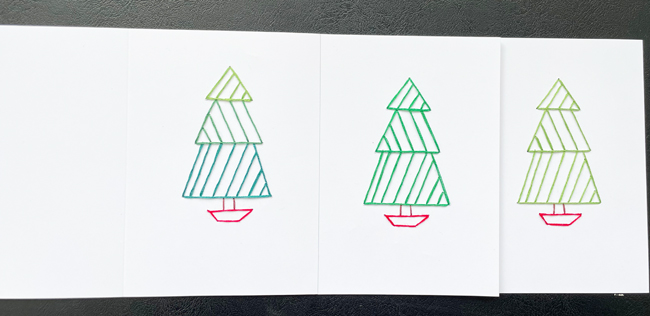
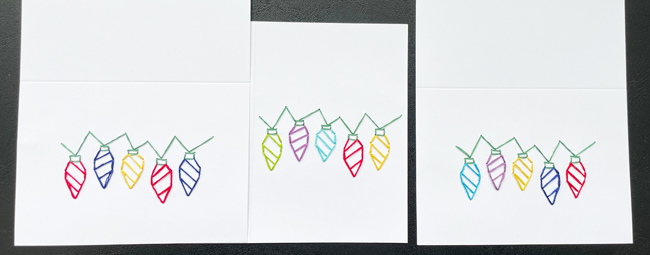
I really try to make my Christmas cards for the coming year in January or February. Any later in the year and I either completely forget about it or am too busy doing other things. I showed you a sample of what this year’s cards would be in my last post. I have now done the embroidery on the 40 cards I need, and here you’ll see them all.
First up is a design I didn’t create; it comes from stitchedstories. You can find a wide variety of patterns there, some are very complex; I just downloaded her free printable holiday gift tags. Here are her snowflakes. Easy and lovely. They were the first cards I embroidered.
Next I moved to a simplistic trees. I added all the red accents and a few of the green lines on one card, but somehow they never really pleased me.
A few other designs came with the free pack, but either they didn’t speak to me or I tried them unsuccessfully on cardstock. So now came the REAL time suck. I sat in front of my computer and googled. And googled. And googled some more. Then I got out my graph paper, 6″ ruler, and mechanical fine-line pencil. This led to a seemingly-endless round of drawing and erasing, trying again, crumpling paper, repeat. But I came up with some designs I liked well enough to try. First up here is a different type of simple tree. It’s just okay IMHO. Three cards was enough for me.
Then I tried some strings of lights. Fun, but still just okay, so I was again done after 3 cards.
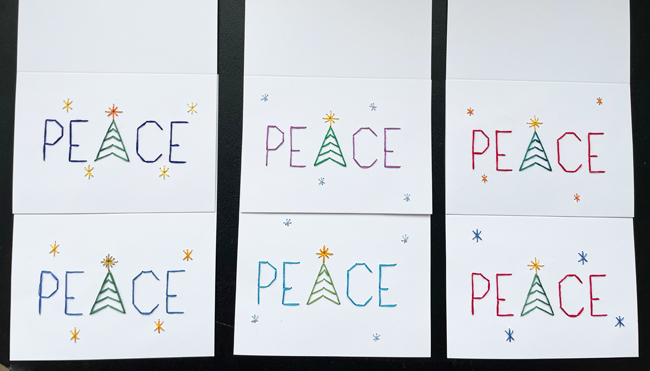
Now the more serious designs started being embroidered. Here are my Peace cards. I liked them well enough to initially embroider 3 of them. At this point I realized that I was better at the embroidery end than at the design end. I knew what I liked but not necessarily how to create it. So what could I do to make my Peace cards please me more? I added the little stars, which I thought improved them, ultimately making 3 more.
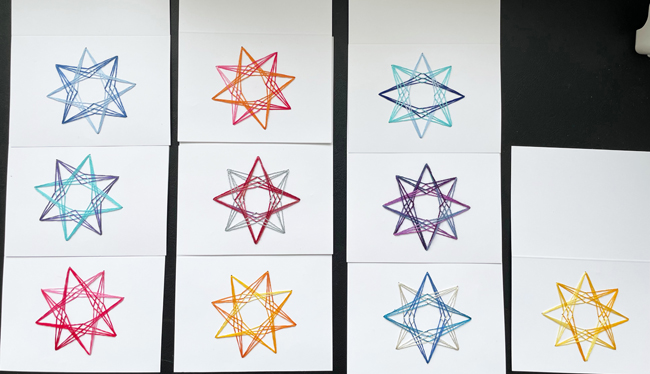
Next up, I designed a rather complex-looking star. Interestingly, I think it wasn’t as hard to emboider as it looks like it would be. I initially made just a few of these, and then as I was counting the completed cards and figuring out how many more I needed, I made more and more of these, ultimately finishing up with 10 cards. They are my favs, for sure.
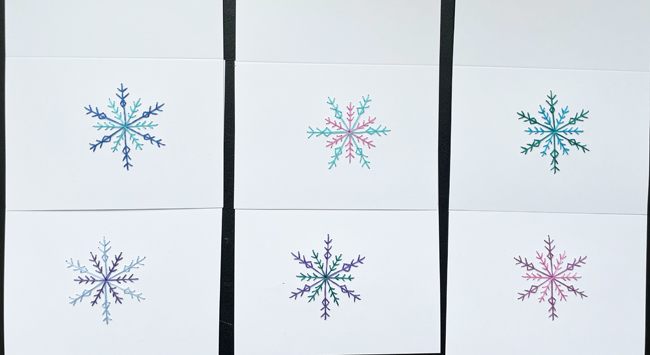
The last cards I designed were a more complex snowflake than the downloaded snowflake. I quite liked these, too, and made 6 of them as well.
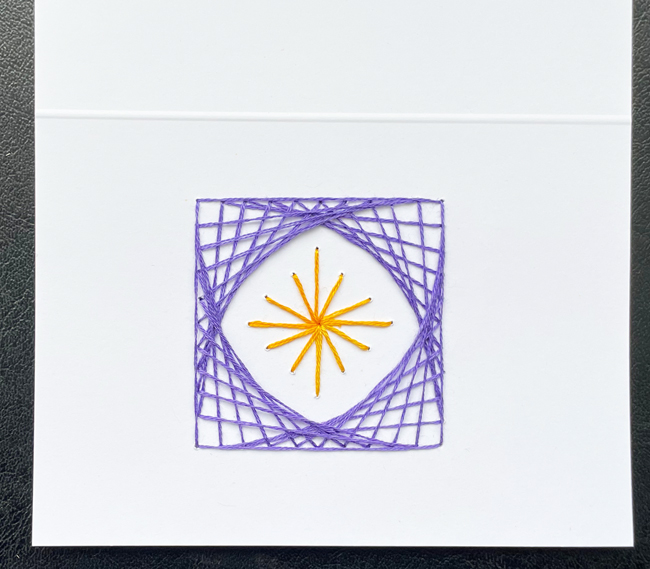
The final design, a parabola with a star, worked fine but didn’t seem very Christmas-y, so I only made 1.
A clever reader will count and see that this is 39 cards, not 40. HAH!! My record-keeping sheet told me I had made 11 of the complex stars, but in reality there were only 10. I didn’t realize my error until I was in front of the computer making this blog post. However I’d already put away all the supplies and wasn’t going to get them all out again, so I’ll go into the 2024 holiday season with 39 cards. This will probably be enough – I usually have a few extra. If not, I’ll make one more at that time. I certainly kept all my designs along with the finished cards, so it won’t be a huge deal. Plus, that’s the time when I’ll have to decide what to back the cards with. The backside of the embroidery is very messy and must be covered – will I use card stock? Wrapping paper? Something else? I have time to make that decision.
At the end of every calendar year I have to do a bunch of administrivia for my weaving business. I sort of hate it. I dread it. Until I get started, it’s always a HUGE deal. Once I’m in the process, it’s not so bad. It takes probably a total of about 8 hours, all told. But because it only happens once a year, I don’t seem able to remember that it’s just not all that bad. So I got that done in preparation for my accountant guy.
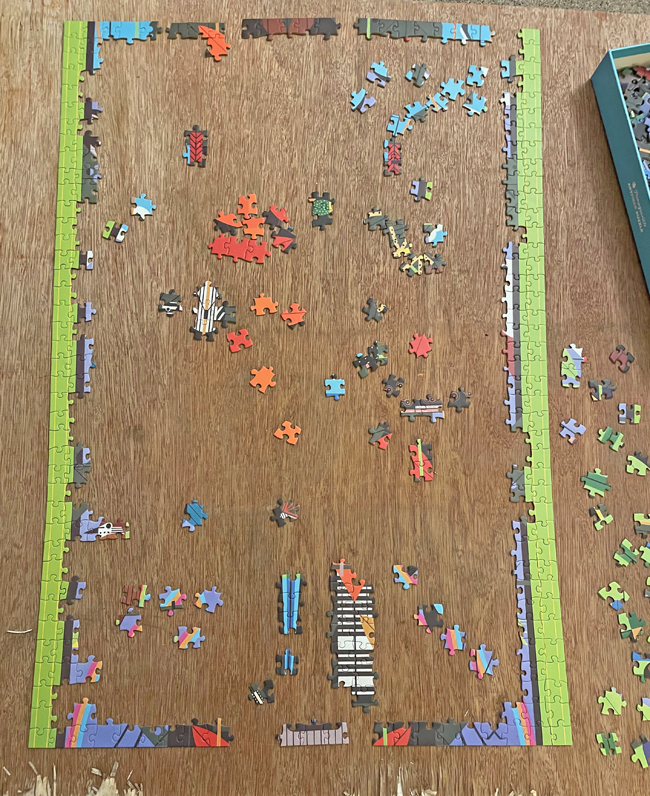
I also like to work a jigsaw puzzle this time of year. It’s an indoor activity that has a high degree of inherent reward and gratification – what more can you ask? I’ve had this particular puzzle for about a year, so it was time.
In the past I’ve done the puzzle at my kitchen table, but it takes up my entire small table so I can’t even eat at it. So this year I had a different plan. I had a large piece of plywood in my garage that was left over from some project or other. I measured it and it was perfect. Brought it in, put duct tape on the raw/fraying edge, put it on my large ottoman in the living room, and set to work on New Year’s Eve. Here’s how far I got that evening before I went to bed at about 9PM. (Yup, I’m a party animal – but a tad more on this below.)
After not having a cold for a few years thanks to constant masking, I’m now working on my second cold in several months. BAH! This one started with a fever that had me sleeping for about 24 hours straight. After that I don’t feel bad, but there’s lots of sinus involvement, with plenty of post nasal drip and its resultant coughing, and this time some plugged ears, to boot. Not a big deal, but not pleasant, especially when trying to sleep. So that’s my excuse for going to bed so early on NYEve. Mind you, I’m usually in bed by 10PM anyway. HAH!
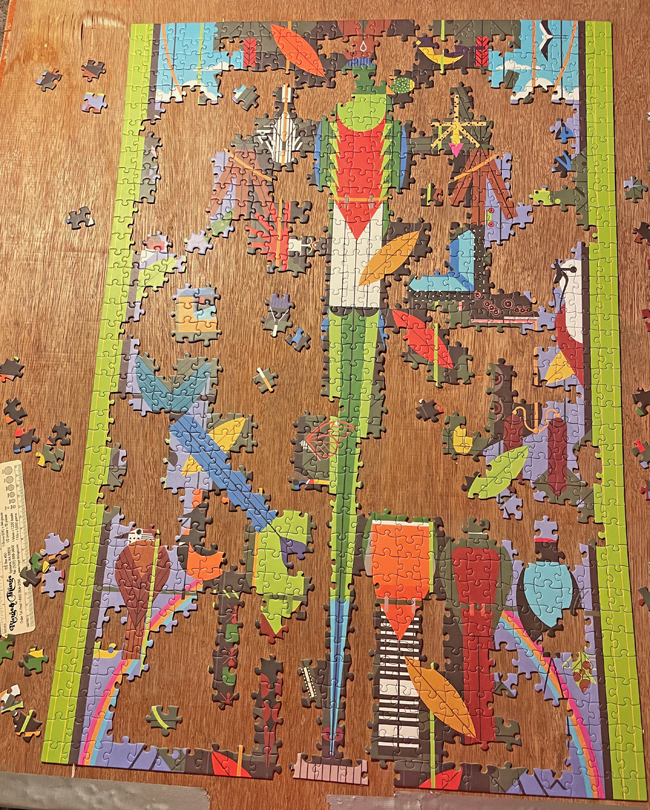
On New Year’s Day I spent a bunch more time working on the puzzle. Sappy Christmas movies were on the whole time. Seasonal, and yet no attention is needed. By the end of New Year’s Day the puzzle looked like this.
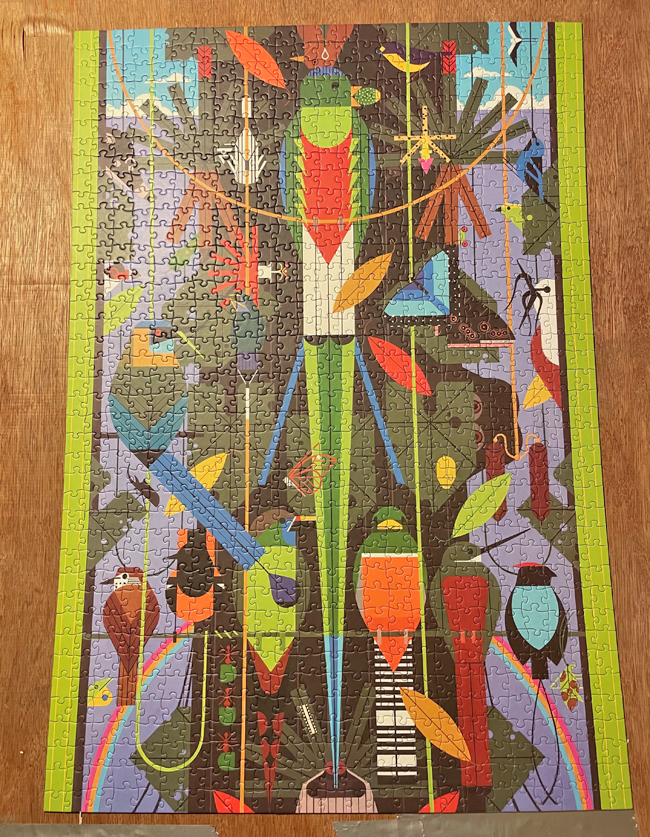
This happens to be a Pomegranate puzzle, 1000 pieces, title Monteverde. I found its design and use of color quite a bit easier than the last puzzle I did – and definitely easier than the one I did in 2000 – which was a good thing…since I hadn’t yet done the above-mentioned administrivia.
I finished the puzzle up on Tuesday.
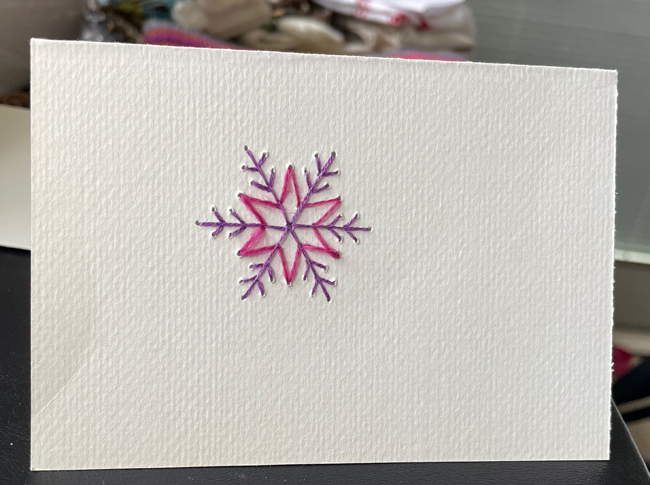
Now it was time to try out some ideas I had in my mind for my 2024 Christmas cards. I’d gathered a sizeable amount of used & crumpled wrapping paper from Christmas with the family, and planned to use it to make paper for next year’s cards. But then I saw something online that intrigued me and I exchanged texts with a fiber friend. She expanded the idea a bit – embroidering on card stock. Would I, could I, do this on handmade paper? I tried it, and the answer was I could, but it wouldn’t be as clean and easy as doing it on card stock. And it added an unnecessary step that would not add to the finished result. So I did a sample on some card stock I had here, and it was a definite YES!
This is one of several designs I’ll be using. I have the card stock and envelopes ordered, and am excited to start this process when they arrive.
Now I have to run without even proofreading because I’m babysitting tonight. Maybe the next post will be about this year’s handmade Christmas gifts.