Archives

Weaving Napkins

After finally figuring out how to draft a design in block theory, I spent a long time designing my actual napkins for the International Napkin Exchange. I wanted to do something with a sort of architectural feel to it, something that reminded me of Frank Lloyd Wright’s sensibilities. This sounded relatively straightforward to me. HAH!

I should know by now that it takes more skill to make a clean, attractive, simple design than one that’s crowded with activity. Frank certainly was a master of his craft, and I would certainly not call myself a master weaver!

So I spent hours drawing. First on graph paper, then on my weaving software. Then I realized that I didn’t have the graph paper design right, and I didn’t have enough graph paper to do what I wanted, so I went to Excel and created a grid that resembled the squares of graph paper. I spent hours getting the design that I thought I wanted, then went back to the weaving software.

Hmmm….still not right. The basis of a summer & winter pattern, which is what I wanted, is that what’s light on one side is dark on the other. To keep me happy, I had to like both sides of this piece. So back to the drawing board.

To add to the challenge, the napkins had to be a certain size, 18″ to 22″ square. So I had to have the right number of threads across both the width and length of the piece. Again, my obsessive-compulsive nature slowed my design time — I really wanted a pattern that was completely symmetrical, both left to right and top to bottom. And one that had a reasonable balance of light and dark on both the top and the bottom.

FINALLY I got a design that I liked, got the warp prepared and on the loom, and started weaving.
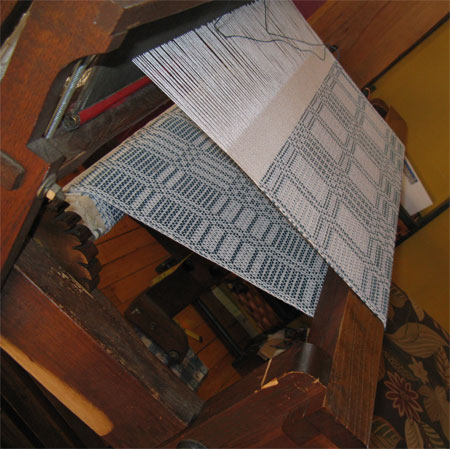
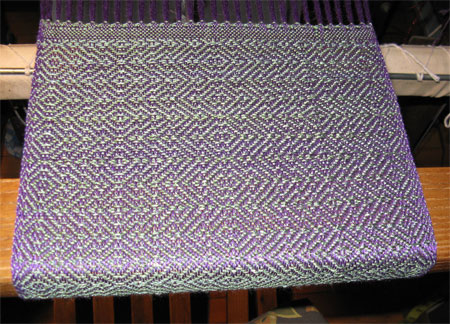
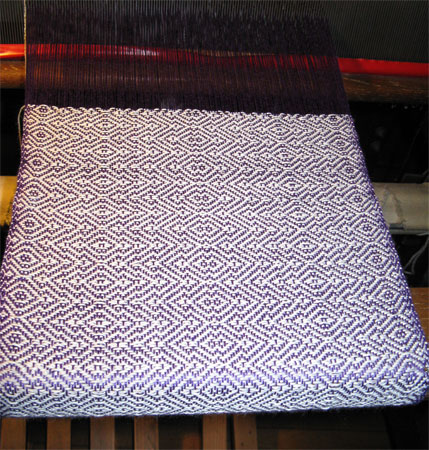
handwoven napkins on loom

The above picture shows you both the top side and underside of the weaving, so you can see how the colors reverse themselves. It still amazes me that I can do this bit of weaving magic, particularly on my little 4 harness counterbalance loom. This type of weaving is possible by using two shuttles, one with your background color (white) and one with the alternate color (purple for the napkin below).
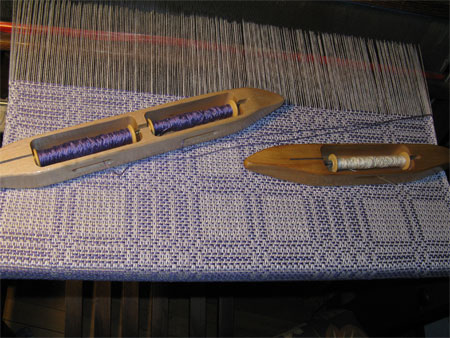
weaving with two shuttles
To make things look the way I wanted them to, I had to use two of my colored threads and one thinner white thread. If I were a spinner, I’d have spun those two or maybe even three purple threads together to make one fatter thread, but alas, I don’t spin. So I had to be satisfied with two threads and use my double shuttle for the purple, sending both through simultaneously.

I’m pleased with the way they’re weaving up. The warp is presenting some problems, however. The right side is substantially looser than the left. I’ve hung weights on it to even out the tension, but I doubt that this will be enough for the entire length of the warp. Time will tell.

Your turn: do you make things harder than they need to be, or can you be satisfied with changing your plans?

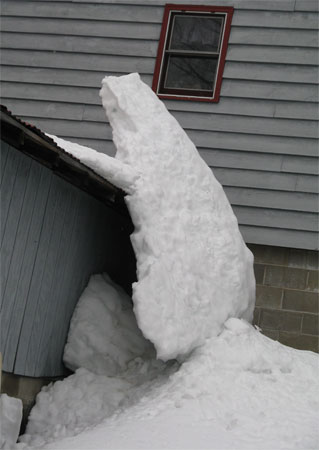
It’s A Frog, It’s A Whale, It’s…

…SuperSnow!
frog-whale-snow

I came home from work and saw this odd formation. At first glance I thought it looked like a breaching whale Then I thought it looked like a frog climbing onto the roof.

Obviously it’s a big block of snow & ice that slid off my garage roof all in one piece. In all the years that I’ve lived in this house (30+), I’ve seen lots of configurations of snow sliding off the roof, much of it really beautiful, but I’ve never seen anything like this before. Clearly the weather conditions were just right to create this formation.

I know that as humans we’re programmed to see faces in inanimate objects. It’s called anthropomorphism.

Tell me: Is there a term for turning objects into animals?

Second Wind Survey

I like taking surveys. Online surveys and telephone surveys. Political surveys and consumer surveys. I have an opinion about lots of things, and am happy to give them to people.

I hope you feel the same way. And that you love a bargain.

I’ve created a really short survey to get to know my readers and customers a bit better. And I mean short – there are only 5 questions, and 1 of them is optional. It shouldn’t take more than 2-3 minutes to complete it. Created with SurveyMonkey, your response is completely anonymous and confidential.

To sweeten the deal, I’ve built in an incentive. Take the survey and get a coupon code for 10% off any in-stock merchandise you order from my website! When you finish the survey, you’ll get the code, and you can use it anytime till the end of August.

What are you waiting for? Go take the survey!

Rayon Scarves in Complex Twill

I’ve had fun designing new twill patterns, watching how thread patterns emerge when I change the threading or treadling I use. Although I have the basic version of Fiberworks software design program, it does a great job for me. No doubt it has features I’ve never used.

I’m in a rayon mode, and prepared a solid, dark purple warp, long enough for three scarves. For the first one I decided to use colors I loved in my jewelry design – amethyst & peridot – green & purple.
green & purple rayon scarves
This photo doesn’t do it justice, but even so, I wasn’t as excited about how these colors worked together as I thought I’d be. Maybe I needed to use a lighter green.

So for the next scarf, I really wanted the weaving pattern to pop. What better than white? Naturally, I didn’t have a white rayon. (No matter how many cones of yarn I have, I always want something else.) But I did have a nice white bamboo that was just a tiny bit thicker, so used that.
white & purple rayon scarves
That pattern does indeed show up well, and people at my fiber arts guild meeting really liked it. For me, the colors are a bit harsh, the white a little too white.

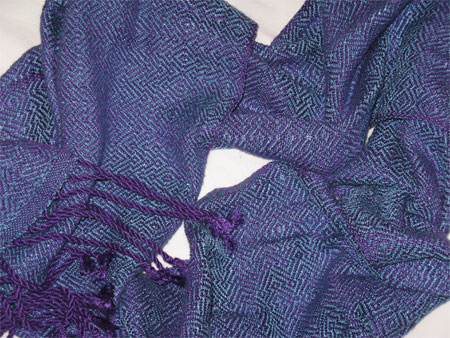
If you read me regularly, you know I love gemtones, so it’s no surprise that I chose a sapphire rayon yarn for the third scarf.
blue & purple rayon scarves
It is, of course, my favorite.

Still, the pattern’s a bit more subtle in real life than it was in my mind.

The whole interplay of colors and patterns can take a lifetime to explore. And I’m sure that if I had exactly the same colors and values in cottons or wools, they’d interact somewhat differently than in shiny rayon. That’s the fun of it all for me. I’m easily bored, so trying new things, learning new things – that’s what keeps me motivated.

Your turn: what motivates you?

Where Does It Go?

I’ll start by saying that I haven’t lived in a city, or even a town, for more than 30 years. I’m therefore pretty ignorant when it comes to how things work in cities.

I get all my water from a spring, not a huge city water supply. When I turn on the faucet, I can hear the pump in my basement kick on to move that water, reminding me to be conservative in my use.

When I flush, everything goes into my septic system, and ultimately out into my leach bed. No city sewer systems out here in the sticks. That has an impact on what cleaning products I use and what I dump down my drain.

So maybe my reaction to a piece I heard on NPR a few weeks ago is completely wrong, based on my incorrect and incomplete information.
snow mound
The discussion was around the challenge that many cities are facing with no places left to pile up the huge amounts of snow they received. Parking lots already have lots of their spaces taken up with snow mounds, empty lots are full of snow, and still the snow keeps falling. Some cities were seeking permission to dump the snow into their lakes and rivers.

Understandably, the DEC was not anxious to give the ok. Those snow mounds are full of road salt, dirt, and garbage. Not a good idea to put it in the water. That made sense to me.

And then I thought about it. Out here in the sticks, we still have plenty of places to put snow. Not necessarily convenient places, mind you, but places nonetheless.

But when the rains and warm temps come and those huge snow mounds melt, where does it all go?

I’m clear on the answer in my neck of the woods: whatever doesn’t seep down to the groundwater (making our already acid soil even more so as the salty water moves through it) flows into the creeks and the river. Our river is the Genesee, ultimately leading to Great Lakes north of us. It carries with it all that road salt and sand, all the dirt and the bits of garbage it picked up.

Whether we put it immediately into the river when it falls or wait until warm weather wears it down, the end result is the same – stuff we don’t want in the water going there. En masse.

I, too, want my winter roads to be safe. I know that a combination of salt & sand is the only way to do that. So while I curse the impact on my car, I’m grateful that tires find purchase on the road. But I sure don’t like to think about when happens when it all melts.

Is it different in cities?