Archives

Rigid Heddle Woven Scarves

Even though I haven’t posted about it as much, I have been weaving away.

I had to do two demonstrations in March, and having no idea how much I’d get woven either time, I warped my rigid heddle loom for two scarves.
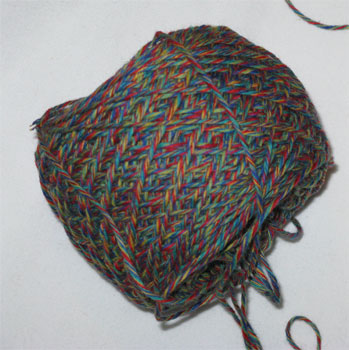
confetti yarn

I’d recently bought this brightly-colored yarn that’s a cotton-linen-rayon blend. It’s not my usual choice in yarns, but it came at a great price with some other colors that I do really like, and I knew I’d find use for this.

I always have a bit of a challenge about what to put on my rigid heddle loom, since I tend to work with finer yarns that I sett at 16-18 ends per inch, and the rigid heddle is 12 ends per inch. The confetti yarn was a bit fatter than my usual, so I figured I’d give it a shot.

I used a cranberry rayon boucle yarn for the first scarf. Although the post has apparently been taken down, I had found a blog post online for a half twill pattern woven on a rigid heddle loom, and decided to try that new pattern on this yarn.
red scarf
The half twill didn’t excite me, but it was interesting. The solid cranberry color really makes the whole scarf look red; the other colors fade into the background. The rayon weft, combined with the half twill pattern, ensures that this scarf is very soft and drapes nicely, but overall it’s not a look I’m crazy about.

So for the second scarf I definitely wanted to use a different weft. I tried a few things, all of which were too bright for my tastes. I finally settled on a very dark forest green pearl cotton. I also decided that I’d do leno for the second demonstration.

I’m usually a very symmetrical weaver, and I’m trying to loosen up a bit, so I decided that I’d make the leno bands random, inserting leno whenever a viewer wanted to see how I did it. I wasn’t sure how I’d like the end result, but I’m just fine with it.

I was surprised at how different these two scarves look. The bright red weft versus the dark green weft makes a huge difference in how much the colors in that variegated warp show up. The cotton plain weave pattern versus rayon half twill pattern also make a sizable difference in softness and drape.
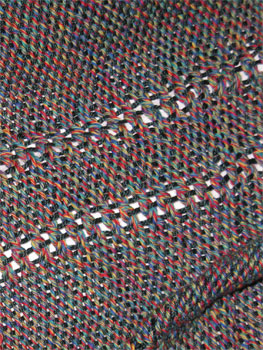
green handwoven scarf

To show a third difference in the way the same yarn looks in different applications, here’s a handwoven napkin using the variegated yarn as weft next to the red scarf and the green scarf with that yarn as warp. I brought these three items to my Southern Tier Fiber Arts Guild this morning and people there were surprised at how different these three pieces look.
handwoven scarves and napkin

Nature’s Art Class

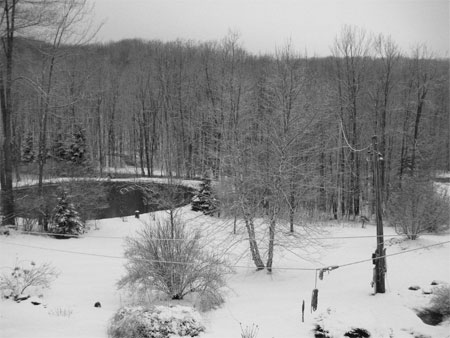
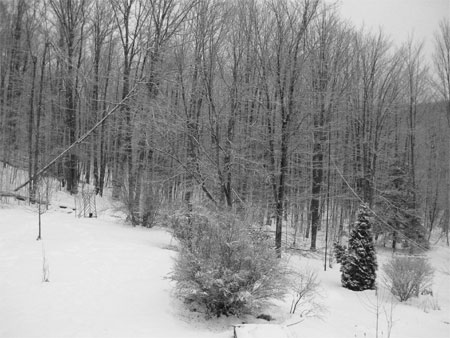
If yesterday was a Currier and Ives painting, today is an Ansel Adams photograph.
April 1 beauty

As usual this time of year, yesterday morning’s thick, heavy, wet snow completely melted off the trees by mid-day.

Starting in the wee hours this morning a very light snow/rain mix fell, providing a new coating, one that was painted with a light hand, not a heavy brush. I couldn’t help but again seeing the beauty in it.
more April 1 beauty

I don’t usually call artists to mind when I look out my window; these two mornings were simply spectacularly beautiful.

Out Like A Lion

The old saw is that if March comes in like a lion, it goes out like a lamb; in like a lamb, out like a lion.

Hah! This year’s a fooler. March came in like a lion and is leaving like a lion.
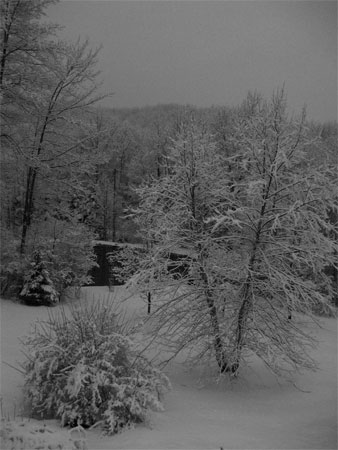
March 31 snow

I awoke this morning to about an inch of snow on everything. In the dark, when I’m walking, it’s a study in black & white. Aesthetically quite beautiful – every little branch, weed, and rock is covered in snow. It’s relatively warm, so the snow is wet & heavy, but not so heavy that I’m worried about it doing lots of tree damage. And it’s warm enough that my walk is reasonably pleasant.

Still, it is March 31. Although I don’t have any photographic evidence that March 1 was lion-like in its weather, I’m sure it was. I’ve lived here in western New York all my life, and I know it’s not unusual for us to have snowfall, and even snow storms in March, and April. (In fact, my mother documented flakes falling one frigid Memorial Day weekend about 40 years ago, but that’s another story.) What IS unusual is the continued cold temperatures so the snow never leaves.

The good news is that I think this is a good year for maple syrup producers. The snow and really cold temperatures we had last week would put a stop on bud production (budding maples signal the end of syruping), and the brilliant sunshine warmed things up just enough to make the sap run, providing what I think would have been like a second “first run.” (First run syrup is always the lightest in color, the most subtle in flavor, and brings the highest price.)

I also think that the majority of my garden plants will be just fine. They’re much more likely to come through a loooooooong stretch of freezing temps if they’re consistently protected by a thick blanket of snow. It’s much more difficult for them when they freeze & thaw, freeze & thaw.

more March snow
So I’m simply going to enjoy the Currier & Ives look this morning, and not lament another snowfall.

Your turn: what’s positive about the weather where you are?

How Lucky Am I?

My wonderful son spent the weekend with me. He’s kind, easy-going, fun, hard working, and quite talented. He designed and built that wonderful cone rack a few weeks ago.

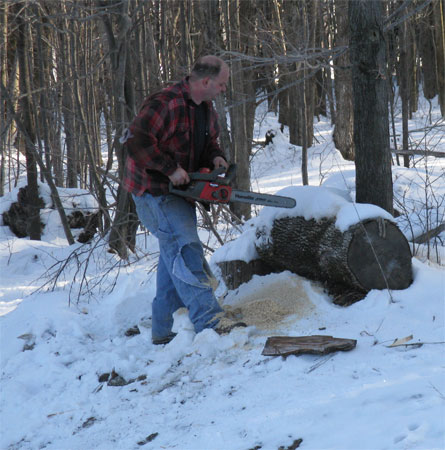
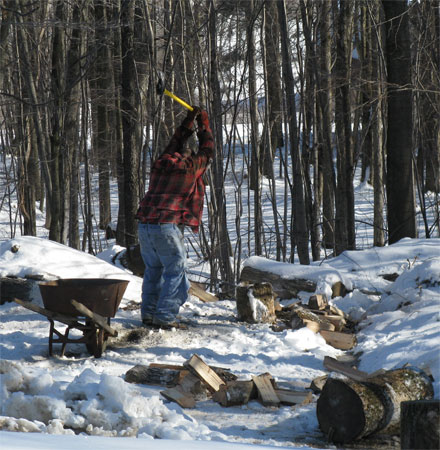
This weekend I was almost out of firewood and we were in the middle of a late March cold snap. I was completely willing to turn on the oil furnace for the remainder of the season. Michael decided that he wasn’t happy with that, so instead he went outside and cut,
sawing wood

split,
splitting wood

and carried some firewood into the house.
carrying wood

Enough to both get me through the remaining frigid temps and have a bit left in case we have a storm that knocks out the electricity.

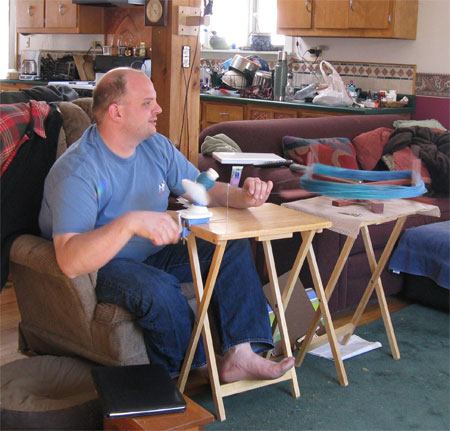
Later in the day, while I was weaving, he offered to wind my hand painted skeins of yarn into balls for me.
winding yarn
I would have been happy if he’d wound the next color I was going to use – 8 skeins. Michael didn’t stop till he’d wound 27 skeins! So I’m a’weaving now!

Your turn: has someone gone above & beyond for you lately?

Summer & Winter Handwoven Napkins

I’m FINALLY able to share the results of my handwoven napkins for the International Napkin Exchange.

I wove 10 napkins. All have the same white warp, and all have the same summer & winter block design. Summer & winter means that’s what’s dark on one side is light on the other. The term came from many years ago when coverlets were woven in such a way that people used the side that was mostly light showing during warmer weather, and mostly dark showing during colder weather. My goal was to have similar amounts of light and dark showing on both sides.

Here’s one napkin, woven with a burgundy weft, so you can see the whole design. It was important to me that for this project – a napkin that should be square – that my design repeat both horizontally and vertically. The planning was tedious, but I’m glad I did it. I think I achieved my goal of a somewhat architectural design fairly well for my first attempt, too.
burgundy handwoven napkin

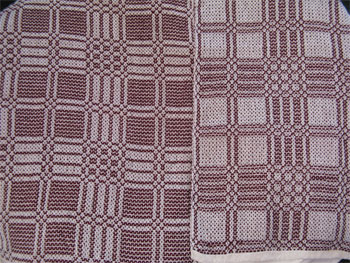
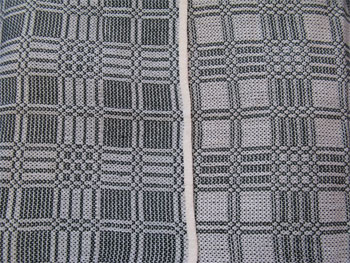
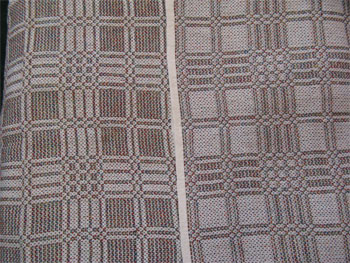
And here are the two burgundies, one up and one down so you can see the difference.
2 burgundy napkins

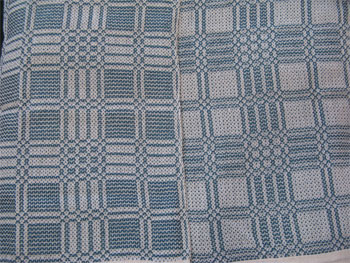
I also made two in a deep teal,
2 teal handwoven napkins

2 in dark forest green,
2 forest handwoven napkins

and 2 in an interesting multicolor variegated yarn.
2 variegated handwoven napkins

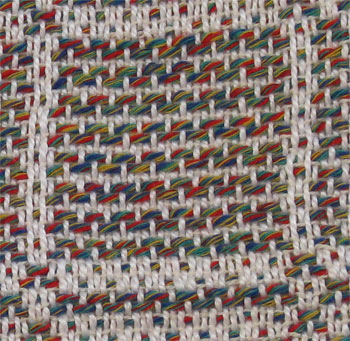
Here’s that variegation up close.
variegated handwoven napkin

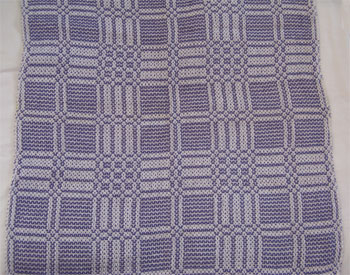
I also made 1 in lavender,
lavender handwoven napkin

and 1 in an odd chartreuse boucle.
chartreuse handwoven napkin

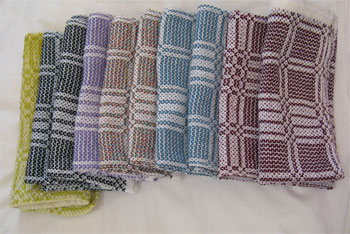
Here’s the 10 of them together.
10 handwoven napkins

You can see immediately that the chartreuse yarn was larger, and therefore resulted in a larger napkin. That’s ok. What’s far less than ideal is that the chartreuse color has been bleeding out like mad. I’ve now washed the napkin 3 times. After the first one, the entire thing was green; you couldn’t really see the contrast with the white. So I washed it again and the white showed better, but the green was quite blotchy, as you can see in the picture. I’ve now washed it a third time, and am waiting for it to dry to see how it turns out.

That green one aside, I’m quite happy with my work. I’m pleased with the way it turned out, and happy that they will be traveling to 10 different weavers around the world. I’ve never done any block designs, and was pleasantly surprised to learn that I can turn out pretty complex patterns like this on my 4-harness counterbalance loom.

After weaving and wet finishing, I had to hand hem both sides of each napkin. They still all have to be pressed before I can send them off.

Also, I’m still working on the reporting that has to accompany each napkin. That way, every person who gets one will have all the detail they need to know exactly how it was made, including both threading and treadling details, shrinkage rates, yarn samples, and more. Although I find this part tedious, I know when I get my ten napkins in return, I’ll be really glad for that much information.

Your turn: have you expanded your repertoire recently?