Days and weeks seem to fly by. I know it’s not just me, but I find it troubling nonetheless. And yes, the older I get the quicker the clock and the calendar seem to tick. It takes longer to accomplish things than it used to. I have less patience or motivation for doing things that annoy me, that I simply don’t like to do, or that I find rather useless. I want to spend my time doing things that bring me joy. So I do things like housekeeping even less than before. Don’t like my dust bunnies? Don’t look at them.
In keeping with that, I realized that although it’s not a huge time demand, I no longer have the interest and desire to spend time every month volunteering at the Weaving & Fiber Arts Center. I know how things work, and know it will take time for someone else to step up to the plate. So last week I let the other members of the Management Team know that I will step down in the foreseeable future. If I can find a volunteer by the end of this fiscal year (May 31), great. If not, I’m done by December 30, 2024 regardless. I’ll announce it at the next Weaver’s Guild meeting and we’ll see who might come forward. I believe I’ve held this role since the middle of 2016, and while I know several members of the Team have been there far longer, I just need to step aside.
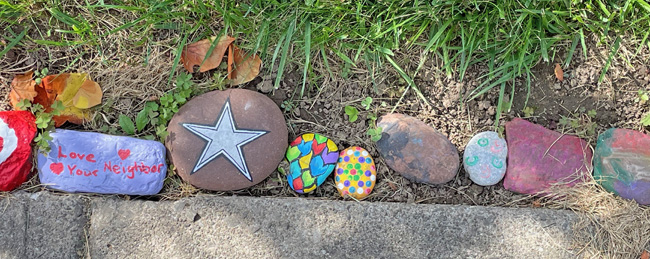
Changing to something fun, here’s a Ssssid update. Many additions, which continues to make me really happy.
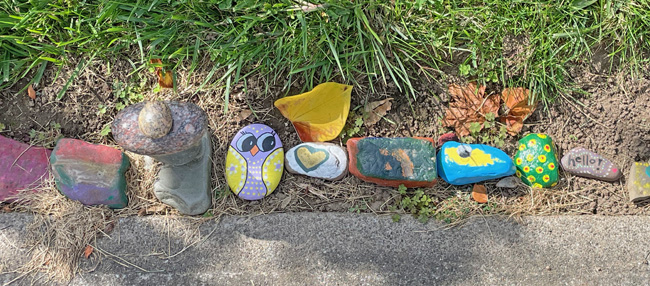
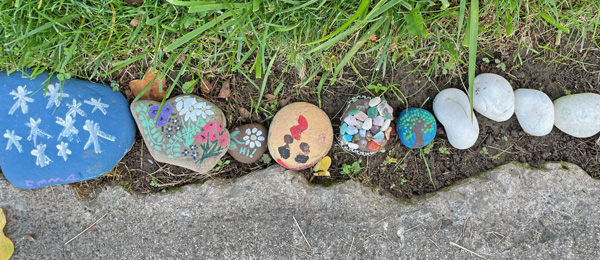
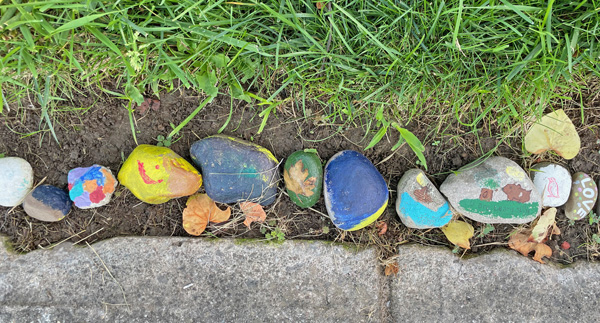
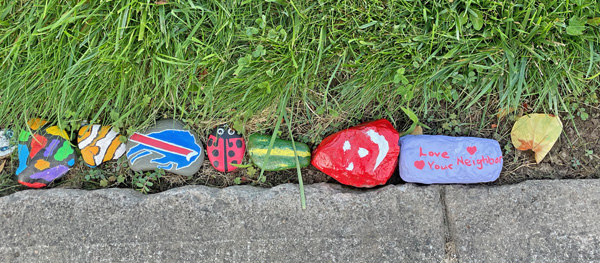
I’ve learned a few things since the last post. There’s a woman who has now added several rocks. 🙂 She and her hubby did #26 – the rock with the mini gemstones on tops. She has now started painting a rock each weekend. 🙂 She did the great Bills logo – #55 and the ladybug – #56. (She has now painted more of the Bills logos and placed them in various locations in the neighborhood.) Next of hers was #60 – the Cowboys logo; she likes both teams. Rocks #61 & 62 came on the same day. Nice and colorful. The next four – #63-66 – also showed up together. I’m assuming they came from the same household. I hope their colors hold up.
Rock #67 came from one of my grandsons. It’s a little rock statue that he picked up somewhere. Can you guess where #68, the owl, came from? Same woman as the team logos and the ladybug. Over the next few days we got that sweet little heart, #69 and the semi-smiley face, #70. I really like rocks that clearly came from little kids who wanted to add their own artwork. I happened to see the woman as she placed #71, the blue & yellow rock. She was startled and not necessarily happy that I saw her put it down, so we chatted a bit so I could put her at ease. She told me where she lived, and I told her I thought that the woman she lived with had painted #23 & 24, but she assured me that was not the case, that a neighbor of theirs had done it but she wasn’t sure which one. A few days later #72 arrived in all its green and flower-y glory. So bright and happy. Then #73 offered a little hello.
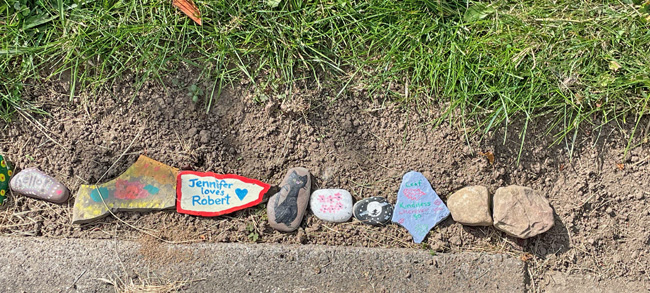
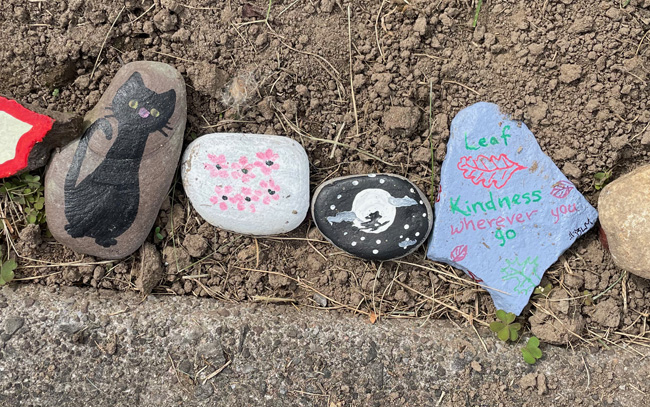
A few more days passed before we got the sort of impressionistic colors of #74. Then I walked out one morning to find that Jennifer Loves Robert – #75. Another sweet sentiment! When I saw the black cat of #76 I guessed that the woman who’d done the several other rocks added this one, but I was wrong. Don’t know where it came from. Nor the flowers of #77 or the tiny witchy #78.
I had to take a closeup of that last section so you could see all the detail of #78. That rock is roughly the size of a quarter, so someone took a LOT of time painting with a VERY fine brush. Or more probably paint pens. I admit that I added #79 – one of my kindness rocks. I’ve learned through experience that sharpie doesn’t hold up well to sunshine, but probably should have chosen darker colors of the paint pens. Oh well. And those 2 unpainted rocks – #80 & 81? Clearly they were placed there on purpose. As a message that the painting should end? I choose not to think that. By someone leaving them for someone else to paint? Maybe. By someone who wanted to participate but doesn’t have paint? Perhaps.
Moving on. Despite the fact that I’ve woven a lot in the last 15 years, there remain many things to learn. I had a hands-on example recently.
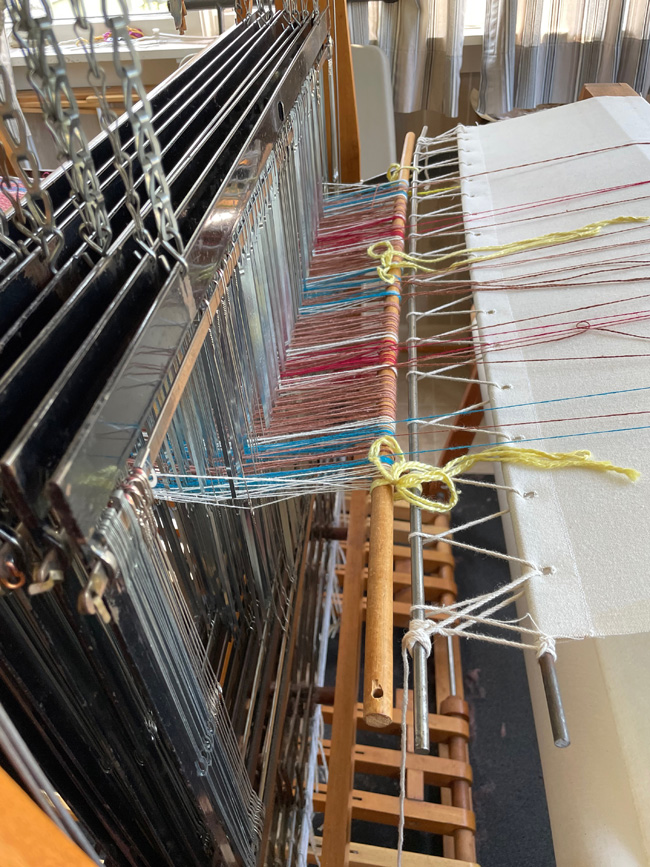
I purchased two pre-wound warps within the last year, I think at a Guild event. In my never-ending quest to use up the stash, I figured now was the time to use them. The warps were clearly labeled with number of ends and approximate length. I knew that neither had enough threads to make a warp wide enough for a project and they didn’t work together, so I set about planning what I could combine with the longer one to make an attractive towel warp. I measured out my needed warp ends, in 3 separate bouts: red, blue, and white, expecting to be able to weave 5 towels from the warp.
Then I started messing up.
I see people online mixing warps all the time. Overwhelmingly (always??) they are warping front to back. While that is something I can do, I’ve not done it enough to be comfortable with the process, so I opted for my typical back to front warping. Mistake #1.
At that point I should have used two sets of lease sticks, one for the purchased warp, one for my three bouts to be added. Even that wouldn’t have solved my entire problem, but it would have made it better. But I didn’t do that. Mistake #2.
Instead I painstakingly placed the planned number of each color of threads in the one set of lease sticks I was using. I was careful and didn’t lose the cross on any of the bouts. Yay! I spread the warp in my raddle and proceeded to wind on.
YIKES! I quickly had quite a mess. Threads from 4 different bouts crossing in front of the lease sticks ALL OVER THE PLACE. They were sticky and unhappy, with lots of tangles happening. And just to add to the challenge, I had about 30 extra ends in the purchased warp that weren’t being beamed at all. Needless to say, things were a mess. (I didn’t take any photos.) My patience was wearing quite thin and decided to make things better by cutting off those 30 extra ends and get them totally out of the way.
You can guess what happened, right? I didn’t cut the correct threads. AAARGH!!! Mistake #3.
So now I had no choice…simply beam what I could and when I got to the end, cut off all threads at approximately the same length. So that’s what I did. I didn’t really know how much was left or how many towels I’d get from the warp.
I threaded with a draft I used before and liked and moved forward. I had about 10″ woven when I realized that something was wrong with the threading near my right selvedge. Mistake #4.
I decided to fix it by cutting out the wrong thread and needle weaving in the replacement thread in correct places while on the loom. Ok. Proceed with the weaving.
Nope, not ok. Mistake #5.
What I fixed was only part of the problem. The mistake would not affect the usefulness of the towel, so I decided to weave this first towel, then do the bigger fix before I started the second. That all worked. Although as you might guess, I am most definitely not enthused with this warp. Nothing about it has made me happy.
I wove three more towels and was playing warp chicken at the end of towel #4.
Finally got all 4 off the loom, did my bit of machine stitching by the seams, and into the washer & dryer they went. When I was doing the hard press after that, I saw that I had a mis-treadling on one of the other towels. DRAT!! Mistake #6.
So now I know that the first towel, with the partially-corrected threading error, and the third towel, with the treadling error, won’t be accepted into the Guild show in November. Sigh.
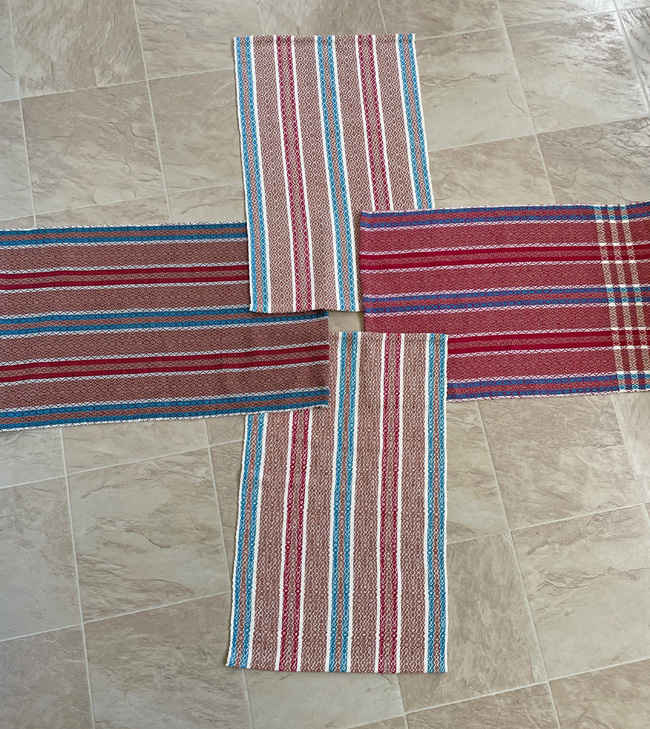
I’ve been invited to a birthday party for a line dance woman who I think is turning 80. She will get one of those towels as a gift. I’m not sure yet what I’ll do with the other. Here are the 4 towels…the one at 9:00 isn’t yet hemmed in the photo but showed up for the picture anyway.
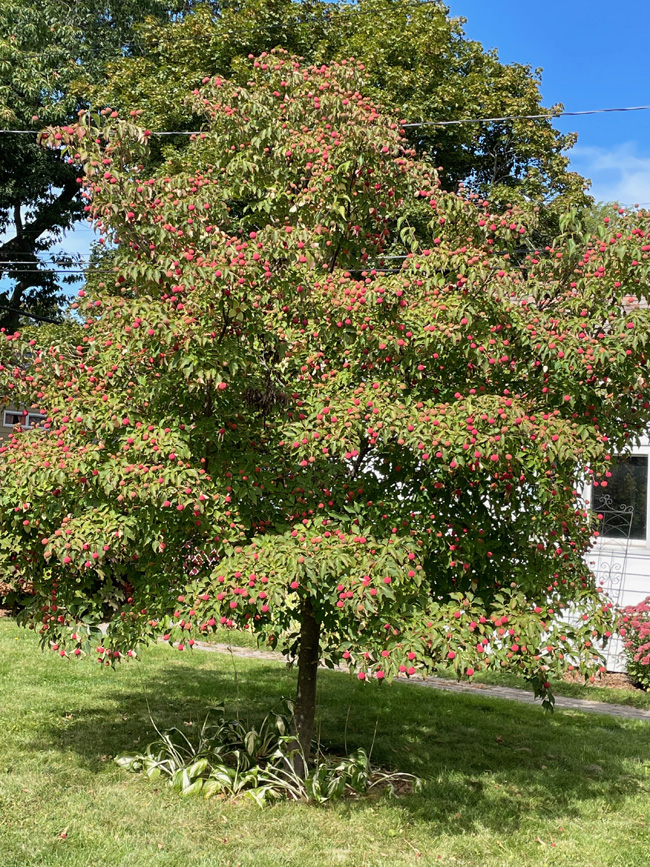
So let’s move back to more pleasant topics. How about a bunch of nature shots. Here’s my Japanese dogwood in full fruit. Wow!
I knew that the squirrels love those fruits. I’d forgotten that someone else does, too. Jack. When they fall on the ground he just loves to gobble them up. Like the only time of year when he’ll ask to go out in the backyard when I’m not there. I don’t let him stay out there too long and they don’t seem to wreak havoc with his digestion, so I let him enjoy them. The season doesn’t last long.
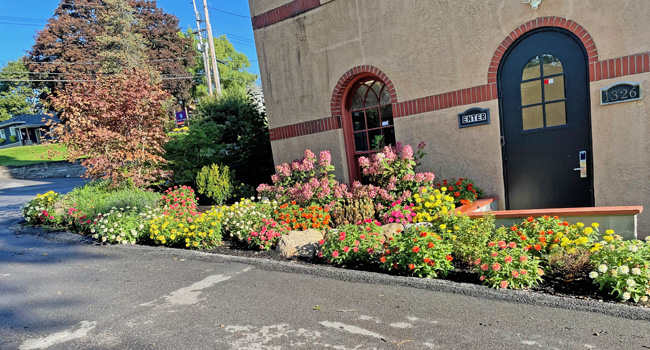
This is one of the places I sometimes walk by. Those zinnias certainly put on a show this year.
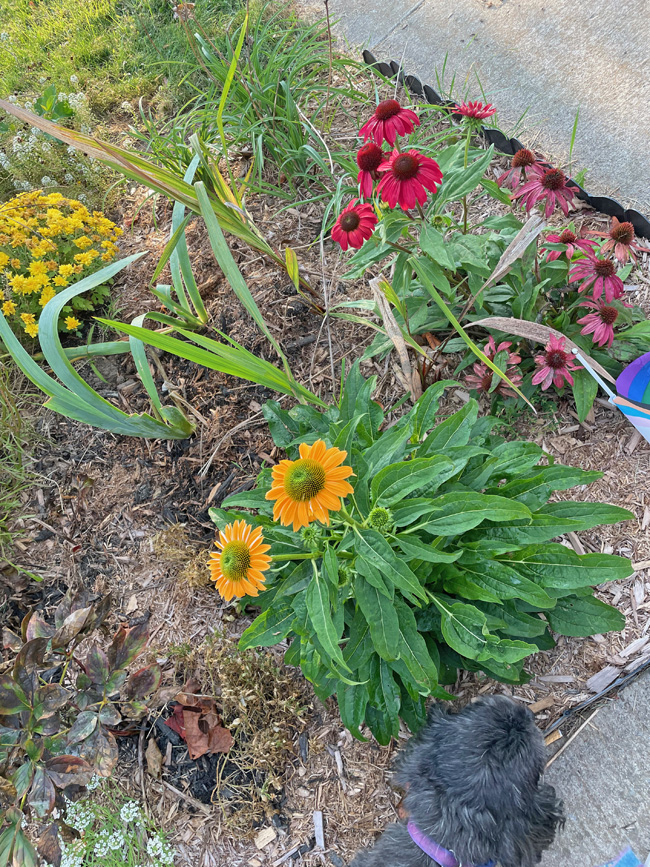
I bought these two hybrid coneflowers this year and popped them in my front garden. They certainly seem hardy enough and I love the colors. Winners for sure.
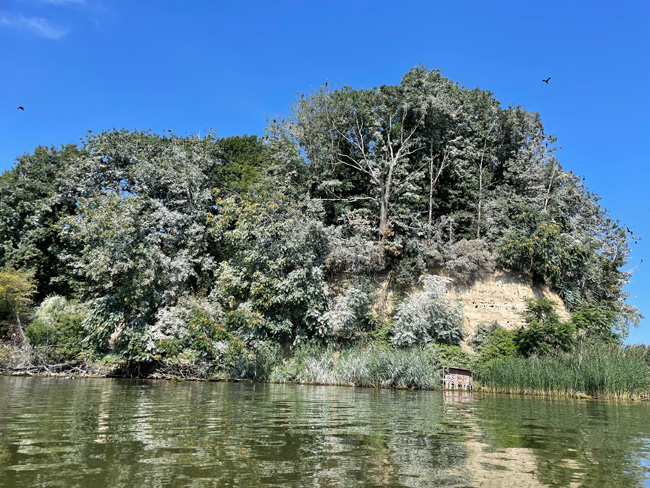
Now for a not-so-nice nature shot. One morning in early September I put in my kayak at a little local park, planning to paddle down the creek. But the bay was so calm I decided to take advantage of this unusual occurrence and paddle on the bay instead. I hadn’t been in the bay all summer. I passed this rocky outcropping and was quite confused. Why were the trees all dusty/dirty? Had sand from that hillside blown up on them during a storm? Had they somehow gotten frosted? I pondered this as I paddled past it. Then I realized what it was and had to take a photo on my way back to document it.
The bay, along with the much of Lake Ontario and some of the Finger Lakes, have been totally overrun with cormorants. The birds like the trees – both the living and the standing dead ones – on this hillside. The leaves are completely covered with cormorant poop. My son tells me that these birds were once in a lot of trouble, one of the species whose eggs were particularly harmed by our use of DDT. Since that poison was outlawed, they have had a remarkable comeback. According to the NYS DEC, the number of breeding pairs went from 2,100 in 1985 to more than 10,500 in 2003 and have continued to rise. And since they have 6-8 eggs per hatch, their numbers just keep rising. So cormorants are now displacing many other water fowl, including herons and terns. And they live in colonies that can contain thousands of birds. Yuck.
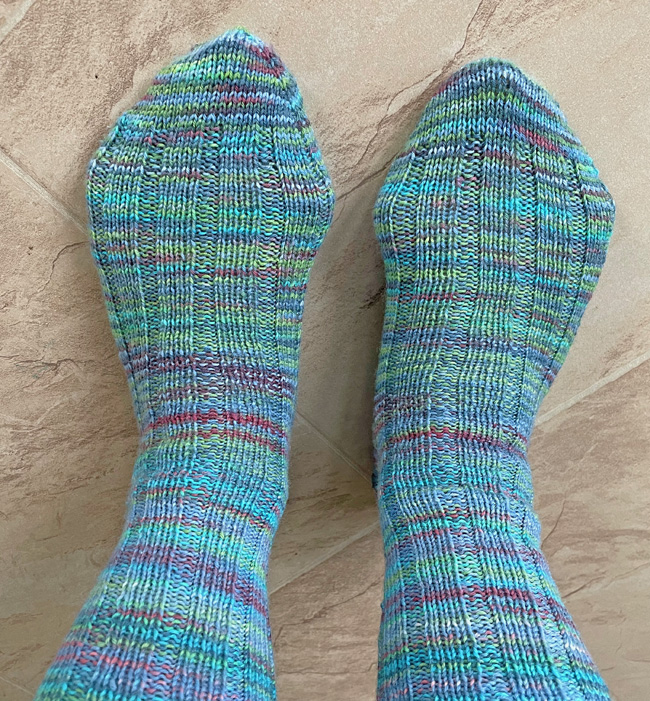
Back to something fiber-y. Way back in February I dyed a sock blank. I didn’t keep a good count; this may have been the 4th sock blank I dyed. But this time I painted it with my colors on the diagonal. I was curious to see how it would knit up. I FINALLY finished those socks last week.
I have to say I had no idea what to expect, but I really do like these socks. Because of the many colors, I decided to knit in a very simple ribbed pattern for the entire sock (except the soles, of course).
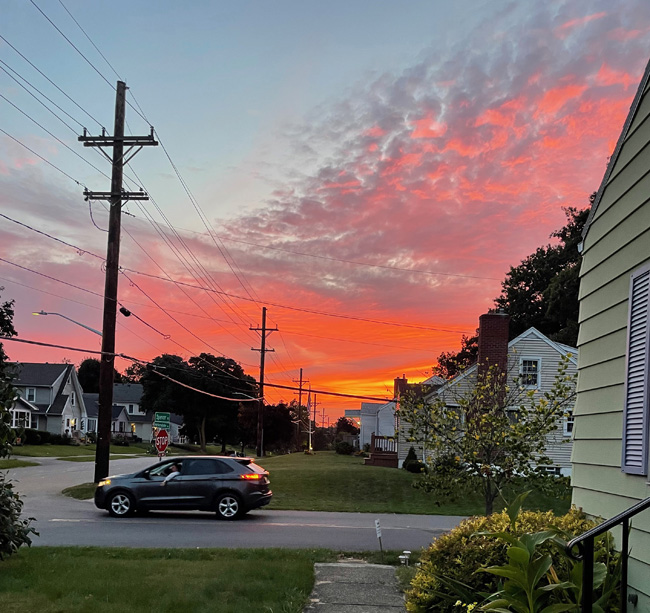
And now for the close…here’s a shot of a recent sunset from my house. Totally gorgeous!
I THOUGHT I’d get another post done in August, but I guess not. A day late and a dollar short – could describe much of my life.
Anyway, you won’t see any weaving in this post. I’ve done some but don’t have pix yet, and if I waited for that, who knows when I’d get to the laptop to post? So what have I been doing that’s fun?
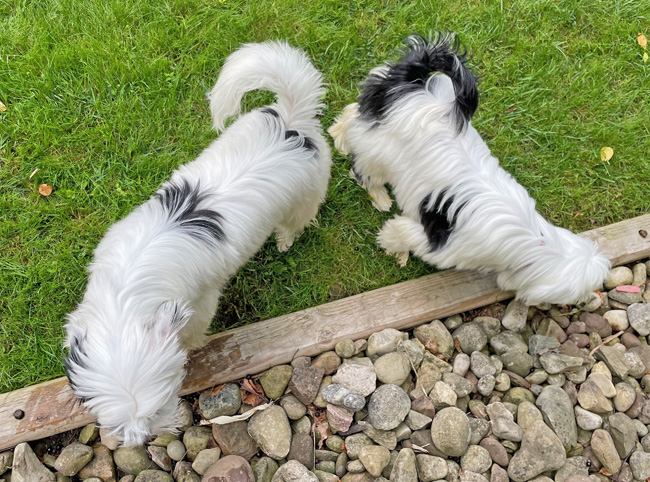
Well, my daughter lost her 13-year old Tibetan Terrier some months ago and was waiting to get another TT. Then suddenly, instead of a 2-month old, she got TWO 5-month old sisters. They had out-of-town overnight plans, so I’m sharing some puppy sitting with my son. I’m here from mid-day to this evening. Making tacos to enjoy with my son for dinner, then will head home with Jack while their uncle spends the night here. He has to leave in the morning for a commitment, and I’ll head back here for some hours tomorrow till the family returns.
They’re very cute and sweet. Already taller than Jack, but surely weigh a bunch less. Still definitely in puppy mode, with periods of zoomies and followed by heavy napping.
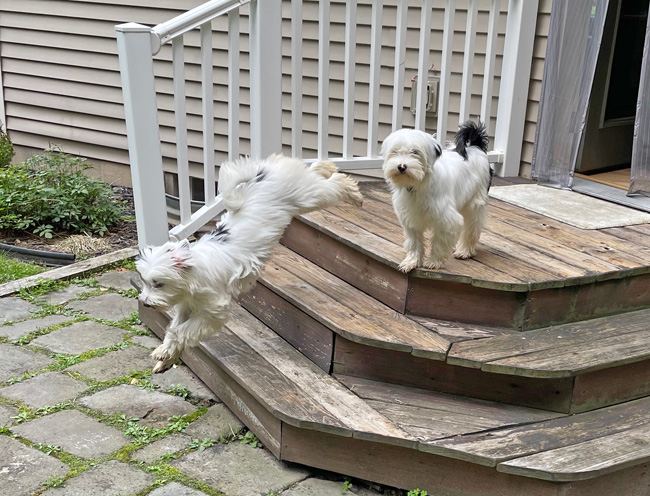
Interestingly, the smaller one (Dolly), who was the last born and a full two pounds smaller than Dee, who was born first, is most definitely bolder and braver. She’s the one leaping from the steps here. Maybe she had to be more assertive to get the attention and food she needed?
They definitely understood Jack. They were interested and did a lot of sniffing and checking him out. When he’d had enough he gave them a bit of a growl, and when they didn’t back off he gave a sharp, loud bark. They got it and have given him an appropriate amount of older dog respect.
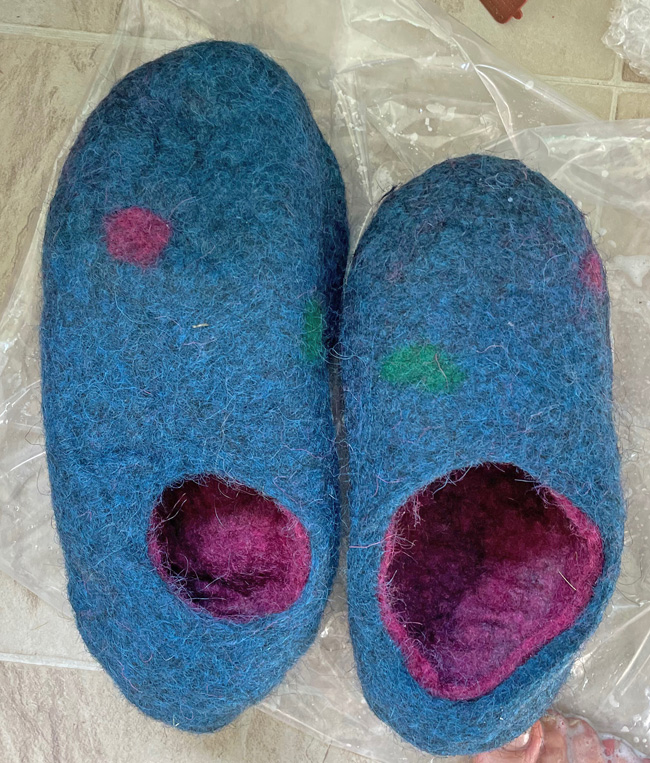
In other news, I took a class at the Weaving & Fiber Arts Center on making felted wool slippers. It was a full day of lots of work, and I left with very wet blobs of wool that still needed quite a bit of work to turn them into slippers. Here’s a shot after I’d spent another 90 minutes or so at home – on the right slipper. You can see the big difference between the two.
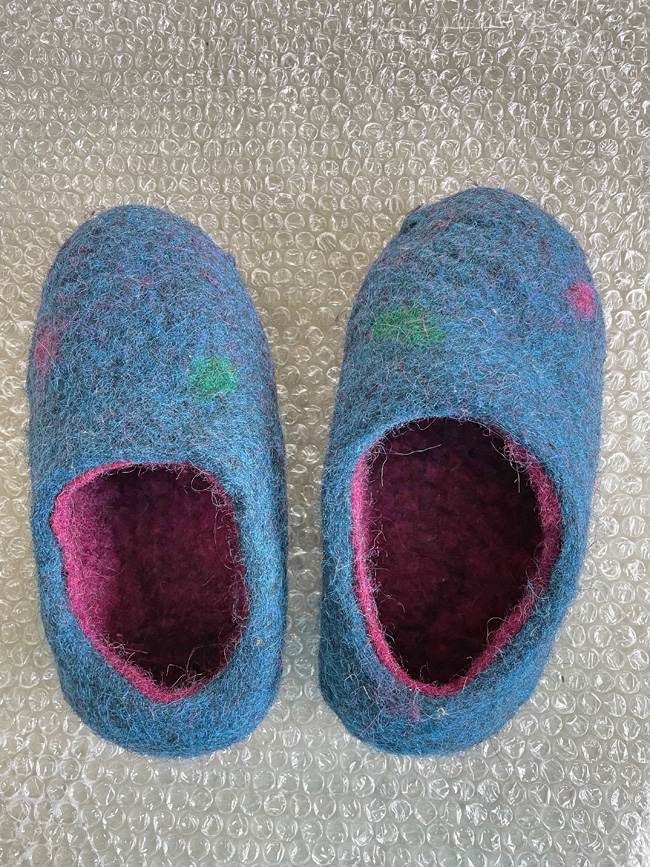
After spending a similar amount of time on the left slipper, they’re once again the same size.
I’m guessing they’re about 80% done here. I have to re-wet them and do a bit more felting to both to make them just a bit smaller. Then after they’re fully dry – again – I can do my needle felting decorations. But I haven’t had another uninterrupted hour or two to spend on them in the past week. They’re not going anywhere, and as long as I let them sit in the open, they’ll be fine when I re-wet them.
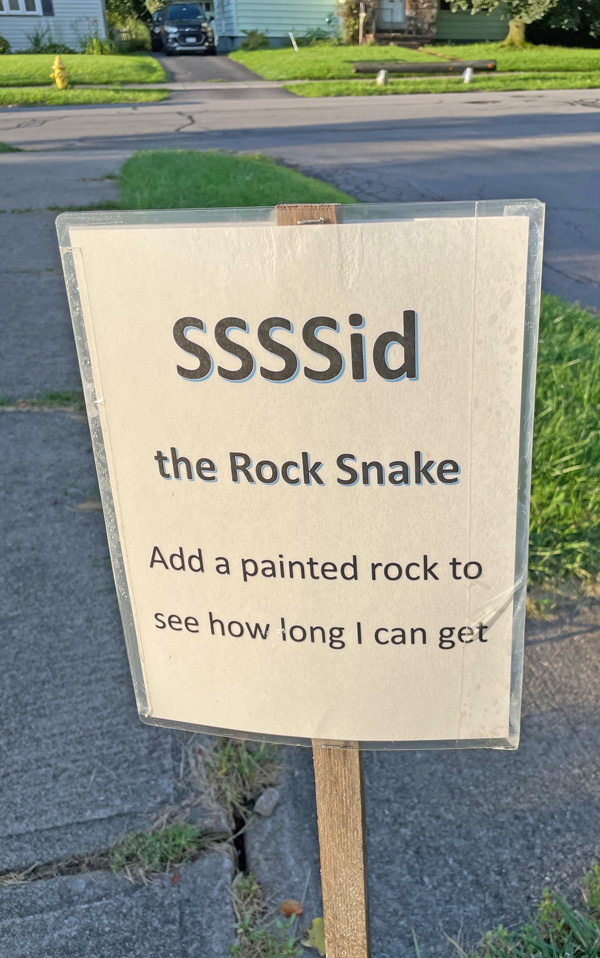
This next bit didn’t take huge amounts of my time, but it brings me great joy. Back in June (I think) my son sent me a photo of something he’d seen on Facebook. I loved the concept and decided I had to do it at my house. Life intervened, and I didn’t get mine started until around the first of August. The concept? A rock snake. Here’s my sign.
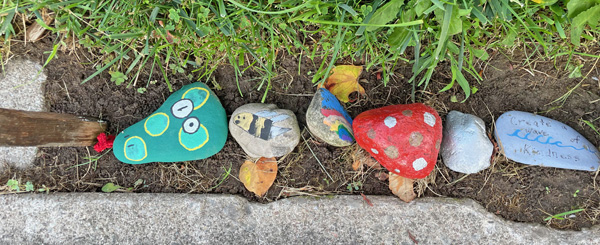
One grandson painted his gorgeous head, and between the two of them they contributed the next 2 rocks. I painted rocks 4 & 5.
Rock 6 was one of my kindness rocks that someone moved from in front of their house to here. Then more rocks started arriving. It’s unfortunate that some of the paint/markers used really fade in the sun. Rock #8, the black cat, has Bruce’s name on it. Next to him, #9 is a pig that was just adorable before he faded to almost invisible.
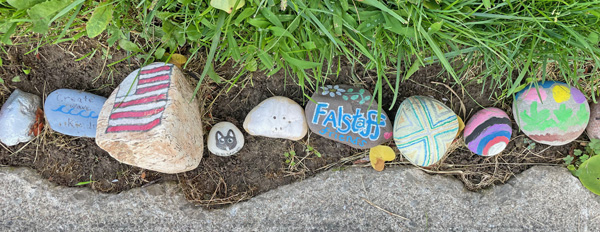
FYI Falstaff is the next street over, and I love that Falstaff friends left me rock #10. I did #11 with sharpies, which clearly don’t last anywhere near as well as paint. #12 & #13 were very nice rocks that kids painted.
Several of them from #14 to #22 were done by kids. YAY! Emma was obviously proud of hers since she signed it.
I think I know who painted the sweet flowers on #23 & #24, but I haven’t bumped into her lately to ask her. #25 was another child, and #26, with all the little stones glued to the top and a found bracelet around it was a couple I see and talk to walking regularly. No clue where the nice tree #27 came from. I was walking Jack one evening, going up one side of the street. Coming down the other side was a little parade, 7 or 8 people, apparently at least 3 generations of a family. I said hello, and they told me they were headed to Sssid with their rocks. How great is that?! They placed the next 4 rocks, #28-#31, which must have been done with sharpie like my #11, because they faded quickly. One was a smiling face, one was a whale or shark, and I honestly don’t remember what the other two were, although they were clearly identifiable when they were placed.
#32-35 were more kids’ artistry. #36 was a decoupage leaf, so that was cool. #37-40 were done by my grands and my daughter.
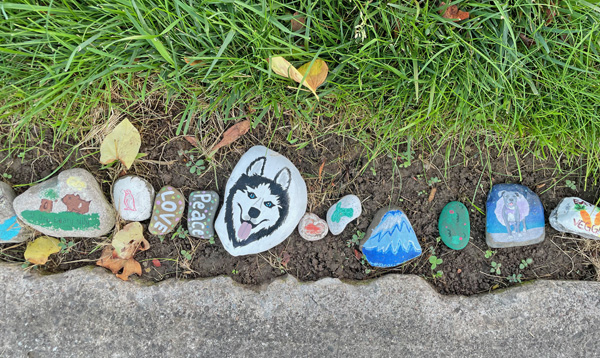
I don’t know who gave me #41 & 42 – Love & Peace, but I love them. Then there’s #43 – that husky. O.M.G! That is quite a piece of artistry. I see several people walking huskies in my neighborhood, so first I asked the woman I thought was most likely. Nope. Then I asked the man who I thought was least likely and was surprised when he said yes. There’s a bit of a story with that one. The mother of a friend of his apparently paints beautiful rocks and just puts them around in various places in her neighborhood. He asked his friend if mom would paint one of his dogs for him, for a fee. No, mom won’t take orders or consignments. But then one day this beautiful rock husky showed up on his porch. And looks EXACTLY like one of his dogs. He said he held onto it for a few days before he brought it over; he liked it so much he hated to let it go. But then he realized he’d asked for it so he could gift it to Sssid, so that’s what he did. He sees it every day when he walks his dogs.
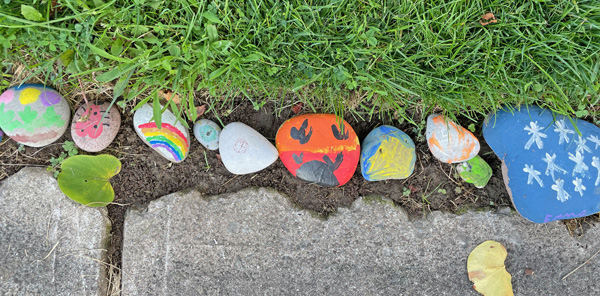
I don’t know anything about #44-47, but it appears they were a combination of kids and adults. They’re small so don’t show up well in the photo. Several days later #48 showed up. I’m hoping you can see it well enough in the photo.
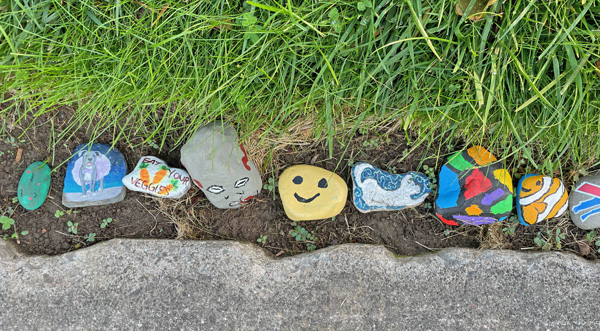
It’s a pit bull wearing a pink tutu and a bow tie! SWEET! And I don’t have a clue who, and don’t see any gray pit bulls being walked in the neighborhood so it’s a real secret. Next to that is #49 – Eat your veggies. 🙂 Then comes a sort of scary bloody skeleton-type dude at #50. I can’t help but smile that someone put the next rock down – #51, a smiley face – right next to scary dude. #52 is another very cute dog, this one at play, that probably doesn’t show up well in the photo, followed by #53 & 54 – a stained glass window and a clown fish both placed the same day.
#55 & 56 also showed up on the same day – a very good rendition of the Buffalo Bills logo and a nice ladybug. #57 & 58 also came together; I think the green stripe is just a snake part that goes with Sssid’s head, and the brightness and happiness of that red smiley face is adorable. Last to date is #59 – Love your neighbor.
All of this happened in just under a month. Most days saw no new rocks or just one. This concept has generated more interest and more conversation than I could ever have anticipated. It is all WONDERFUL!!! Do feel free to start something like this in YOUR neighborhood – although now you may want to wait until spring if you’re in a northern climate.
I just made the sign, had Staples print & laminate it, and the community did almost all the rest. Oh yeah, I had to use my edger to create space between the sidewalk and the grass, and I have to manually remove the leaves that fall and do a bit of weeding to maintain it, but it is SO worth the time invested!
Time to get those 2 puppies back outside to go potty and get treats for same. Hopefully I’ll be back soon with some weaving. And some finished slippers.
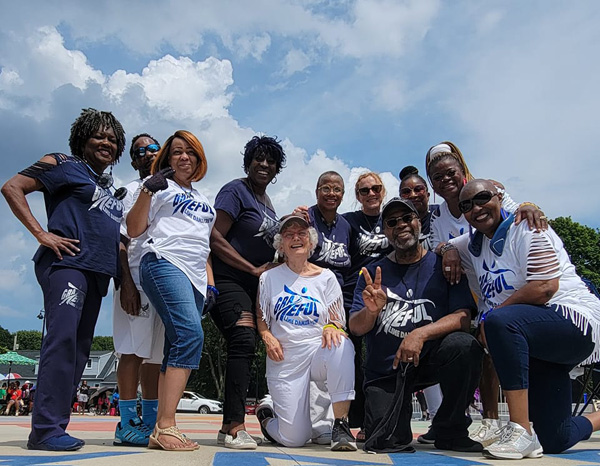
You’ve heard me talk about my wonderful urban soul line dance group, the Grateful Line Danze Krew. I can honestly say I have never been involved in anything like this group before. In my 70+ years, nothing has made me feel so welcome, so appreciated, so truly grateful to be a part of it. I’d like to think that a single Black woman would feel as welcome in a group of white women as I do in this group of Black women, but I know in my heart that is just not true. These women are something else. Like any organization, large or small, so much starts with the person at the top, and for us, it’s LadyP. She exudes warmth and joy. LadyP is the woman kneeling at the far right in the photo below.
Our 2nd year anniversary celebration is this weekend, and I’ve been involved in getting everything ready for a wonderful and FUN time. This year we’re hosting a Glow Party. We have sold 146 tickets to this event, with groups from Buffalo and Syracuse sending large contingents as well as lots of local people.
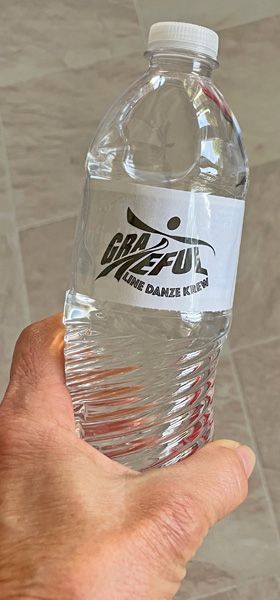
As the name implies, we’ll have black lights and lots of glowing decorations. Everyone will get a bag of favors on entry. Shhhhh…..don’t tell anyone, but here are 2 of the items in that bag. (I suggested these.)
I crammed myself into my little closet to take that one. 🙂
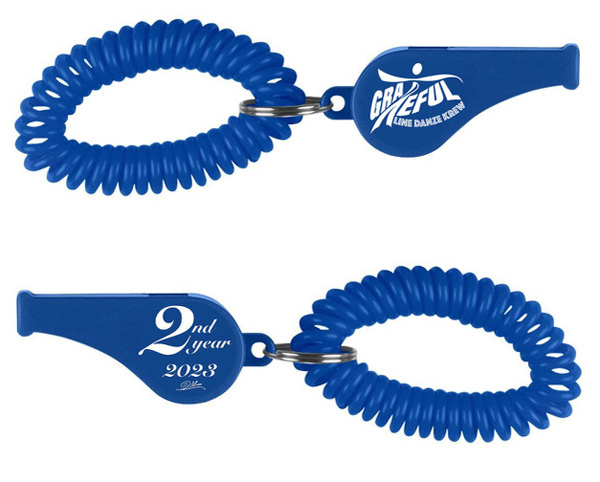
Then, because our line dance group loves to make noise when we dance, the favors also include a branded whistle.
The whistles were my idea, so although I didn’t create the graphics, I was the one who worked with the online company to get a sample, then get our artwork correct and get them shipped on time.
There are also 2 starlight mints in the bag. Here’s a tip from me, learned too late. Don’t buy the mints at the local dollar store. While they taste fine, they are very hard to open and I know that people will find that frustrating on Saturday. Unfortunately I didn’t know that until I had already purchased 5 bags of them and put them in the bags.
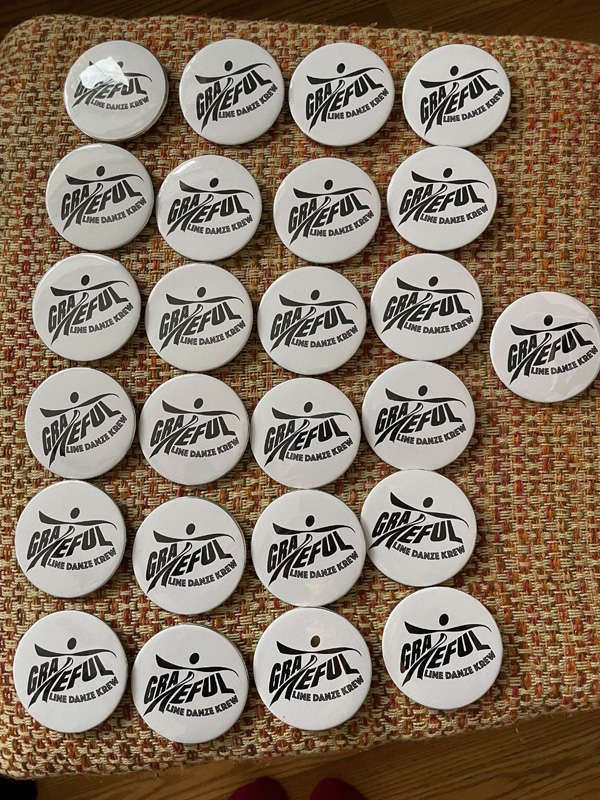
Because there will be so many people, we want everyone to be able to identify who our group is, so if they have any questions or concerns during the event they can easily find one of us to ask. Someone (not me this time) suggested that we make buttons/pins. One of the group thought she had a button maker, but it turned out she’d given it away. So I reached out to a friend of my daughter’s who used to make buttons as a side gig, but she’s a busy woman and it took several days for her to respond. In the meantime I learned that one of the local libraries has a whole button making kit available for borrowing, but unfortunately it was already checked out and not due back in time. I was getting desperate so sent out a group email to my weaving guild and one of the members actually had one she’d loan me. She lives almost an hour away, but we were able to coordinate times for both pickup and return when she would be much closer. But still…time to find one, time to drive to meet her, and way too much time spent at the computer making the logo the correct size and shape to print several of them on a sheet, in a circle that I could very carefully cut around, and then turn into these buttons.
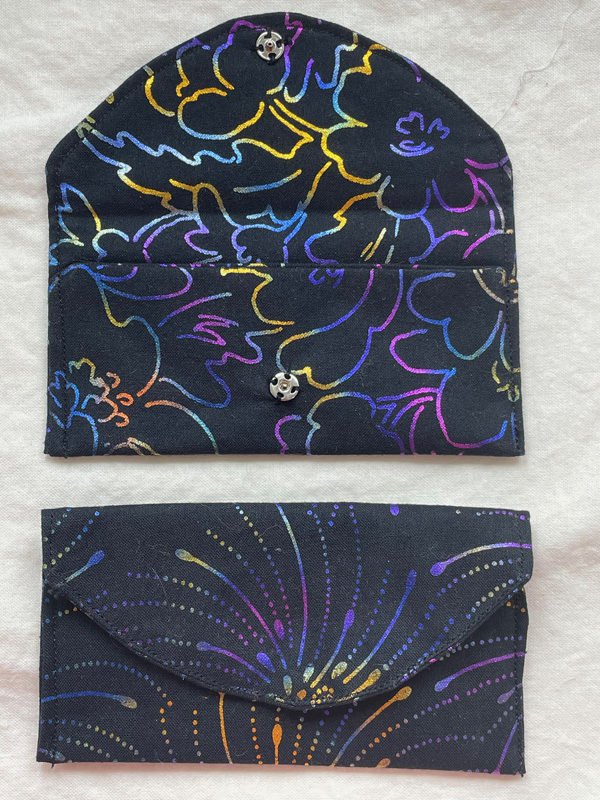
Then, while I was meeting the woman with the button machine, I stopped at a local seafood eatery to pick up gift cards for LadyP and Cleo, her teaching sidekick. (Standing far left in the photo at the top of the page.) One of the other members of our core group suggested I make little pouches to hold the gift cards. I went through my fabric stash and came up with two that I knew would work great. From my sister’s place when I cleaned it out after she died back in January. It took longer to sew on those snaps than to make the little pouches themselves. 😉
Then, one of the group said she’d buy bottled water and make labels for them, also handed out at the event.. She did this last year as well. Last year we had about 85 people come, so she’d planned on bottles for 100. When we sold almost 150 I told her I’d take care of the last 50. I bought the water, configured a Word document with both our logo and that 2nd year 2023 side from the whistles, printed them out, and taped them on. Only after the fact did I have an oops moment. Kim had labels printed on label paper. Mine were on plain paper. They would NOT stand up to an ice-filled cooler. So I went back over each label with clear packing tape. They will likely still have issues and Kim’s will be nicer, but I did what I could. (See how the time adds up?!)
So while I have been busy, it hasn’t included included a lot of weaving.
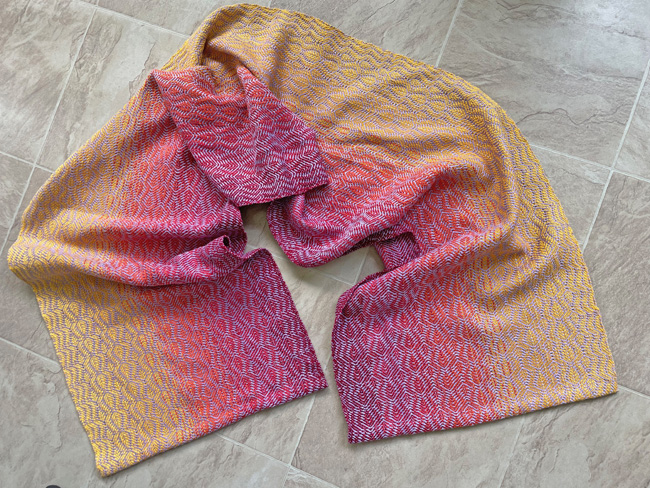
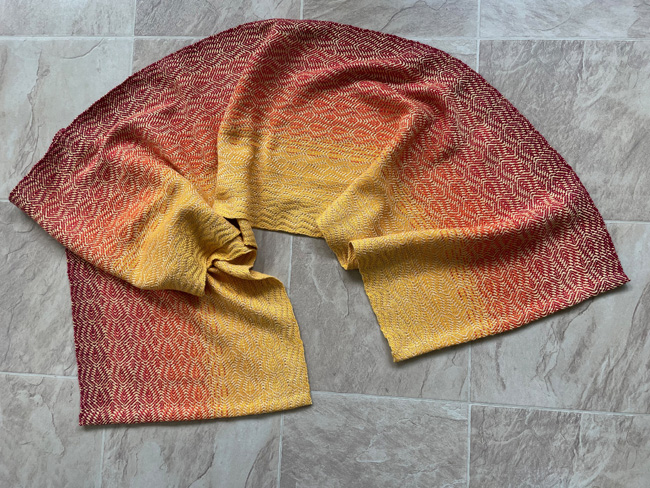
I did finally get another batch of 3 handwoven hugs completed. I’m quite pleased with them. I used a draft I’ve used several times before, because it’s easy to thread and treadle and I always like the look. This first one may be my favorite of the three, and it went first. The warp for all three is mercerized cotton, mostly 6/2, in a gradient. This one has a lavender cotton weft (8/2 and 16/2 held together), that seems to go from silver to bright lavender as it crosses the warp colors.
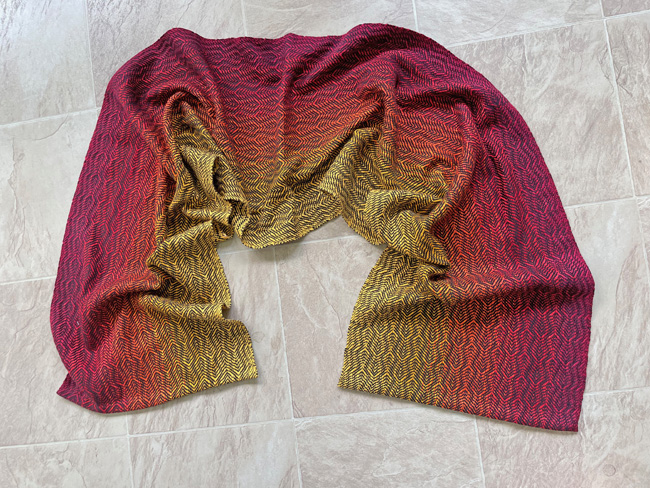
Using the rule about black intensifying colors, I used black bamboo (3 strands of 20/2 held together) for the next one. It’s fine, and got chosen second, but it’s just a tad dark for my taste.
I still have this last one, waiting for someone to claim it. Will that be you?
My hugs are given at no charge to people who are dealing with depression OR Alzheimer’s or another form of dementia. The hug can be for the person with the disease or one of their caregivers or loved ones. I do not have anyone on my wait list, and I know myself well enough to know that I’m motivated by a list, so if you’d like this hug, or to get on a wait list for whatever might come next, PLEASE let me know. All I will ask is reimbursement for postage. The golden glow of this one is so inviting. Another bamboo weft.
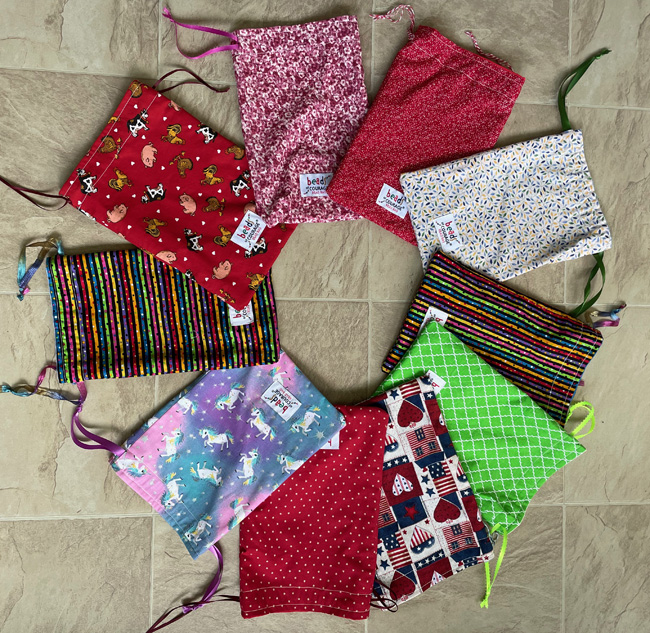
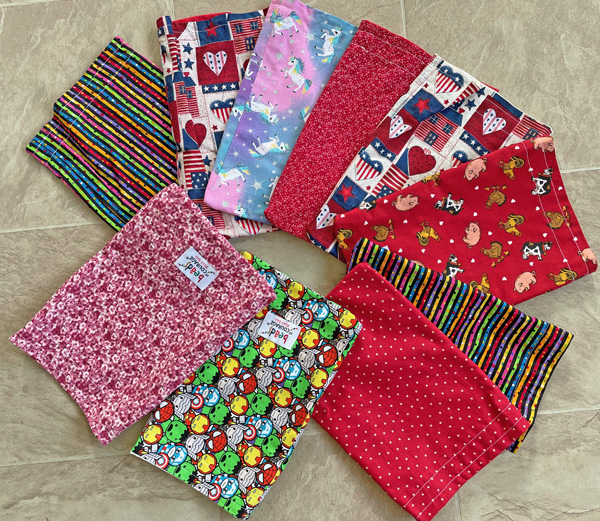
Finally, I did get bead bags sewn for August.
I have some lovely garden shots, but I’ve been sitting in front of my laptop for too long and have to get out and do my morning walk, so they’ll be in the next post.
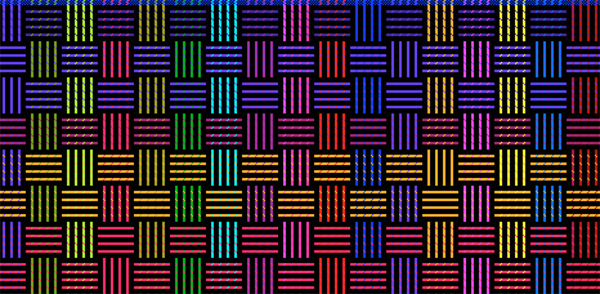
I’ve accomplished a lot in the last few weeks. First up, I wove and finished 8 Fun Stripe towels. I just posted them in my Etsy shop. I saw some towels that used a draft called Dianne’s Awesome Rainbows and posted in Blazing Shuttles Chatter Facebook group by Jean Eldridge Flores. It called to me. I made just the tiniest modification, changing to blocks of 4 instead of blocks of 3, and went to town! Every block of 4 stripes in both warp and weft is a different color, so these towels took much longer to make than is typical for me. That would usually make me not like them so much, but not these towels. I really like them. A lot. I know that my newest creation is often my favorite, so I am trying to remember that.
Look how totally SMASHING this would look with black as the primary color instead of natural! I may have to do that sometime, but probably not for kitchen towels. Maybe as shawls?
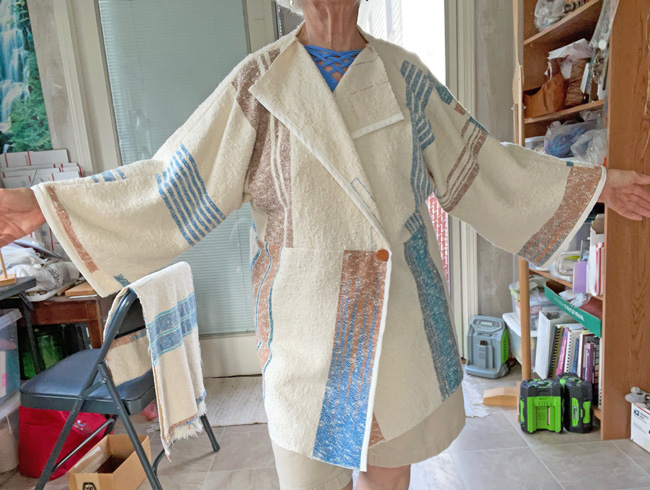
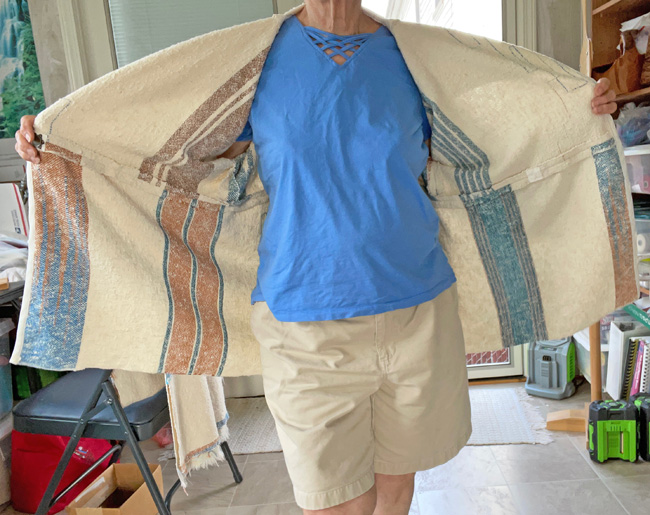
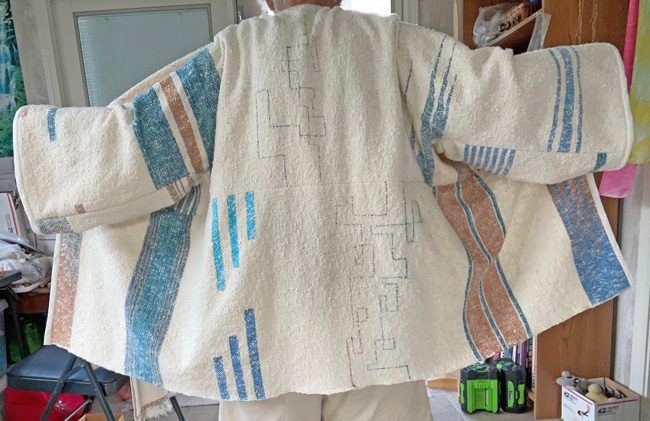
I also finished that second jacket, with some lovely, nubbly, undyed yarn. This one will be for sale…hopefully it will speak to someone.
I spent A TON of time on the finishing of my red jacket, deciding on and then making the closures, and couldn’t do that for this one that’s for sale. So I opted for a magnetic closure with a simple button for looks, one that’d I’d made from polymer clay some years ago. I’m happy with it.
I didn’t plan how the various weft options would fall, it just happened. If I think about it, I may try to do that on my next jacket. I’m kind of sorry that the stripes are mostly on the front and the individual inlays are mostly on the back. Although they take the most time, they are my favorite look and I wish there was a bit more of them on the front. You can just see tiny bits of them on the collar/flaps on the front. C’est la vie.
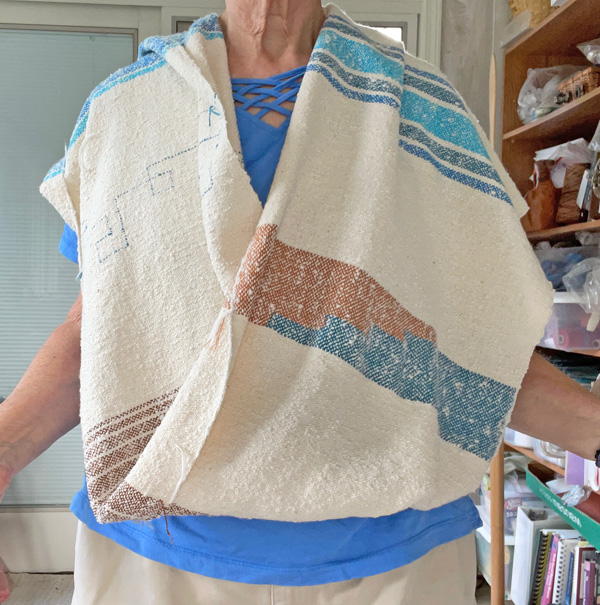
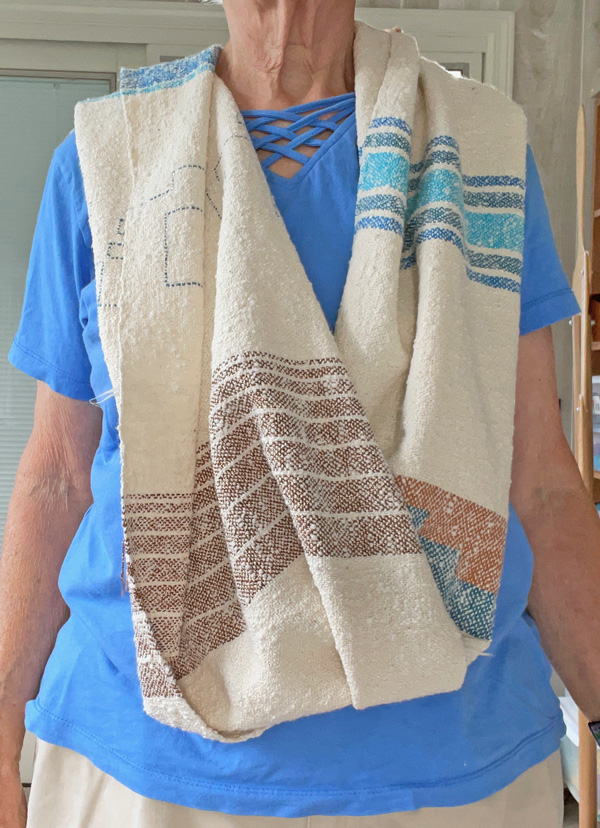
I have quite a length left over. Will I finish it for a regular shawl? A mobius? Something else? I don’t yet know, and would welcome your input.
I also sewed bead bags for July. All this batch needs is the ribbon threaded through the top casing.
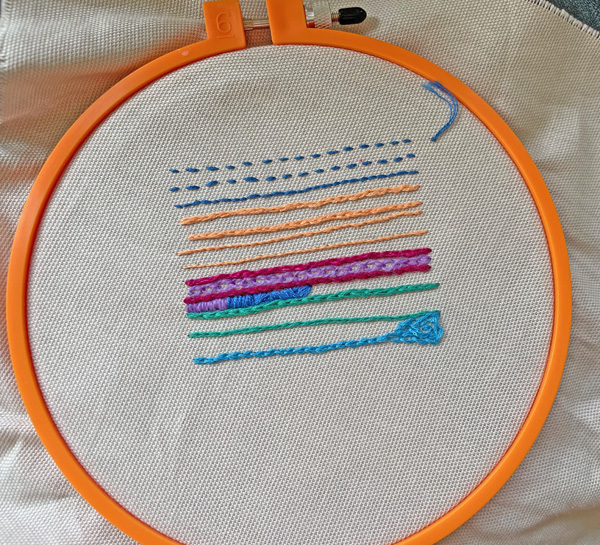
Then, because I apparently don’t have enough commitments (LOL), I decided to take a 3-session beginning embroidery class at the Weaving & Fiber Arts Center. It’s the first time it’s been offered, and I do like this teacher. I knew if she didn’t get enough students the class would be cancelled, so I registered.
I learned to embroider as a pre-teen. In the (MANY) intervening years, I’ve done stamped cross stitch, other stamped embroidery, counted cross stitch, and probably others that aren’t occurring to me at the moment. I was therefore a bit surprised to learn new things in this class. :-0 Here’s the output of the first 2 classes. I still have to do my ‘homework’ before the 3rd and last class which will take place this Friday.
As always, I’ve been line dancing with THE BEST group of people EVER, and kayaking. I even got my 7-year-old grandson out kayaking twice in a little plastic sit-on kayak. I hope we can do a few more adventures when he gets back from family vacation.
…when I let a month go by without posting. I have too much to show & tell. Sigh.
Far more on the home & garden front than the weaving front, so let’s get that out of the way first.
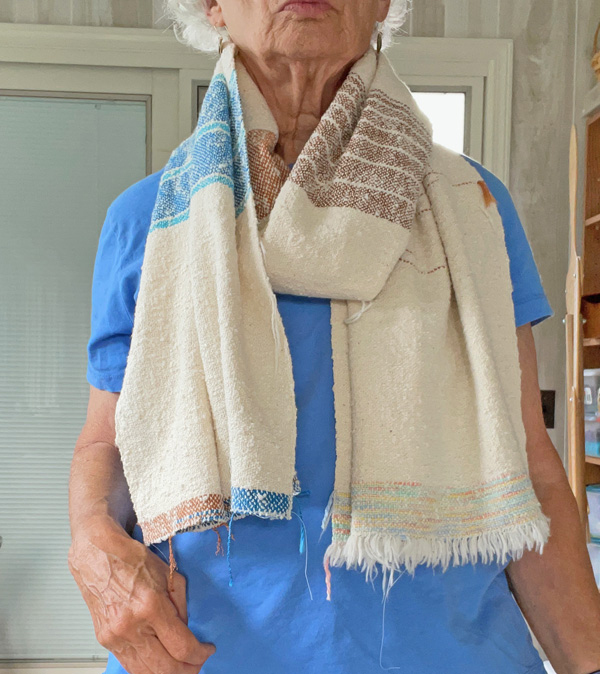
I loaded up my loom with Queen Anne’s Lace yarn from Henry’s Attic, sett at 12 EPI. Then, like with my red jacket, I rather randomly wove in various stripes, clasped weft, and inlays in a few blues and a few browns. This is the fabric immediately after the loom. 6-3/4 yards. Has to be wet finished, cut, sewn, and trims applied. This one will be for sale.
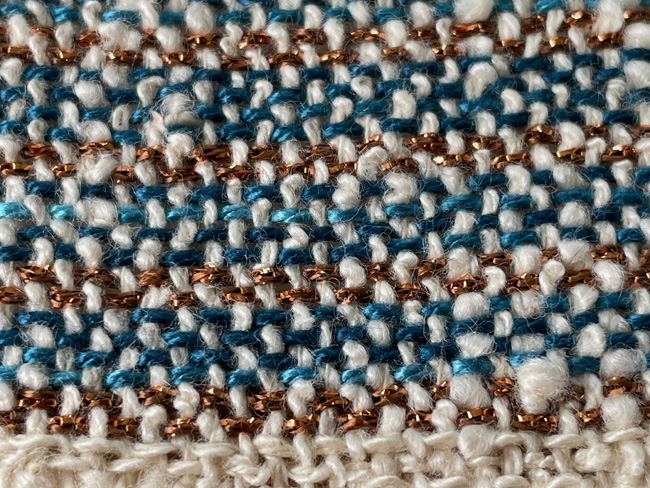
I really like this closeup – it shows you both the texture of that creamy yarn and the glitter of one of the browns.
*****************
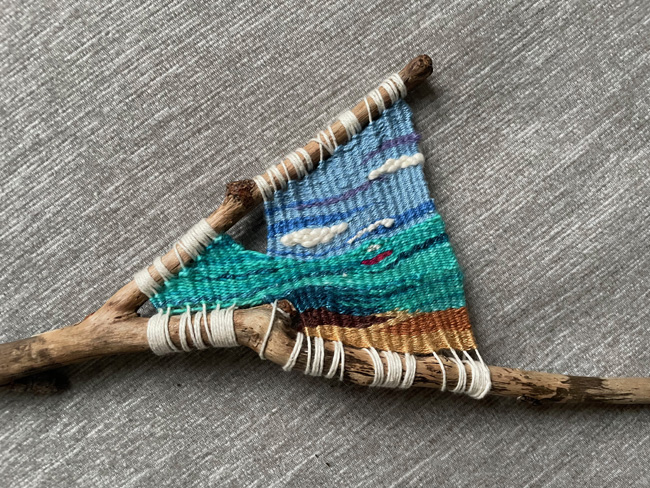
Also weaving but a very different type – I decided to do one more branch weaving, this time a more pictorial form. I cut off my first try, as the warp wasn’t tight enough and was loosening as I wove. After re-warping I made a boo-boo at the beginning that I could sort-of fix midstream. Note: I am most definitely NOT a tapestry weaver, so this stretched my skillset for sure, but I’m pleased with my end result.
*****************
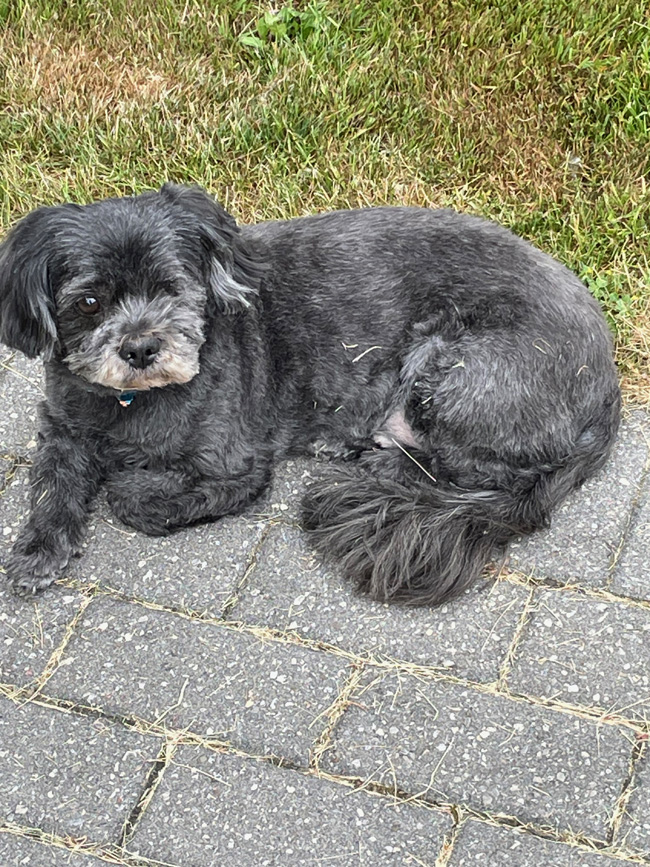
Jack aged 2 years in a few weeks. No, he wasn’t ill or in an accident or anything. It was all about my thinking. I’d been saying that Jack was 9, knowing that I made his birthday be when I got him, which was in September of 2015. So just like with people, he wouldn’t be 10 for a few months yet. BUT! I had to stop in at the vet’s office to pick up a regular monthly preventative prescription for heartworm & I saw that they had his birthday listed as 2012. I thought that was wrong, as I believe he was 2 when I got him, but decided not to question it at the vet. I came home and looked at his adoption papers, and sure enough, the vet was correct. He was estimated to be 3 when I got him, not 2. So suddenly he went from age 9 to almost 11. As I understand dog years vs. human years, (1st year=1, 2nd year=2, 3rd year=4, all subsequent years=7) he went from age 49 to 63 in the blink of an eye. While I was wrapping my head around that, he got his next grooming, and didn’t he look like a little old man when he came home. 🙁 Dogs die too young, and this mistake on my part didn’t add any years to him except in my mind…2 years closer to having to say goodbye to this little guy.
At least I can take comfort in the fact that he’s become a pretty calm and peaceful dog. He has gotten rid of many (most?) of his anxieties.
*****************
Now for what else has been taking lots of my time – my gardens. Which I love. It makes me happy to see things blooming and know that I have planted, weeded, mulched, watered, and tended them. So here are lots of garden shots.
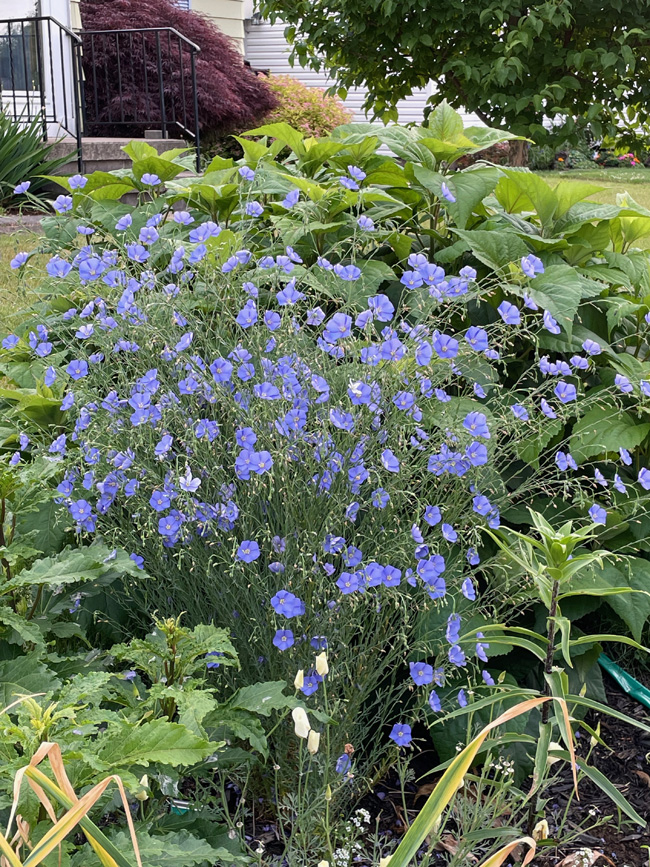
blue flax that came in a wildflower seed blend last year and returned.
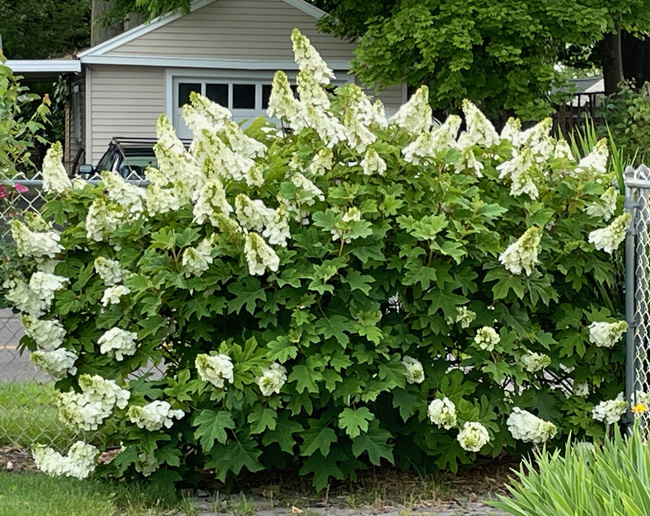
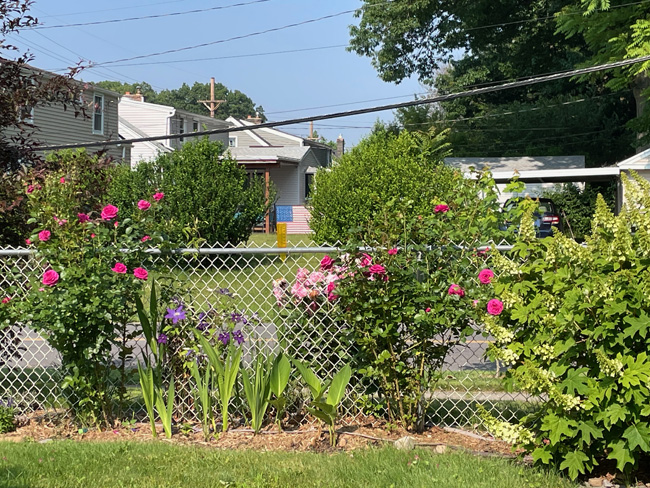
oak leaf hydrangea in full flower
fragrant roses, clematis, peonies blooming, oak leaf hydrangea just beginning
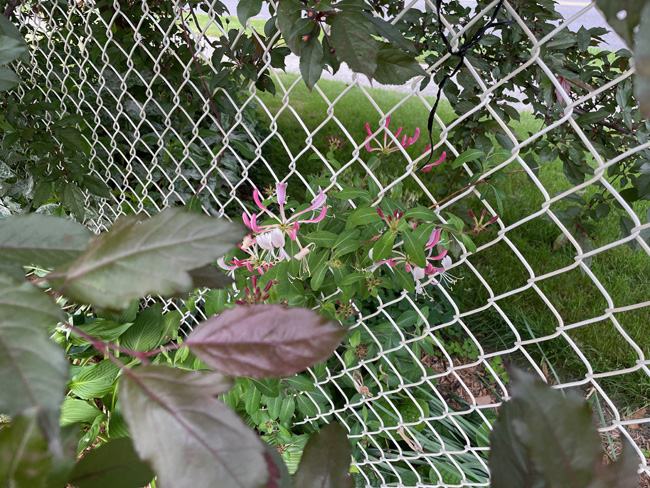
a beautiful fragrant honeysuckle that I’ll have to move so it can get more sun and be more appreciated
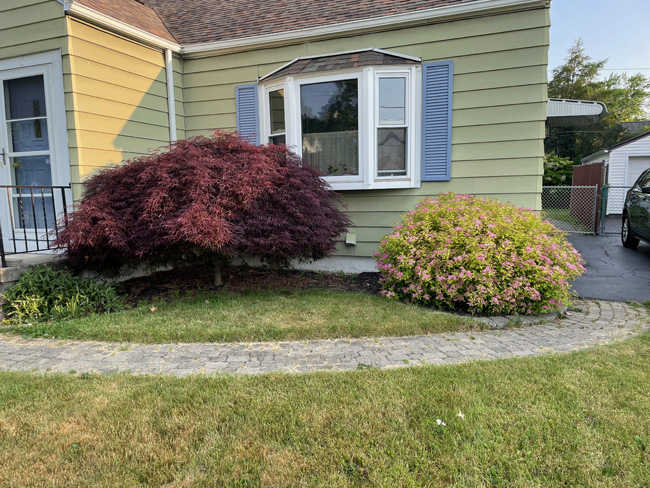
Japanese maple and golden spirea in front of my kitchen
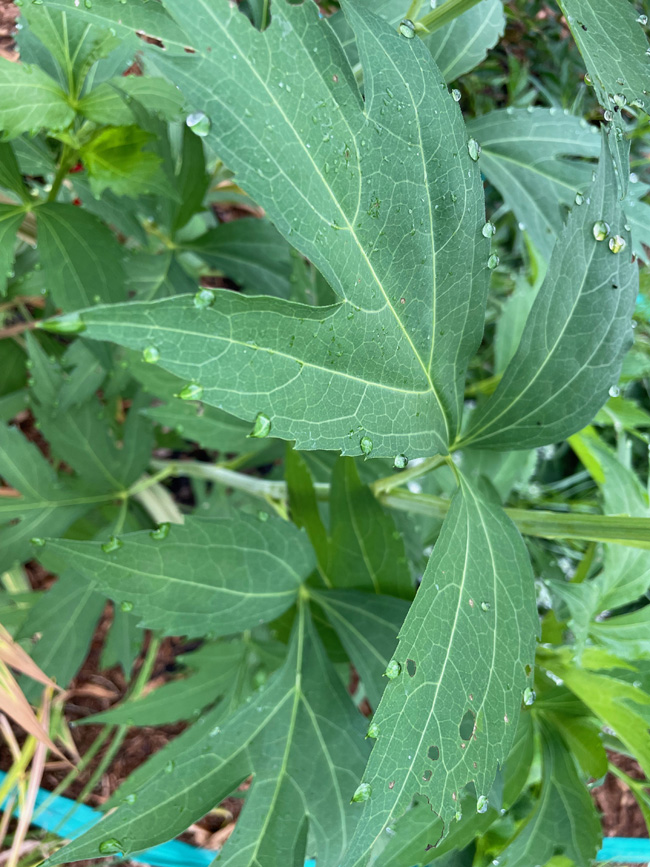
raindrops on cutleaf rudbeckia
I mow my own yard, and it’s always a pain to get under my crabapple tree and mow right up to my chain link fence. So I decided to do something about it. I dug out grass, moved some crowded hosta, and put in border. This new garden area is about 12′ long. Took quite a while to do the work. Thankfully, most of the time I was in the shade of that crabapple.
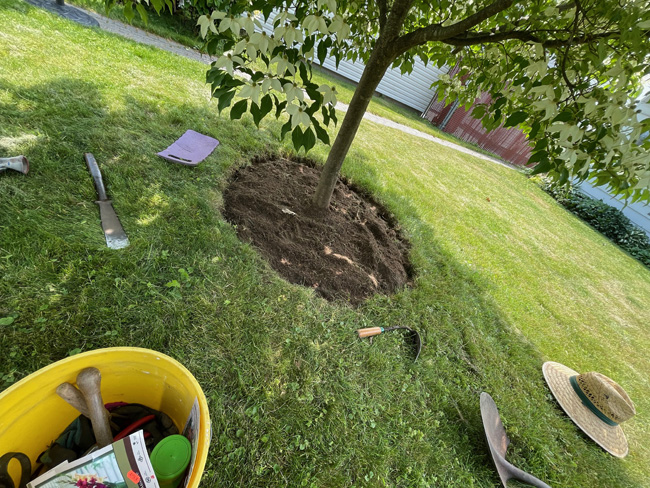
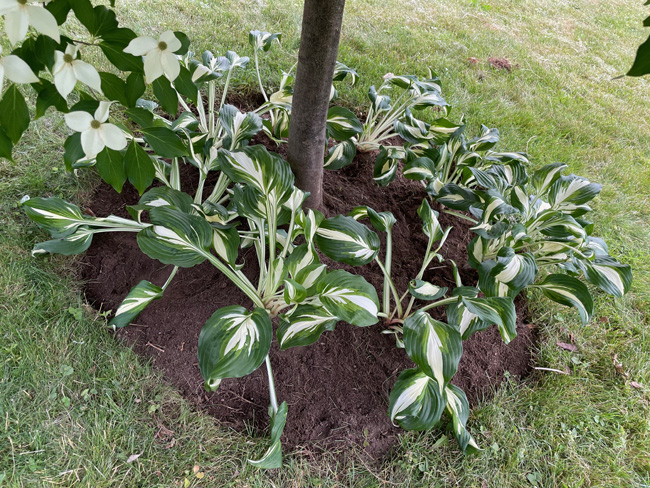
Then, being a glutton for punishment, I decided to move even more hosta to under my Japanese dogwood. Really nothing had grown there before, so again, I had to start by digging out the grass and preparing the soil.
That circle is roughly a 12″ radius out from the tree trunk. Then I dug out the hosta, divided, planted and watered.
I also did a bunch of work on my front garden, but since most of the plants were dug from someone else’s garden and transplanted, they’ve taken a hit in the heat and it doesn’t look so pretty right now, even though I’ve made sure to water it well.
*****************
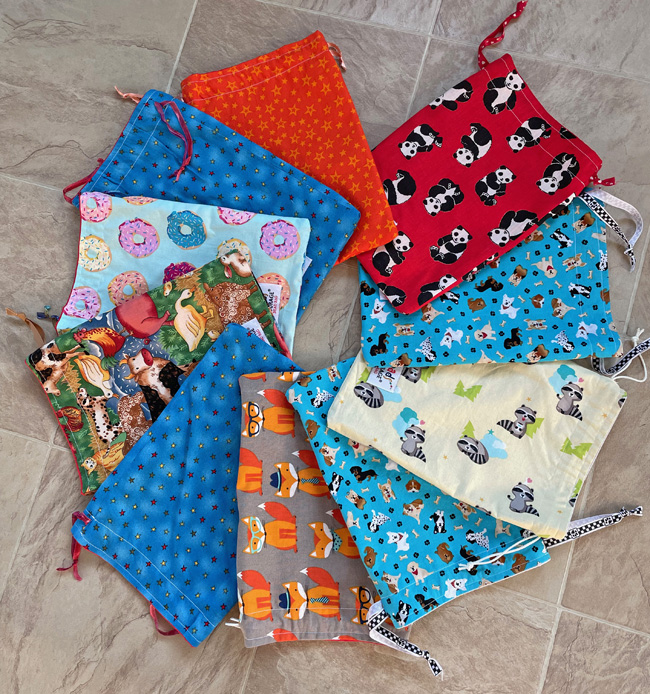
And here are my 10 bead bags for June, 2023.
*****************
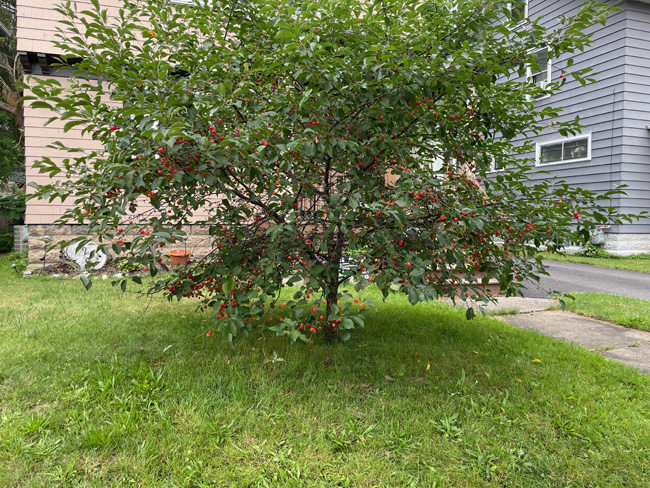
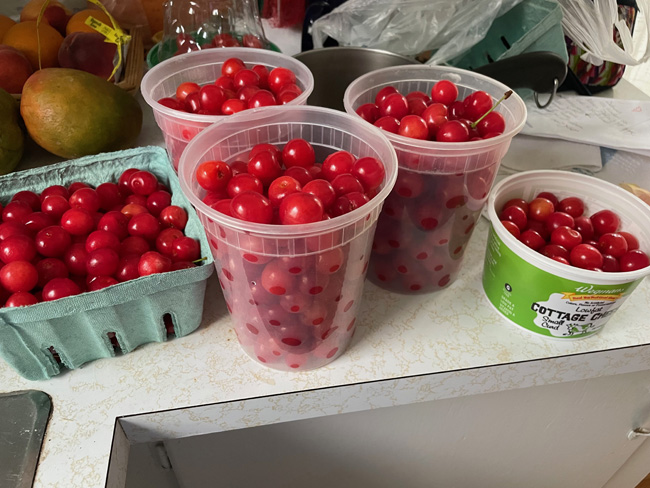
As if none of that is enough…I LOVE my BuyNothing group. A woman posted that her tart cherry tree was loaded with fruit and asked who was interested in coming to pick. She set us up with a sort of schedule so that we’d be there on different days so that we’d all get cherries. I was AMAZED at how prolific her little tree is!
I was there at about 7AM, and picked 4-1/2 quarts in record time.
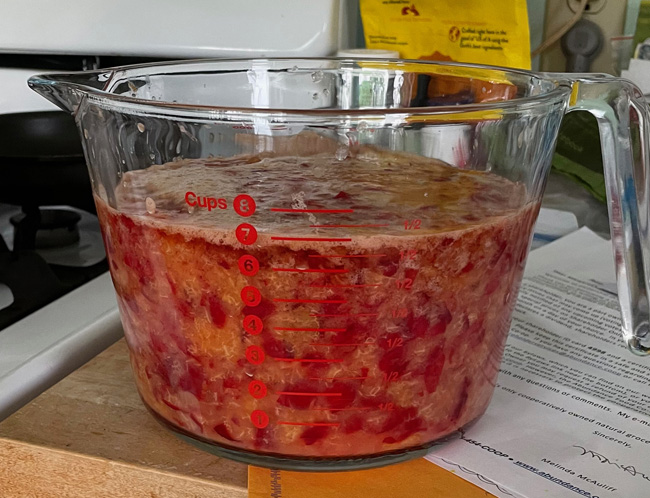
I came home, washed them, pitted them (by hand, no pitter here), pulsed them in my food processor, and set about making jam.
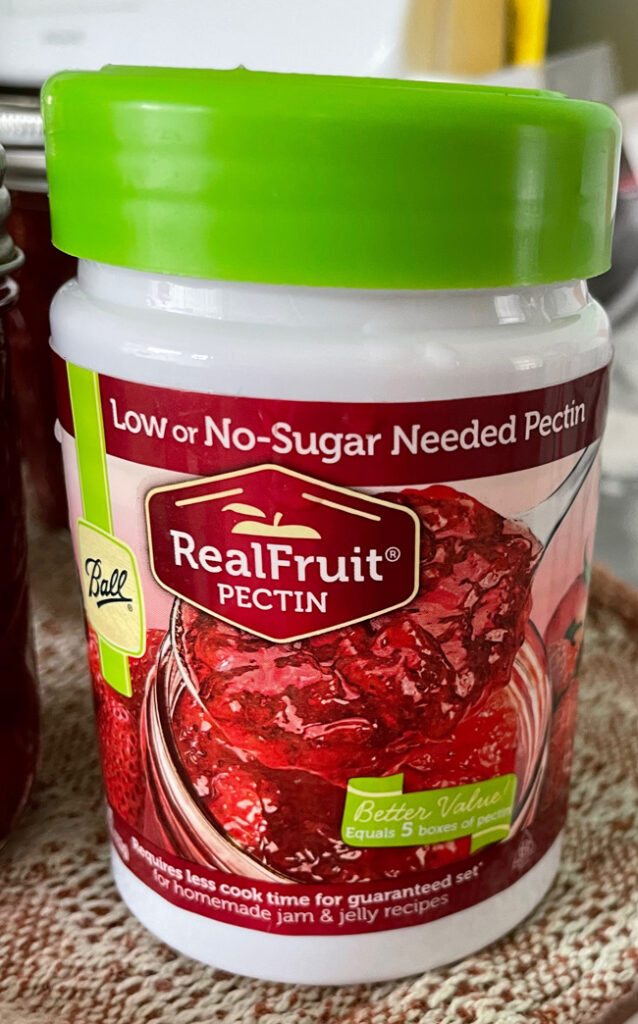
I love using this pectin.
For 7 cups prepared fruit I used 6 Tablespoons pectin and 2 cups of sugar. And that’s plenty sweet for me. I also added about 1 Tablespoon of cinnamon, but I can’t say I tasted that in the final product.
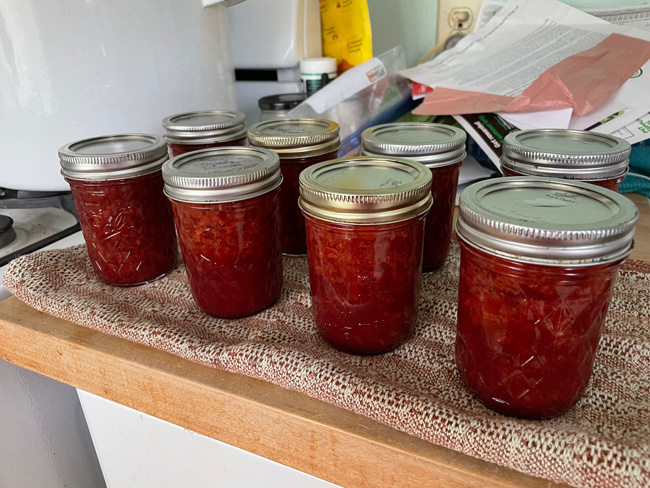
I got 8 half-pints of jam, plus a bit in a mug. One of the jars didn’t seal when it came out of the canner.
I sent that photo to the woman with the tree and offered to bring her a jar. She was so thankful! She invited me back to pick again when she had cherries ready. This time I looked at my watch; it took me 5-6 minutes to pick a quart of cherries. This time I picked 7 quarts. I pitted them all, made a cherry crisp for my son’s birthday, gave him a quart and a half, and put a quart in my fridge. They have graced my morning overnight oats and provided a yummy evening snack.
So you see, I have been busy, I just haven’t had time to do a lot of weaving. I’m currently deciding between various drafts for another set of towels as the ones in my Etsy shop keep selling out. 🙂 MAYBE tomorrow I’ll have time to work on sewing that jacket. Unless something else calls to me.